Chapter 2: The OSI Model and TCP/IP Model
2.3 The TCP/IP model and comparison
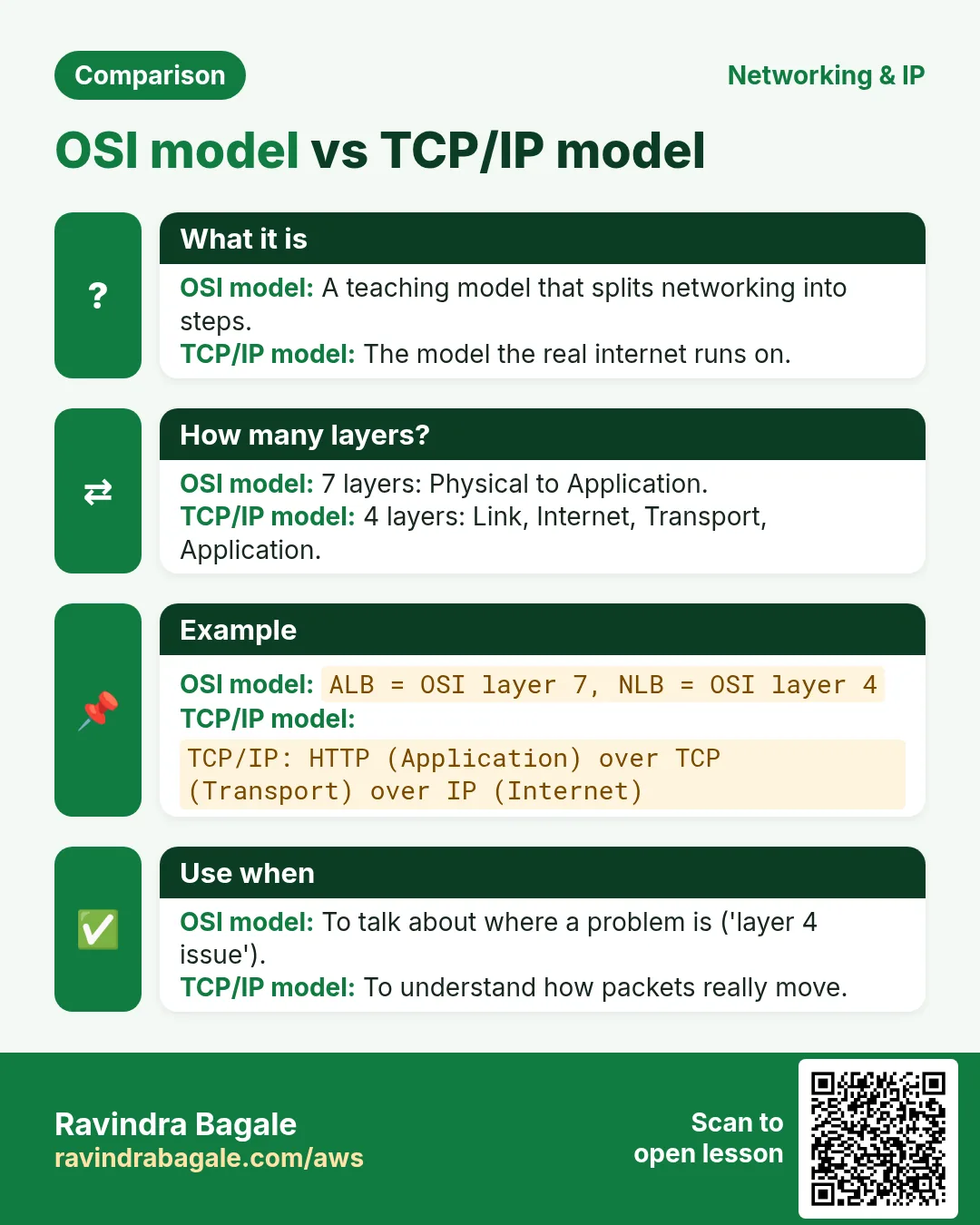
OSI is the language we speak; TCP/IP is what actually runs the internet. In other words, OSI is for talking, TCP/IP is for real running. Got it? Let's compare them.
OSI is the language we speak; TCP/IP is what actually runs the internet. म्हणजे OSI बोलण्यासाठी, TCP/IP प्रत्यक्षात चालण्यासाठी. समजलं का? चला, दोन्ही कंपेअर करूया.
OSI is the language we speak; TCP/IP is what actually runs the internet. मतलब OSI बात करने के लिए, TCP/IP असल में चलने के लिए. समझ आया? चलो, दोनों को कंपेयर करते हैं.
The TCP/IP (Internet) model is the practical model on which the internet runs. It has 4 layers (some books show 5 by splitting the bottom layer).
        OSI Model                    TCP/IP Model
  +---------------------+      +----------------------+
  | 7 Application       |      |                      |
  | 6 Presentation      | ---> |  Application         |  HTTP, DNS, SSH, TLS
  | 5 Session           |      |                      |
  +---------------------+      +----------------------+
  | 4 Transport         | ---> |  Transport           |  TCP, UDP
  +---------------------+      +----------------------+
  | 3 Network           | ---> |  Internet            |  IP, ICMP, ARP
  +---------------------+      +----------------------+
  | 2 Data Link         | ---> |  Network Access      |  Ethernet, Wi-Fi
  | 1 Physical          |      |  (Link)              |
  +---------------------+      +----------------------+
| Point | OSI model | TCP/IP model |
|---|---|---|
| Layers | 7 | 4 (or 5) |
| Developed by | ISO (reference/theoretical) | US DoD / DARPA (practical) |
| Approach | Model first, protocols later | Protocols first, model later |
| Session & presentation | Separate layers | Merged into Application |
| Usage | Teaching, troubleshooting vocabulary | Actual internet implementation |
| Transport layer | Connection-oriented and connectionless | TCP (connection) and UDP (connectionless) |
Where AWS services sit
| Layer | AWS example |
|---|---|
| L7 | Application Load Balancer (routes by URL/host), CloudFront, AWS WAF, Route 53 (DNS) |
| L4 | Network Load Balancer, Security Groups (filter by protocol + port + IP) |
| L3 | VPC, subnets, route tables, Internet/NAT gateways, Network ACLs |
| L1–L2 | Managed by AWS (physical data centres, Nitro hardware, ENIs) |
Ravindra Bagale's Tip
Think of the OSI model like sending a parcel by courier: packing the item (application data), the flat number (port), the full address with pin code (IP), the route of the local delivery van (MAC/data link), and the road itself is the physical layer. But in exams and interviews always explain the real mechanism – a header is added at each layer (encapsulation) and removed at the receiver (decapsulation).
Ravindra Bagale's Tip – मराठी
OSI model ला courier ने parcel पाठवण्यासारखं समजा: सामान pack करायचं (application data), flat number (port), pin code सोबत पूर्ण पत्ता (IP), local delivery van चा रस्ता (MAC/data link), आणि रस्ता स्वतः म्हणजे physical layer. पण exam आणि interview मध्ये नेहमी खरं mechanism सांगा – प्रत्येक layer वर header add होतो (encapsulation) आणि receiver कडे तो काढला जातो (decapsulation).
Ravindra Bagale's Tip – हिंदी
OSI model को courier से parcel भेजने जैसा समझो: सामान pack करना (application data), flat number (port), pin code के साथ पूरा पता (IP), local delivery van का रास्ता (MAC/data link), और सड़क ख़ुद physical layer है. लेकिन exam और interview में हमेशा असली mechanism बताओ – हर layer पर header add होता है (encapsulation) और receiver पर वो हटाया जाता है (decapsulation).
Ravindra Bagale's Tip
Many students put the Security Group at Layer 3. Look at the table above: a Security Group filters on protocol + port + IP, so we have placed it at L4; NACLs, route tables and subnets are at L3. ALB is L7, NLB is L4 – this is definitely asked in interviews.
Ravindra Bagale's Tip – मराठी
बरेच students Security Group ला Layer 3 मध्ये ठेवतात. वरचा table बघा: Security Group protocol + port + IP बघून filter करतो, म्हणून आपण त्याला L4 मध्ये ठेवला आहे; NACL, route tables आणि subnets L3 मध्ये. ALB L7, NLB L4 – हे interview मध्ये नक्की विचारतात.
Ravindra Bagale's Tip – हिंदी
बहुत से students Security Group को Layer 3 में रखते हैं. ऊपर वाला table देखो: Security Group protocol + port + IP देखकर filter करता है, इसलिए हमने उसे L4 में रखा है; NACL, route tables और subnets L3 में. ALB L7, NLB L4 – ये interview में ज़रूर पूछते हैं.
Practice task
Kagdavar OSI vs TCP/IP cha diagram kadha aani pratyek TCP/IP layer samor Mauli Dairy chya website madhla ek udaharan liha – udaharan mhanje Application: HTTP aani DNS, Transport: TCP 443, Internet: EC2 cha public IP, Network Access: AWS che hardware aani ENI.
Got it? OSI is the dictionary, TCP/IP is the real internet. Now let's move on to my favourite interview question – what exactly happens when you open a website?
समजलं का? OSI म्हणजे शब्दकोश, TCP/IP म्हणजे प्रत्यक्ष इंटरनेट. आता पुढे जाऊया माझ्या सगळ्यात आवडत्या इंटरव्ह्यू प्रश्नाकडे – वेबसाइट उघडताना नेमकं काय होतं?
समझ आया? OSI मतलब डिक्शनरी, TCP/IP मतलब असली इंटरनेट. अब आगे चलते हैं मेरे सबसे पसंदीदा इंटरव्यू सवाल की तरफ़ – वेबसाइट खोलते समय असल में क्या होता है?
Quick revision cards
Revise this lesson in two minutes. Save the cards on your phone or download them as PNG files. The QR code on each card opens its lesson.
More cards: Ravi Sir's Cards.