AWS CloudFormation Deep Dive: Infrastructure as Code for Beginners
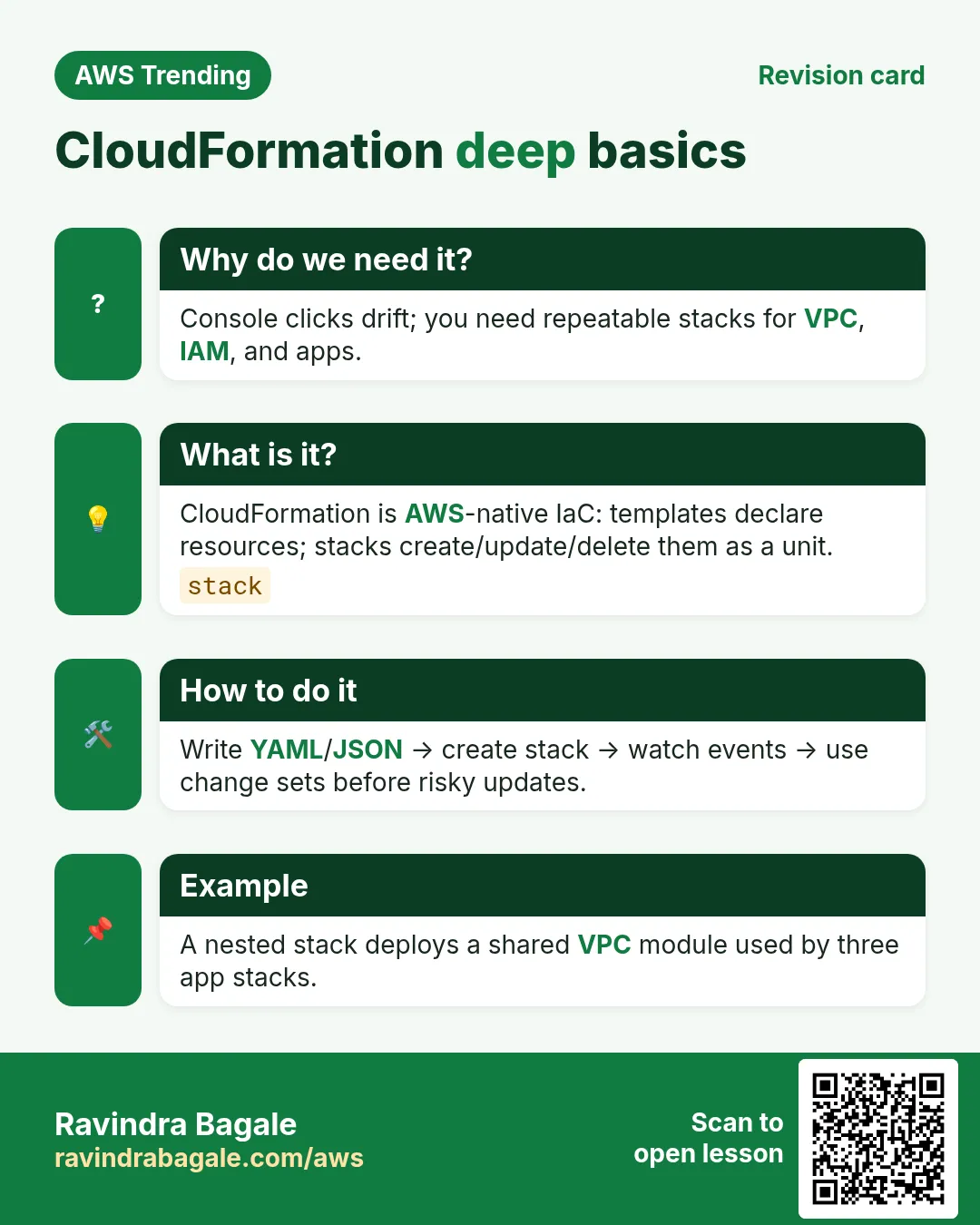
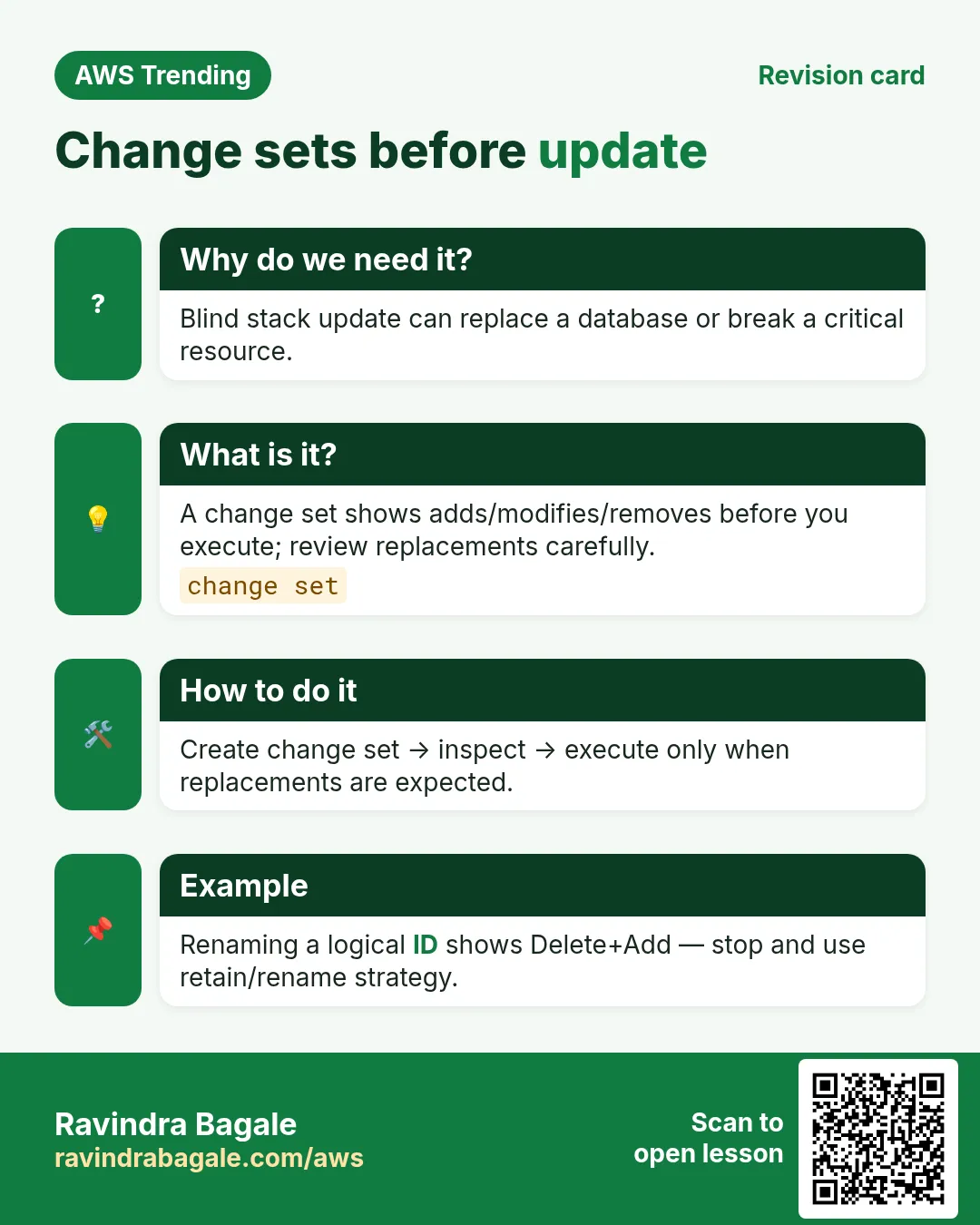
Terraform and CDK are popular, but many enterprises still ship AWS CloudFormation YAML/JSON every day. CloudFormation is the native IaC engine: you declare resources, AWS creates a stack, and change sets show what will break before you update production.
What you'll learn in this chapter
- Why native IaC still matters
- Templates, stacks, change sets, drift
- Parameters, mappings, outputs, nested stacks
- CFN vs CDK vs Terraform decision
- Lab, errors, FAQ, interview
1. Everyday example first
A Mumbai bank must create identical VPCs in three accounts. Clicking the console thrice guarantees drift. One CloudFormation template + StackSets (or three stacks) keeps CIDRs, tags and flow logs aligned — and auditors see the template in Git.
2. Why CloudFormation deep?
Why do we need this?
Beginners learn create stack. Pros learn change sets, drift detection, nested stacks, custom resources and rollback triggers. Interviews and brownfield jobs still ask CFN even if your team prefers CDK.
3. What are the core pieces?
What is it?
| Piece | Meaning |
|---|---|
| Template | YAML/JSON of resources |
| Stack | Live set of resources from a template |
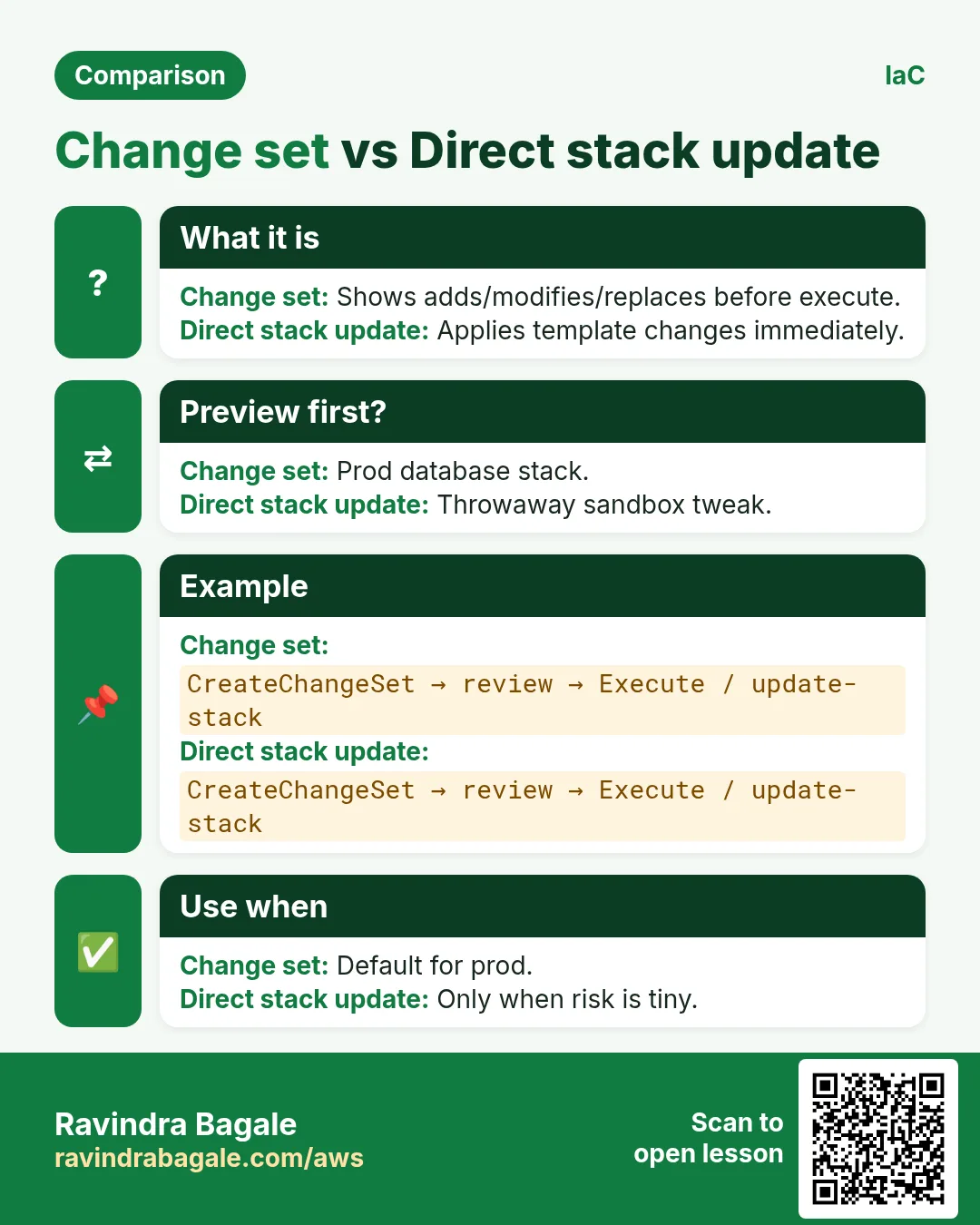
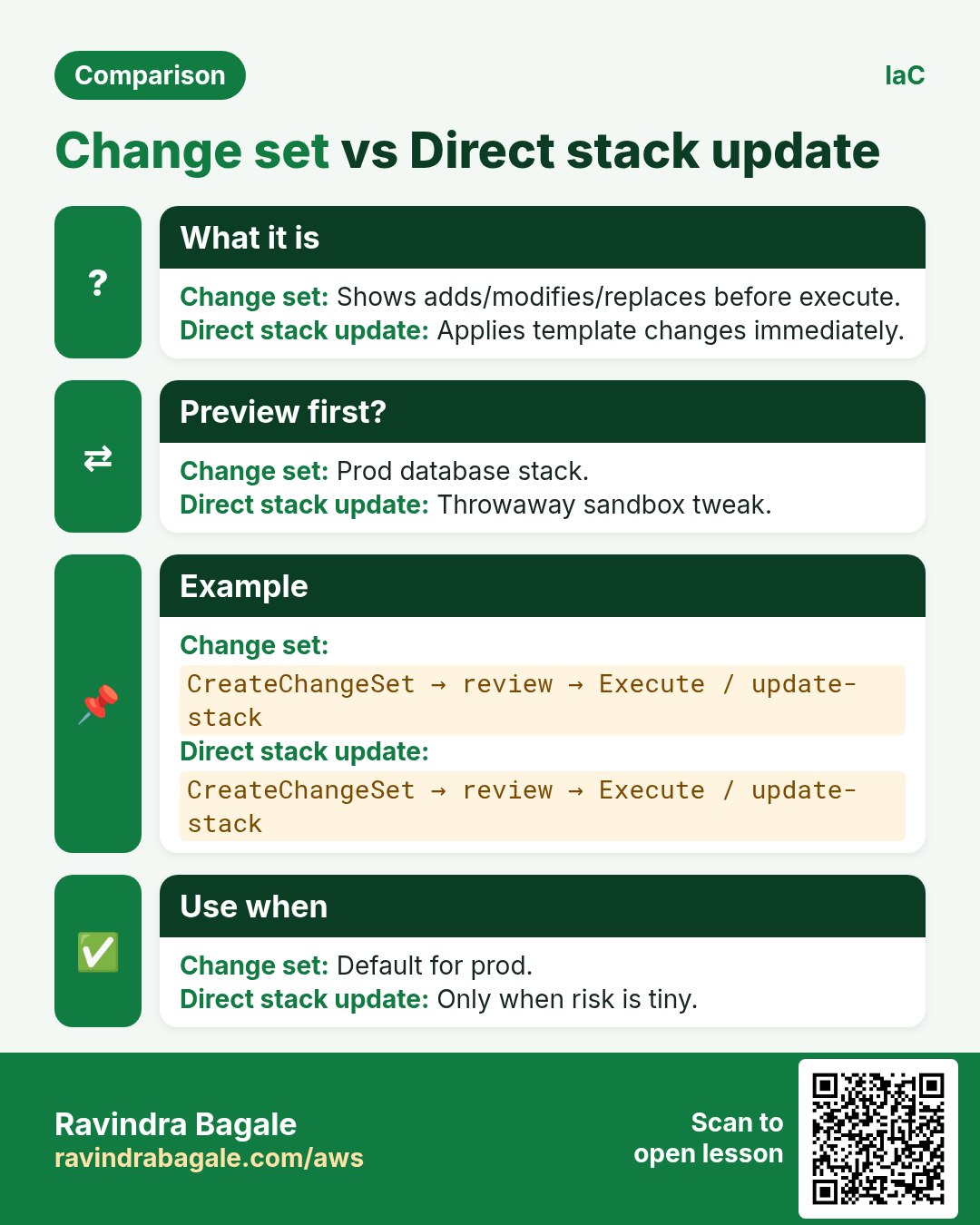
| Change set | Preview of an update before apply |
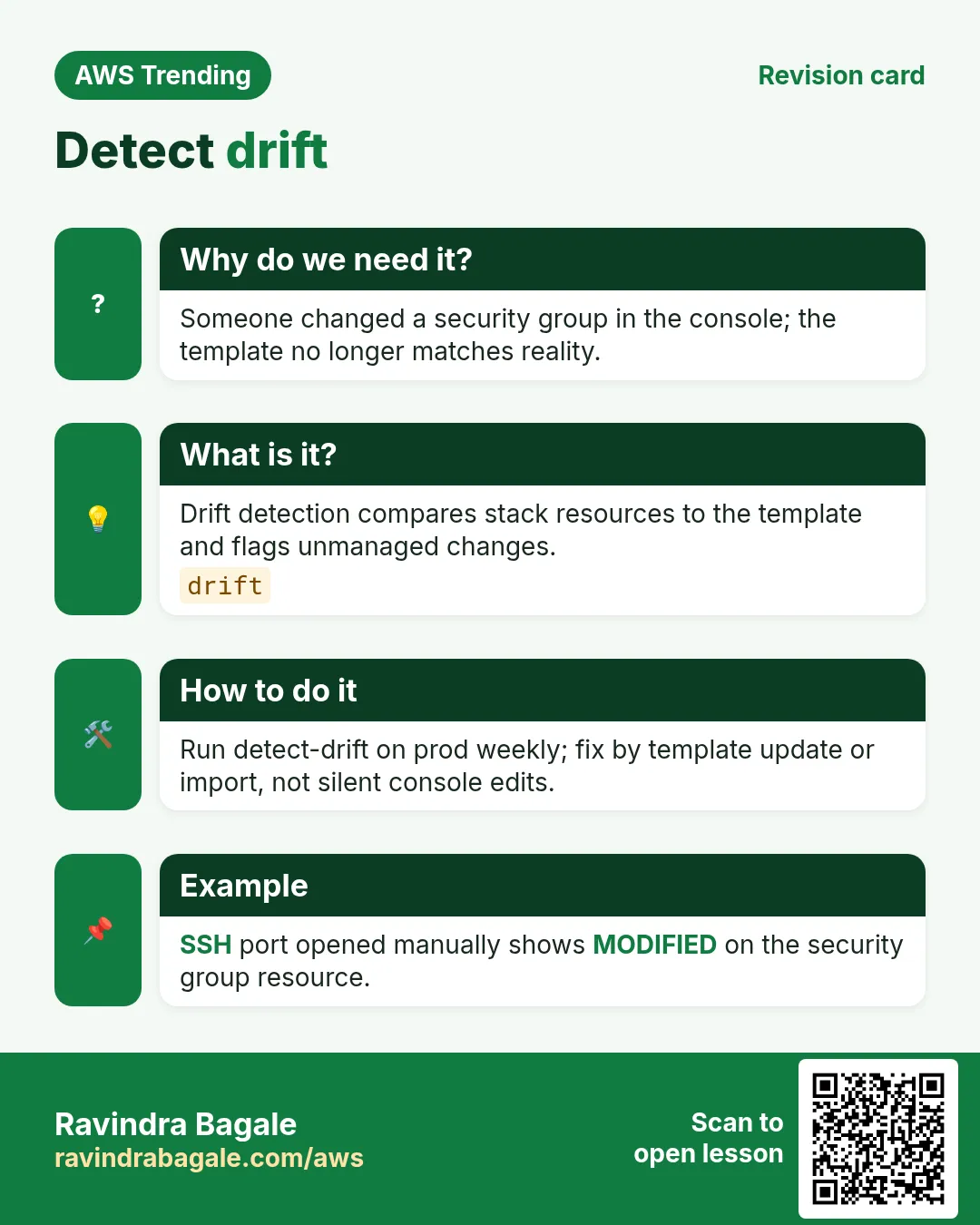
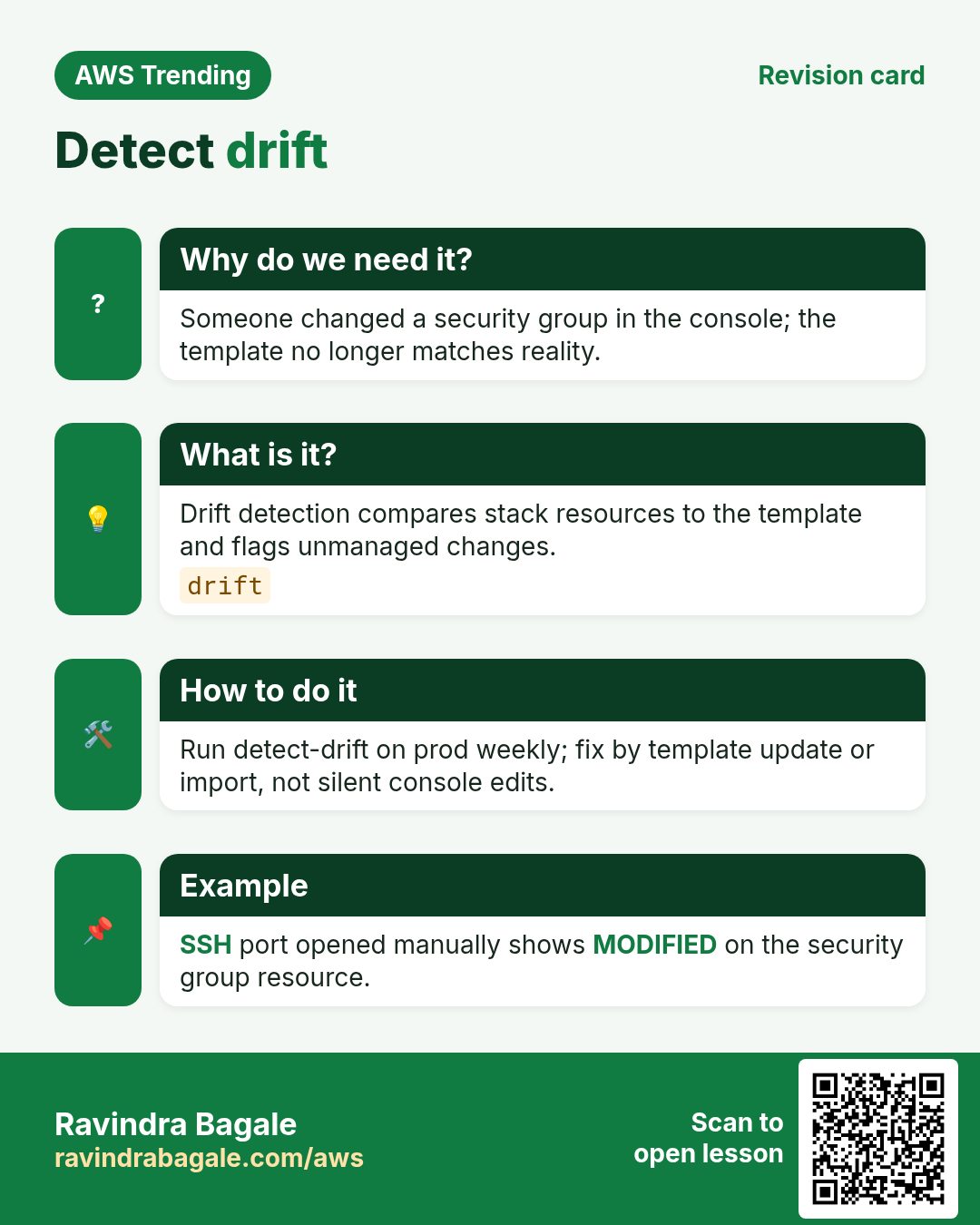
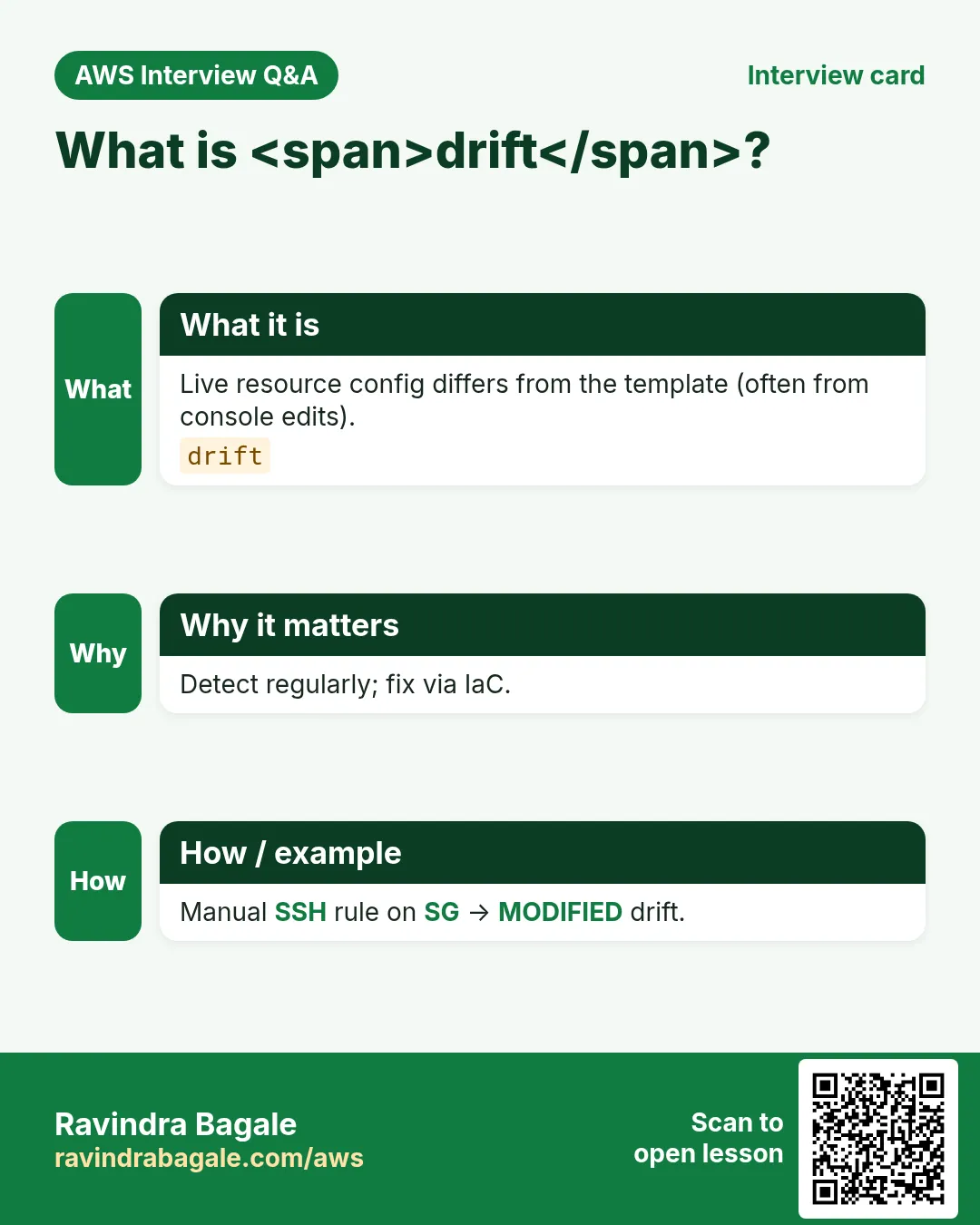
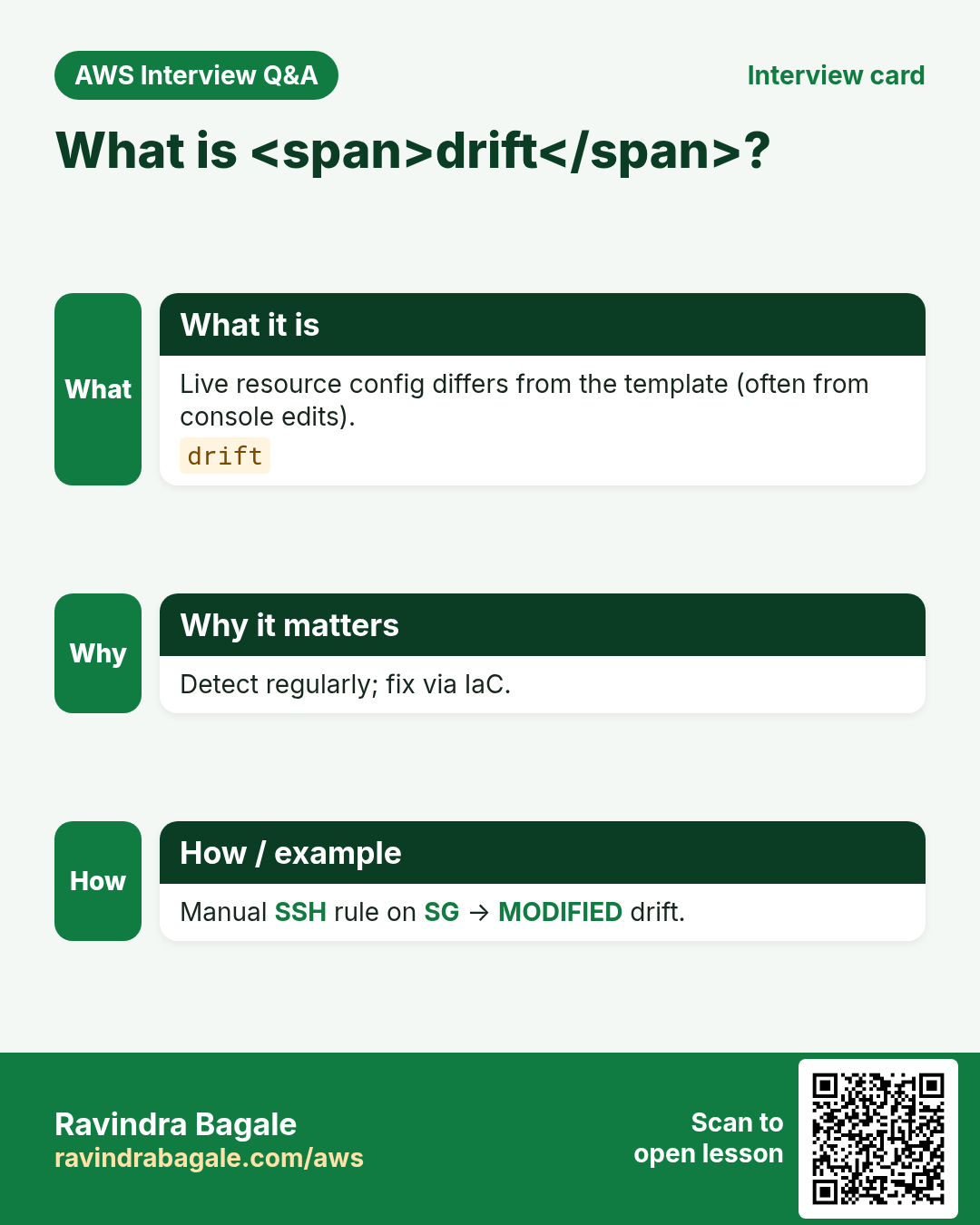
| Drift | Console/API changed resource away from template |
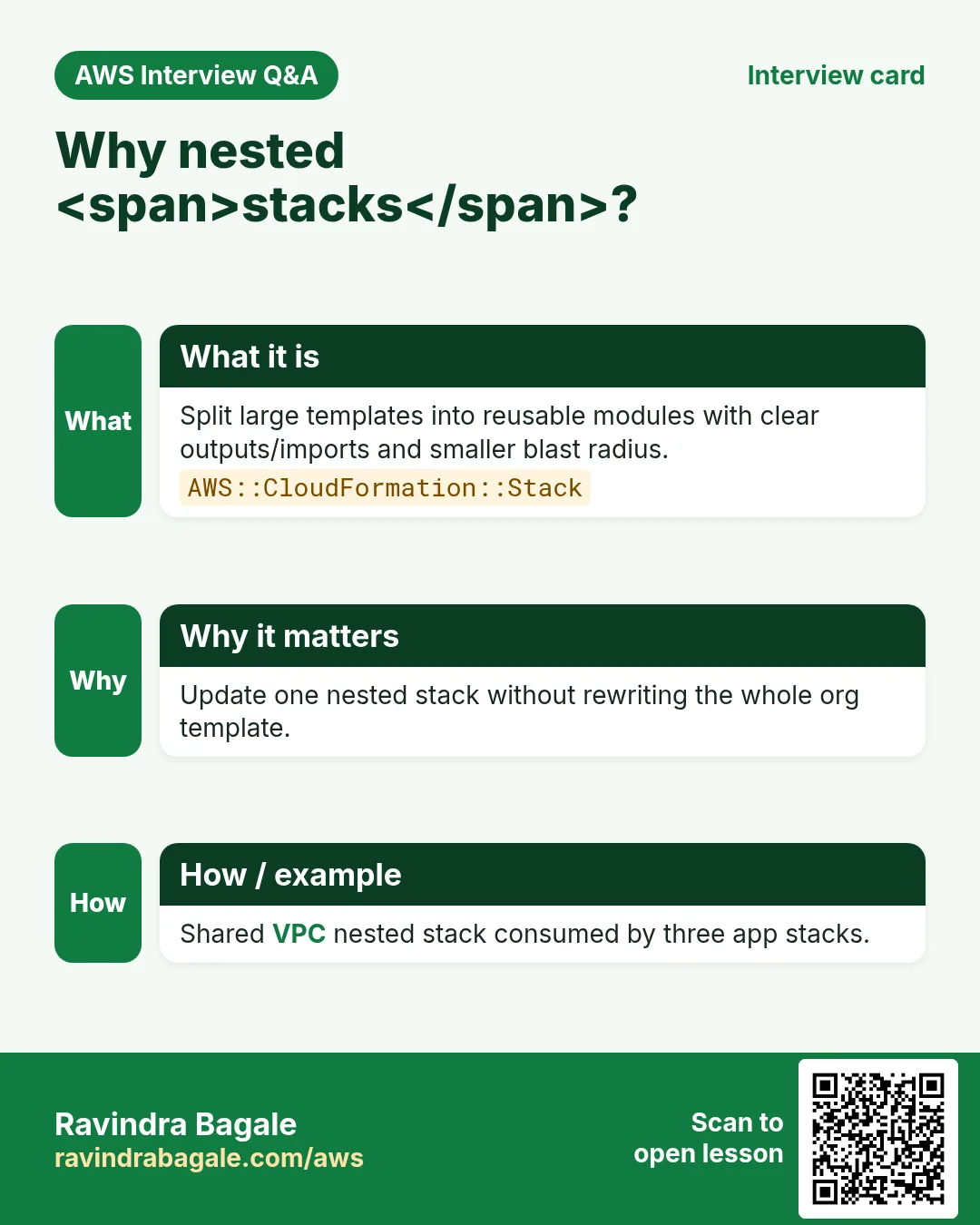
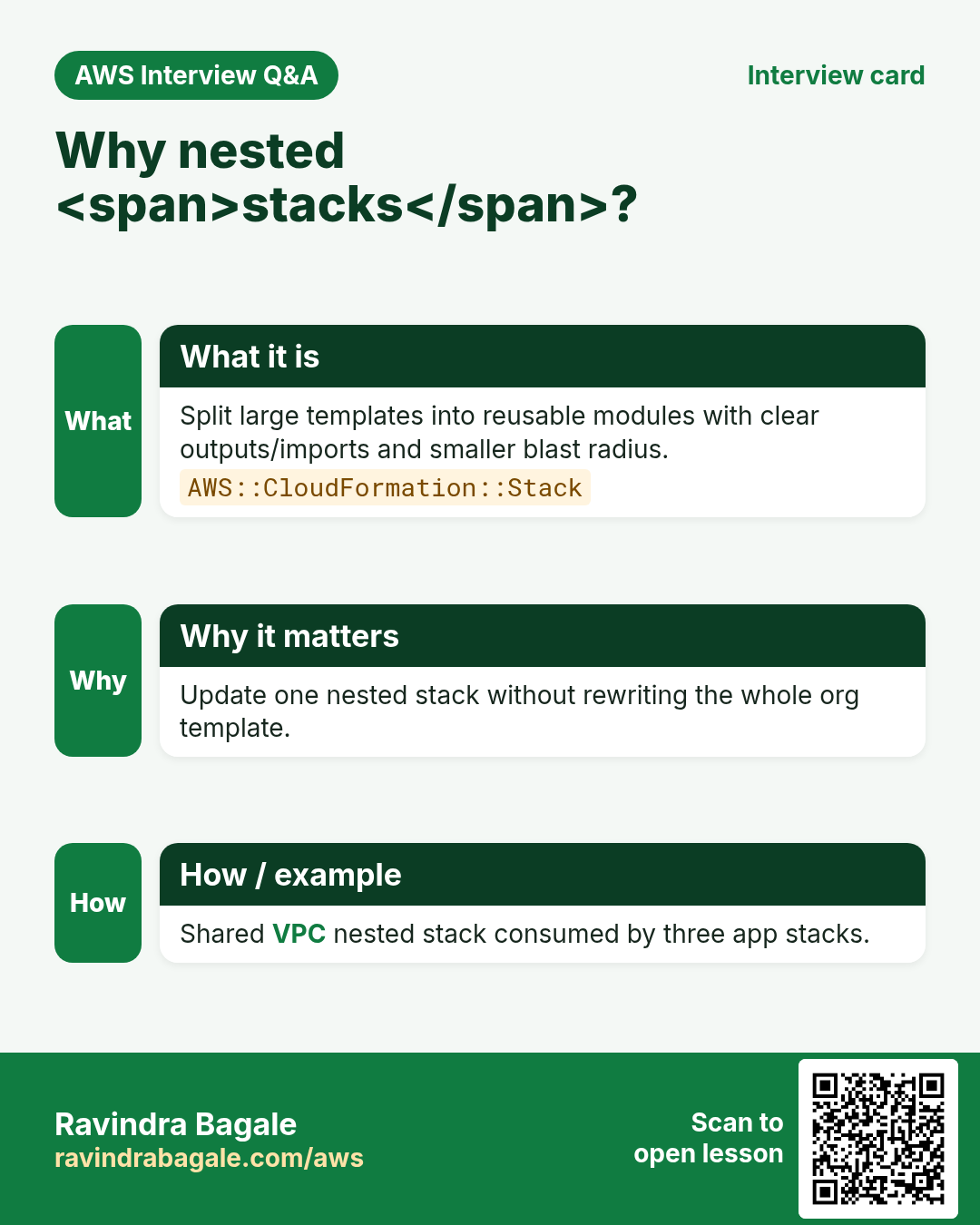
| Nested stack | Stack that owns child stacks |
4. How to work safely
How to do it (step by step)
- Keep templates in Git; never edit only in console.
- Always create a change set for prod updates.
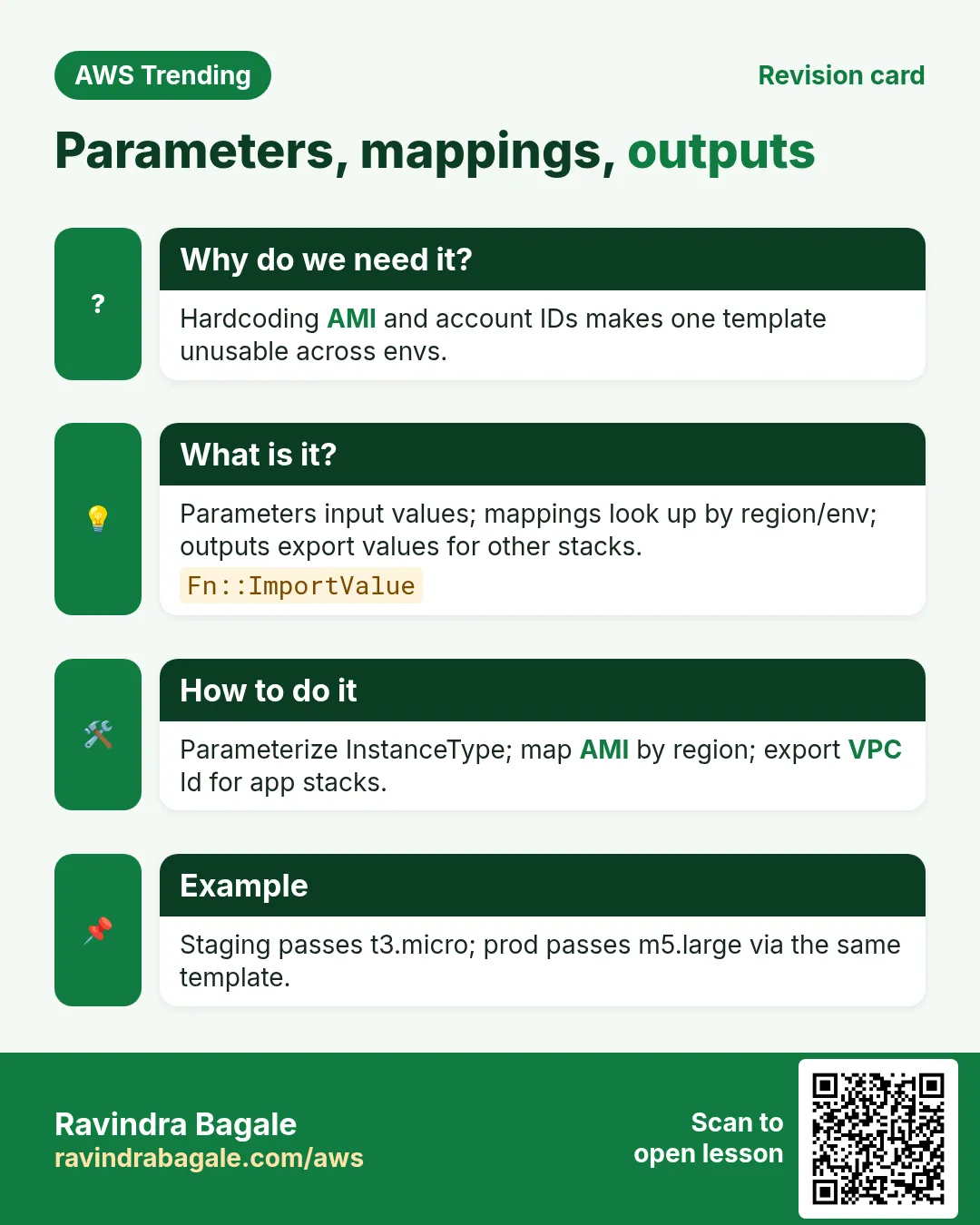
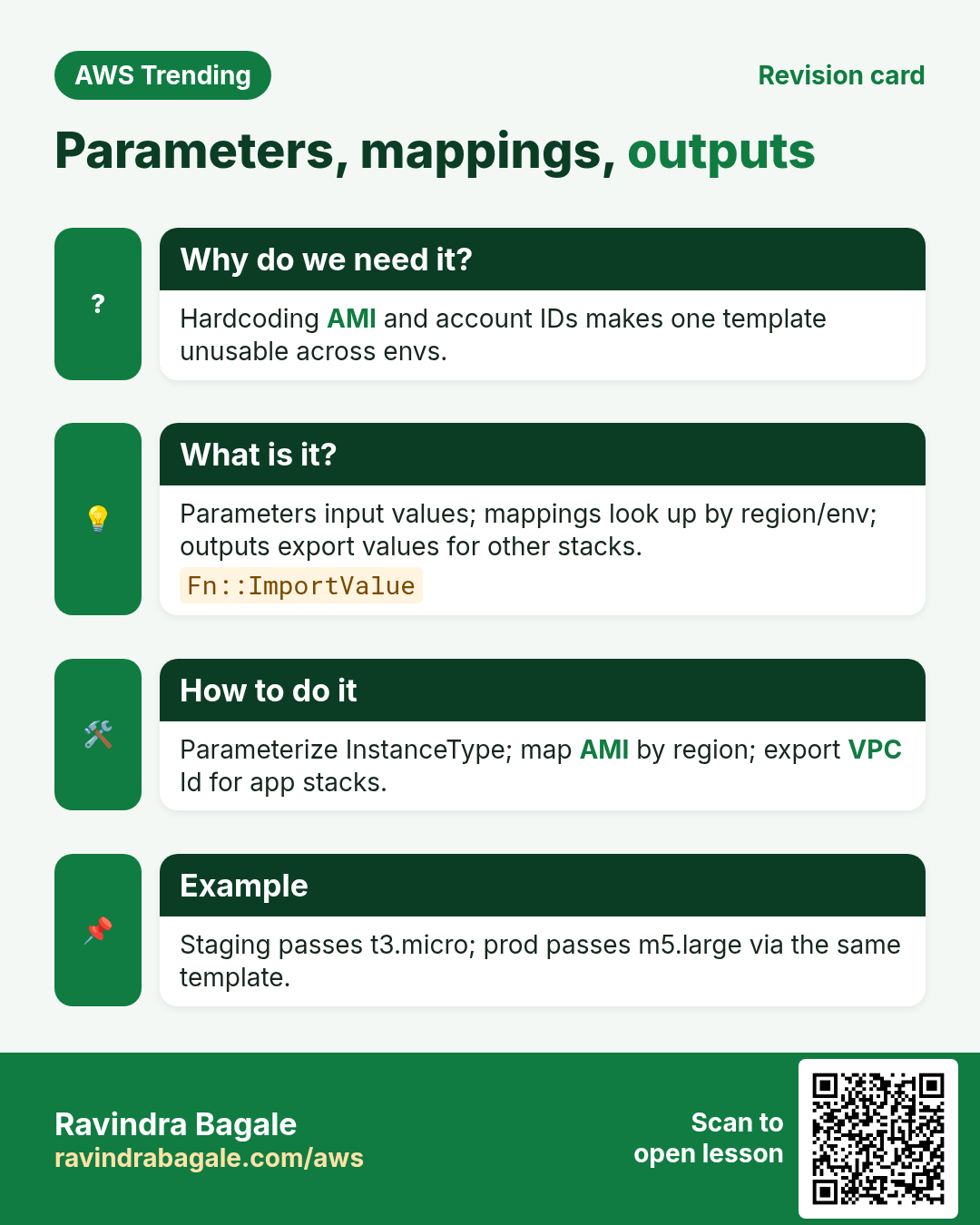
- Use Parameters for env names; Mappings for region AMI tables.
- Export Outputs for cross-stack refs or use nested stacks.
- Turn on termination protection for prod stacks.
- Run drift detection weekly on critical stacks.
AWSTemplateFormatVersion: '2010-09-09'
Description: Tiny S3 lab bucket
Parameters:
  ProjectName:
    Type: String
    Default: cfn-lab
Resources:
  LabBucket:
    Type: AWS::S3::Bucket
    Properties:
      BucketEncryption:
        ServerSideEncryptionConfiguration:
          - ServerSideEncryptionByDefault:
              SSEAlgorithm: AES256
Outputs:
  BucketName:
    Value: !Ref LabBucket
5. CFN vs CDK vs Terraform
| Tool | Pick when |
|---|---|
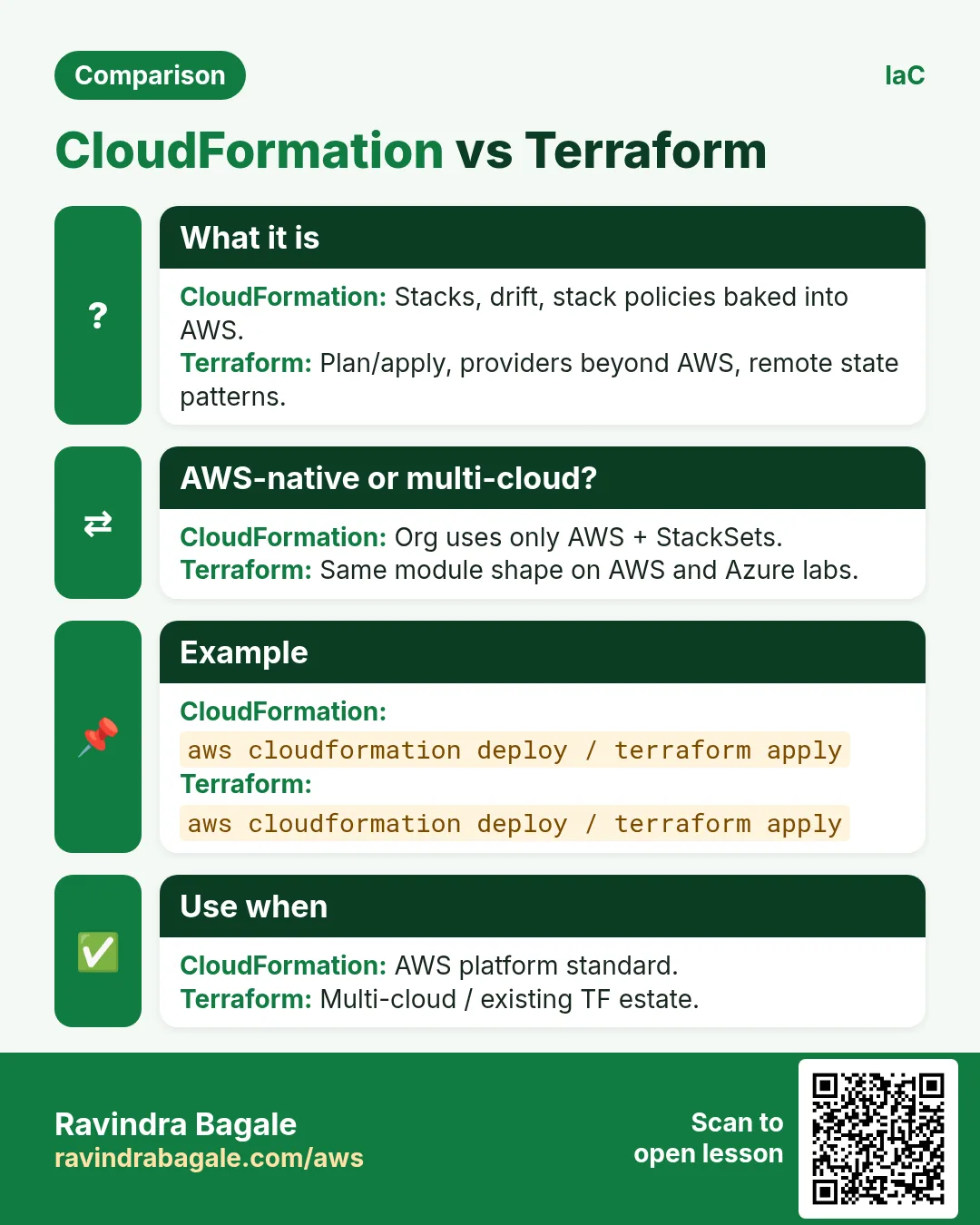
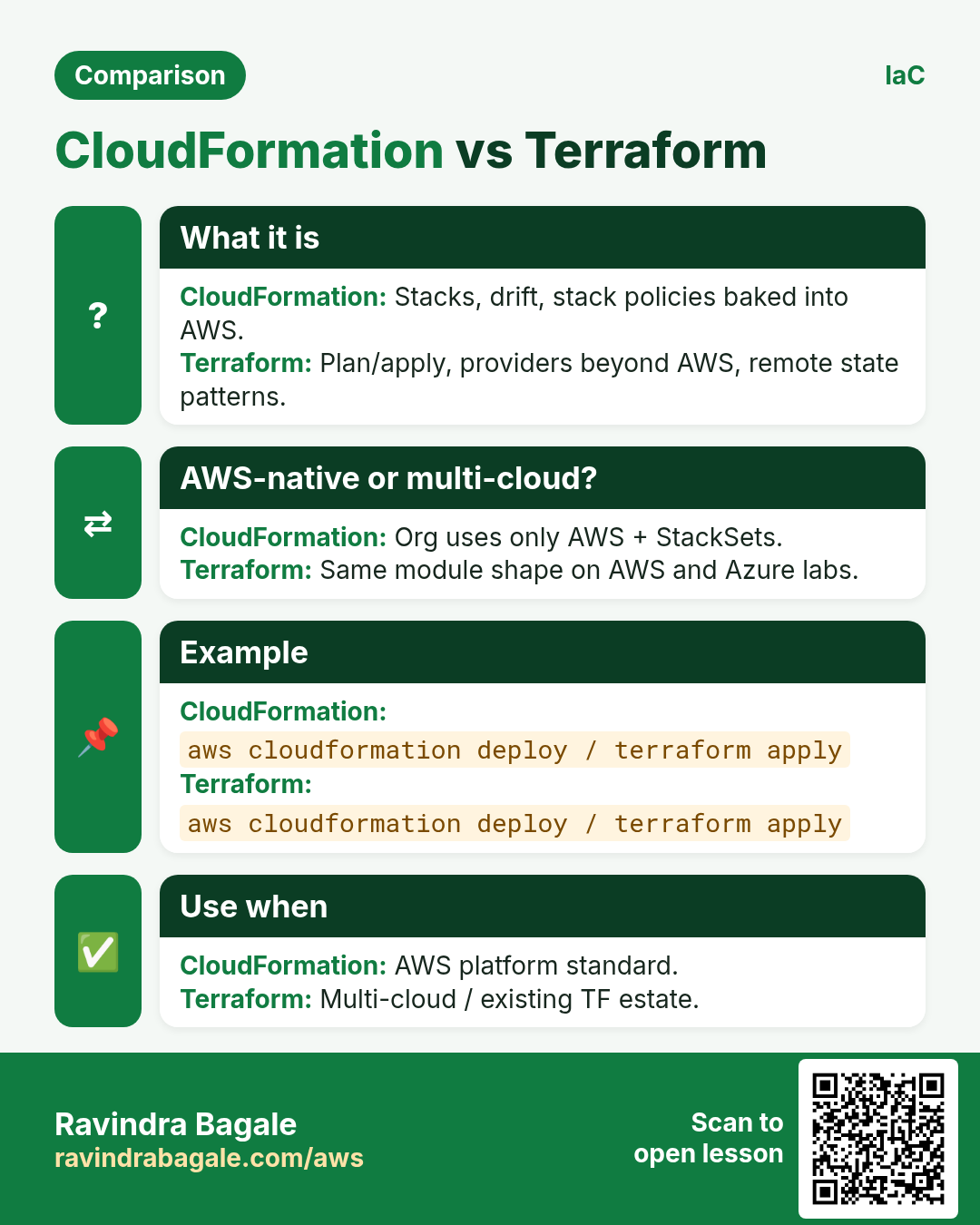
| CloudFormation | Native, StackSets, org standard YAML |
| CDK | Want TypeScript/Python generate CFN |
| Terraform | Multi-cloud or existing TF estate |
6. Industries
- Banks: approved CFN modules in a private registry
- SaaS: nested stacks per tenant baseline
- Gov projects: CFN + CodePipeline gates
- Startups: start CFN, grow into CDK
7. Lab: deploy a tiny encrypted bucket stack
Do this in ap-south-1 (Mumbai) unless your org forbids it. Set a budget alert first.
How to do it (step by step)
- Save the template above as lab.yaml.
- Console → CloudFormation → Create stack with new resources.
- Region ap-south-1; parameter ProjectName=yourname-lab.
- After CREATE_COMPLETE, note Outputs BucketName.
- Create a change set that adds a bucket tag Owner=you.
Cleanup (stop billing)
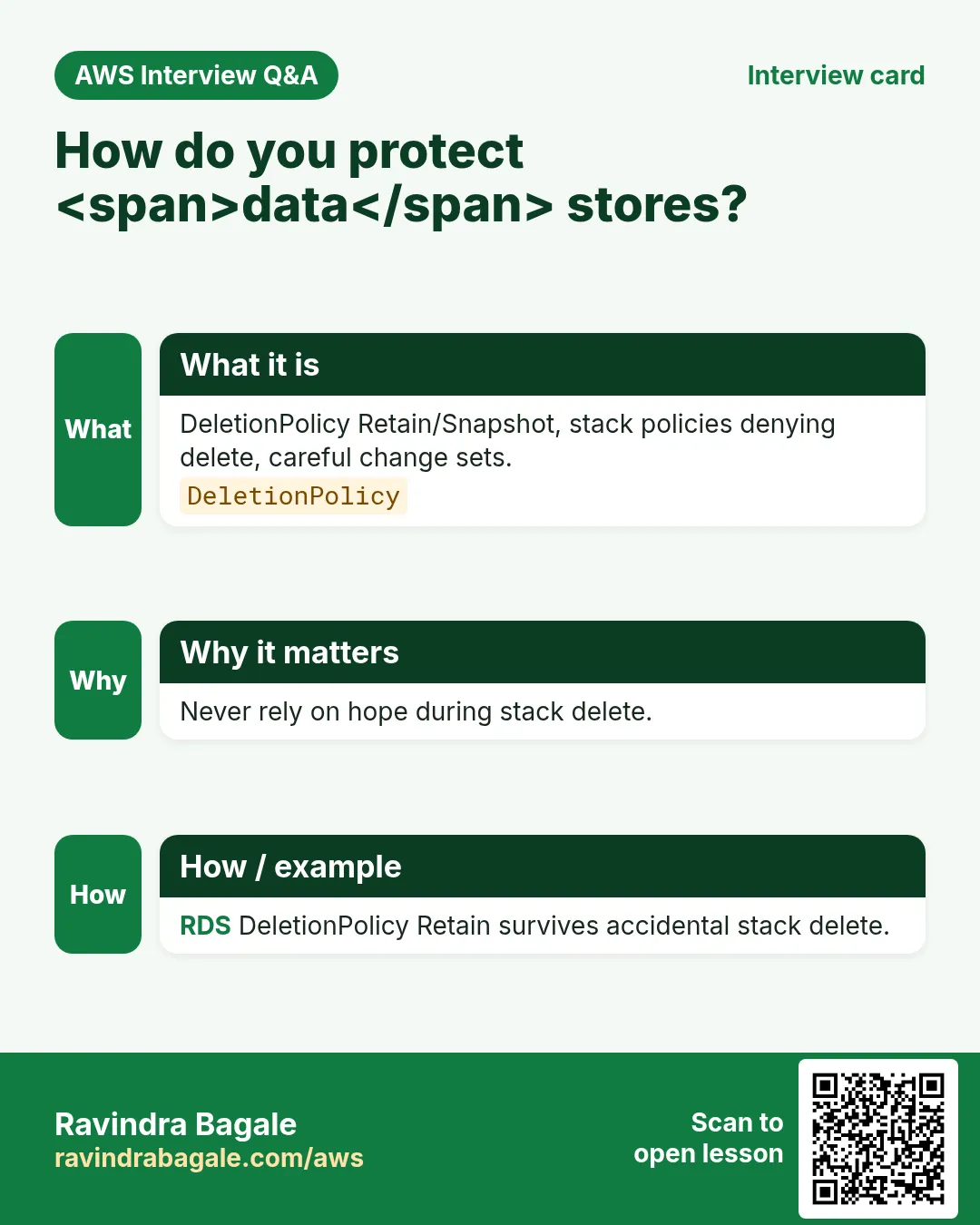
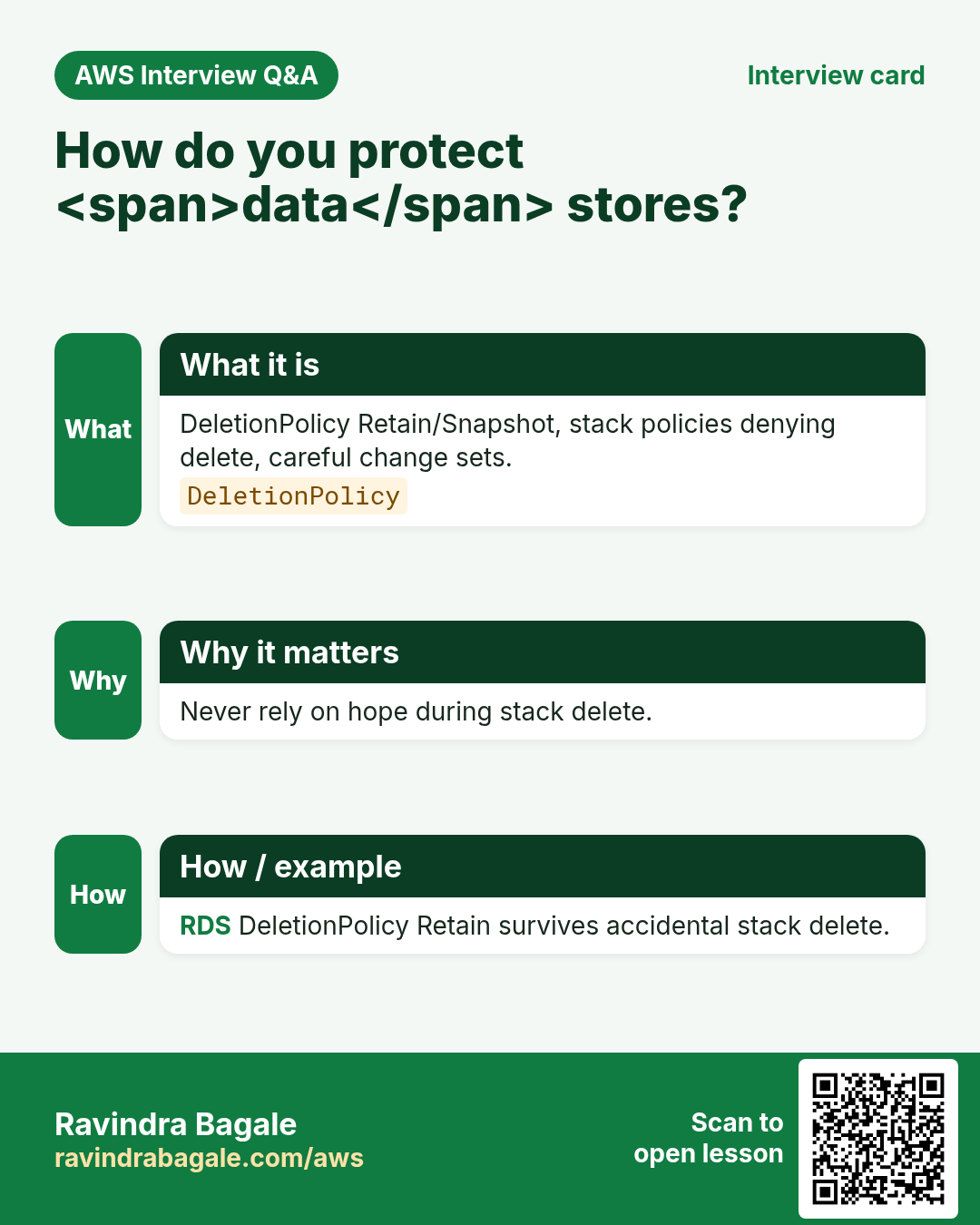
- Delete the stack after verifying DeletionPolicy.
- Confirm no leftover buckets with your prefix.
8. Common errors and fixes
Each row is a real mistake students and juniors hit. Read the fix before you panic.
| Error / symptom | Fix |
|---|---|
| Updated prod without change set | Always change set + peer review. |
| Circular dependency between resources | Split stacks or use DependsOn carefully. |
| Hard-coded account id | Use Pseudo parameters AWS::AccountId. |
| Stack stuck DELETE_FAILED | Empty S3/ENIs; check Retention. |
| Drift ignored for months | Weekly drift + reopen tickets. |
| Nested stack parameters explosion | Pass maps carefully; document contracts. |
| IAM star in template for speed | Scope actions and resources. |
| No rollback triggers on ALM | Add CloudWatch alarm rollback triggers. |
| Edited resource in console | Re-import or reconcile template. |
| Wrong YAML indent | Use cfn-lint before deploy. |
9. Troubleshooting checklist
- CREATE_FAILED → Events tab first line.
- cfn-lint locally before upload.
- Check service quotas (EIP, VPC).
- Permissions: cloudformation + iam PassRole.
- Change set empty? Template identical.
- Export name already exists — unique exports.
10. FAQ
Q. Is CFN free?
Service is free; you pay for resources created.
Q. Can CFN manage all AWS services?
Most; gaps use custom resources / CDK.
Q. YAML or JSON?
YAML for humans; JSON fine for generators.
Q. StackSets?
One template → many accounts/regions.
Q. Replace Terraform overnight?
No — migrate module by module.
11. Interview Q&A
Q. What is a stack?
A deployed instance of a template.
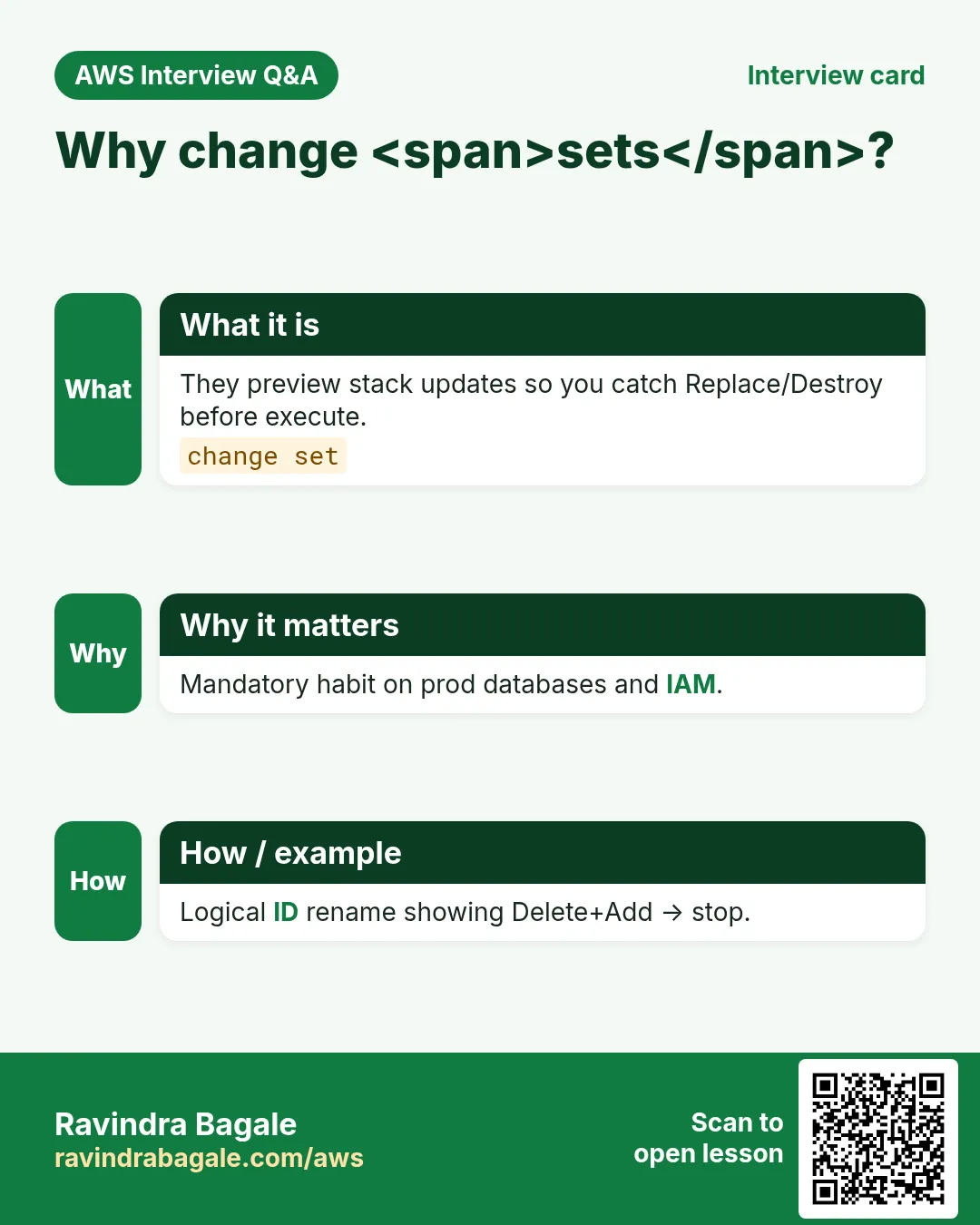
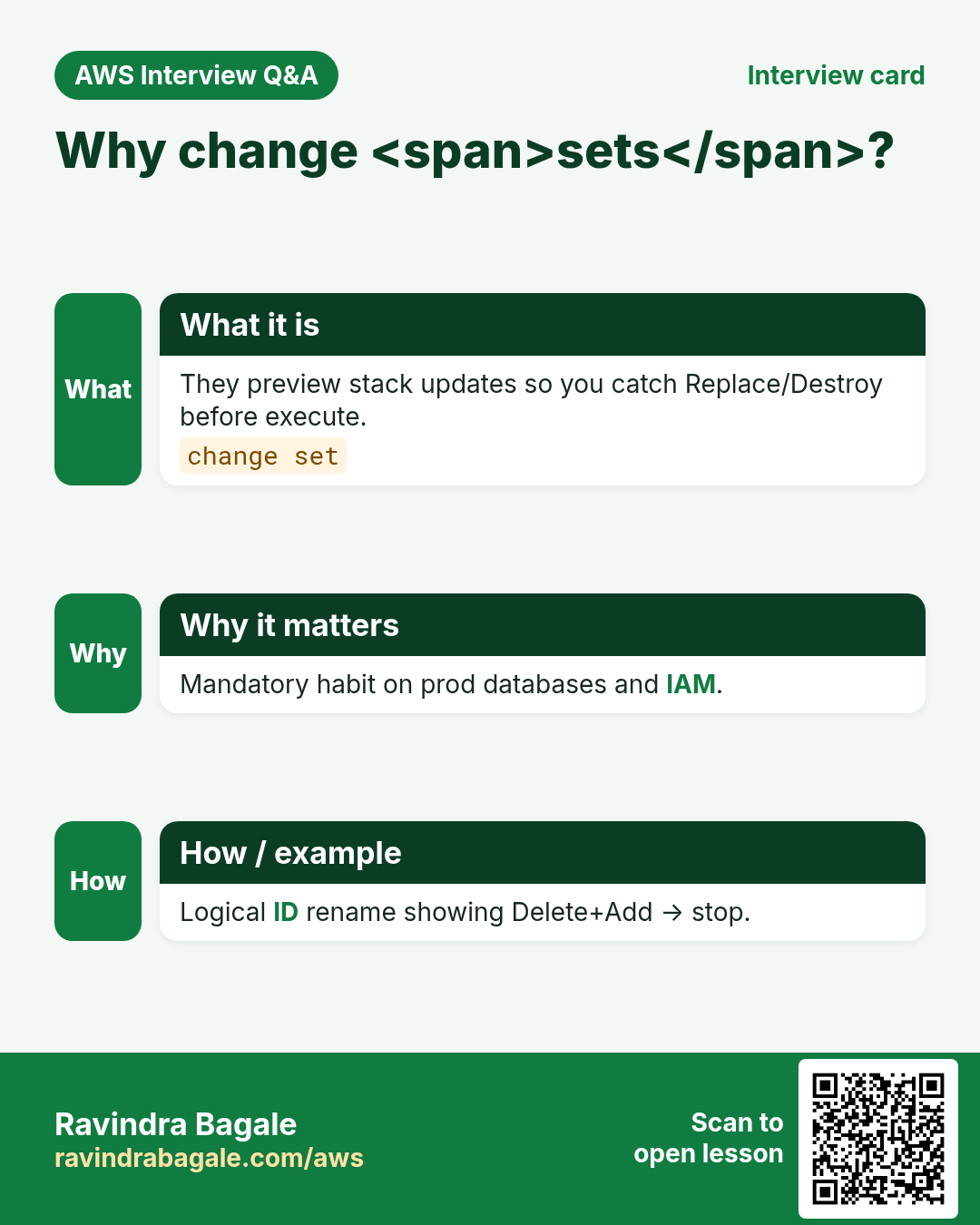
Q. Change set?
Preview of resource changes before update.
Q. Drift detection?
Find manual changes vs template.
Q. Nested vs cross-stack?
Nested=parent owns children; cross-stack uses Exports/Imports.
Q. Rollback?
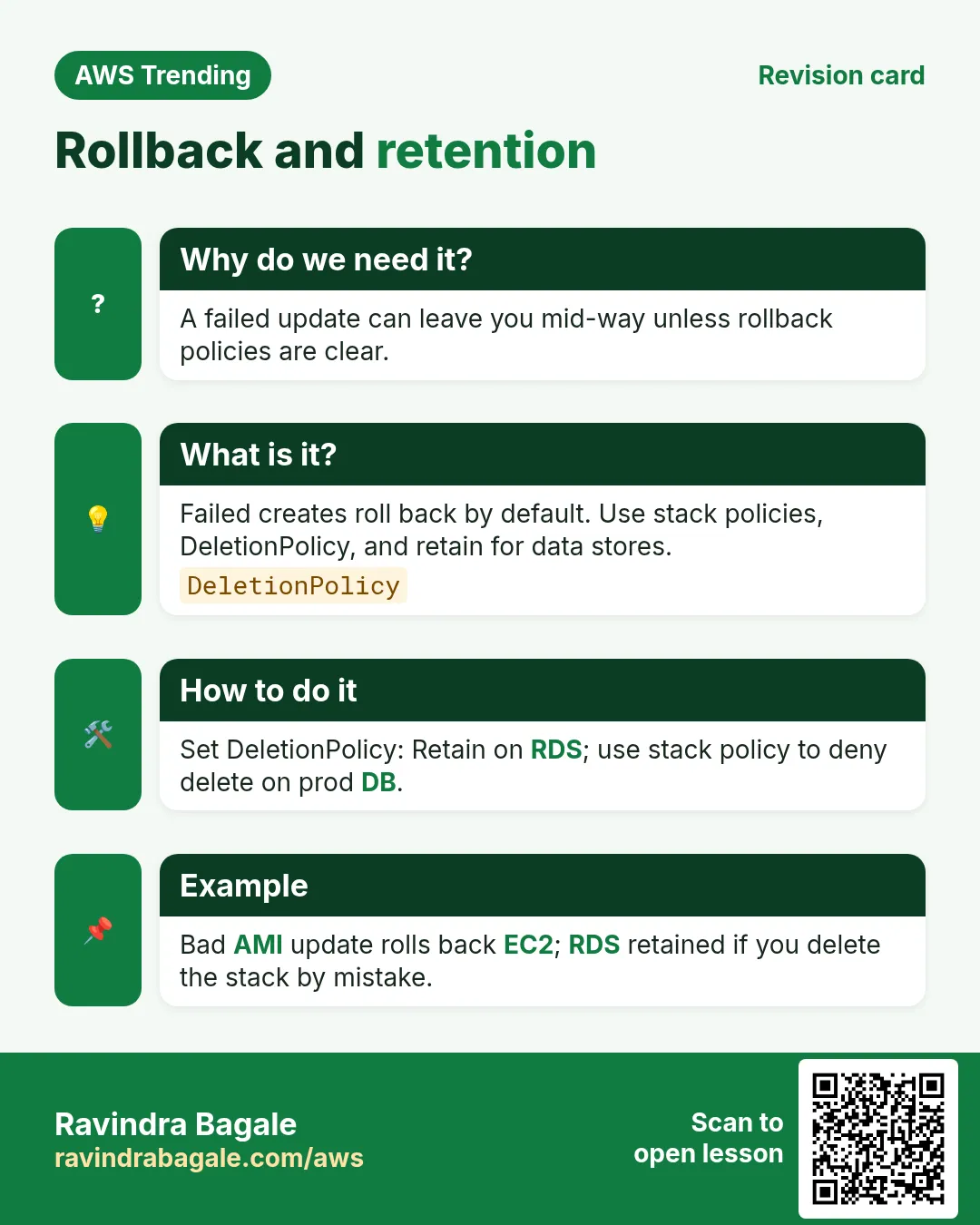
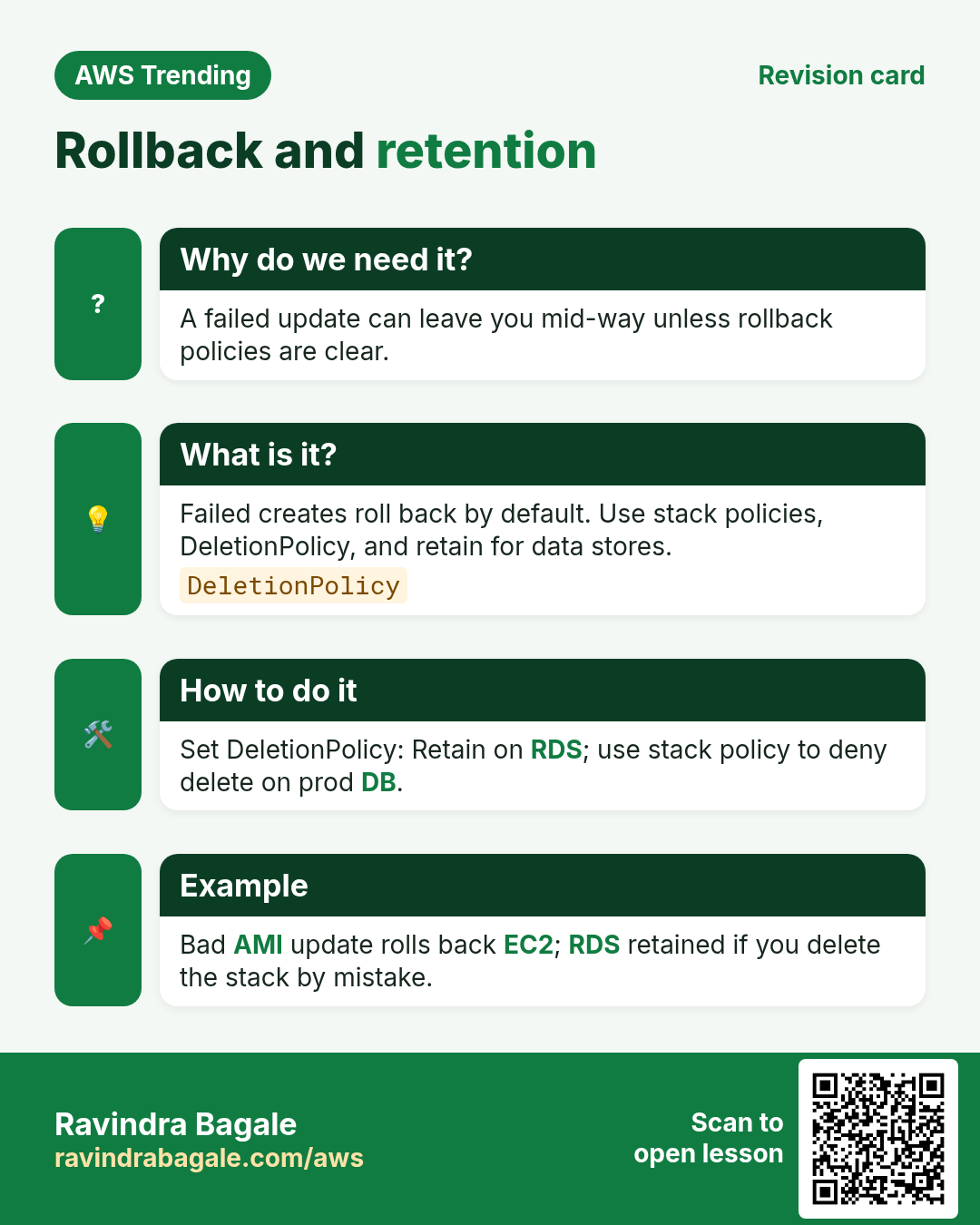
Failed create/update returns to prior good state when possible.
Q. CFN vs Terraform state?
CFN state is AWS-managed; TF state is yours (S3/Dynamo).
12. Tips in English, Marathi and Hindi
Ravindra Bagale's Tip (EN)
If you cannot explain the change set in one sentence, do not execute it.
Ravindra Bagale's Tip (MR)
Change set एक वाक्यात समजत नसेल तर execute नका.
Tip (HI)
Change set एक वाक्य में नहीं समझा तो execute मत करना।
Try at home
- Run cfn-lint on a sample template.
- Draw stack vs change set vs drift.
- List three resources you would never edit only in console.
In short
- CloudFormation = native AWS IaC stacks.
- Change sets and drift keep prod honest.
- Parameters/mappings/outputs structure templates.
- Pick CFN/CDK/TF based on org constraints.
Revision, interview and comparison cards
Revise this lesson in a few minutes. Save the cards on your phone or download them as PNG files. The QR code on each card opens this lesson.
More cards: Ravi Sir's Cards.
Practice Tasks
London Legal LLP is a law business in London. Oliver Hughes looks after its IT and cloud work. They count money in GBP and run their AWS resources in the eu-west-2 Region. In the tasks below you do real jobs for them using what this lesson teaches. All names, account IDs, IP addresses and numbers are made up for practice.
0 / 16
Easy List stacks
Why: See what is deployed.
What to do: List stacks in eu-west-2.
- Read the task and decide which AWS service it is about.
- Write aws, then the service name, then the operation (the action word).
- Add each needed flag (--name) followed by its value from the task.
- Flags can be in any order. Click Check answer.
Easy Describe stack
Why: Status and outputs.
What to do: Describe stack londonlegal-web.
- Read the task and decide which AWS service it is about.
- Write aws, then the service name, then the operation (the action word).
- Add each needed flag (--name) followed by its value from the task.
- Flags can be in any order. Click Check answer.
Easy Validate template
Why: Catch YAML errors.
What to do: Validate template file://tpl.yaml.
- Read the task and decide which AWS service it is about.
- Write aws, then the service name, then the operation (the action word).
- Add each needed flag (--name) followed by its value from the task.
- Flags can be in any order. Click Check answer.
Easy CFN service fee dollars classroom
Why: Service free resources billed.
What to do: CloudFormation service fee in USD for the control plane itself in this classroom (enter 0)?
- Write down the numbers the task gives you.
- Work it out step by step on paper.
- Type only the final answer in the box.
- Click Check answer.
Easy Min AZs for reliable tip
Why: Reliability pillar.
What to do: Minimum AZs often recommended for prod (enter 2)?
- Write down the numbers the task gives you.
- Work it out step by step on paper.
- Type only the final answer in the box.
- Click Check answer.
Easy Run linter before deploy — 1
Why: cfn-lint habit.
What to do: Enter 1 if you should lint templates before deploy.
- Write down the numbers the task gives you.
- Work it out step by step on paper.
- Type only the final answer in the box.
- Click Check answer.
Medium Stack events
Why: Debug CREATE_FAILED.
What to do: Describe stack events for londonlegal-web.
- Read the task and decide which AWS service it is about.
- Write aws, then the service name, then the operation (the action word).
- Add each needed flag (--name) followed by its value from the task.
- Flags can be in any order. Click Check answer.
Medium Detect drift
Why: Find console edits.
What to do: Detect drift on stack londonlegal-web.
- Read the task and decide which AWS service it is about.
- Write aws, then the service name, then the operation (the action word).
- Add each needed flag (--name) followed by its value from the task.
- Flags can be in any order. Click Check answer.
Medium Delete stack
Why: Cleanup labs.
What to do: Delete stack londonlegal-lab.
- Read the task and decide which AWS service it is about.
- Write aws, then the service name, then the operation (the action word).
- Add each needed flag (--name) followed by its value from the task.
- Flags can be in any order. Click Check answer.
Medium Describe stacks only
Why: Read-only ops role.
What to do: Allow cloudformation:DescribeStacks on all stacks (*).
- Start with { "Version": "2012-10-17", "Statement": [ ... ] }.
- In each statement write Effect, Action and Resource.
- Give only what the task needs (least privilege).
- Use double quotes and commas correctly. Click Check answer.
Medium Parameter JSON
Why: Env names as parameters.
What to do: JSON Parameters ProjectName learn.
- Start from the top-level keys the task names.
- Indent child keys with 2 spaces (no tabs).
- Fill in each property with the value from the task.
- Click Check answer. Key order does not matter.
Medium DeletionPolicy retain code 1
Why: Keep data buckets.
What to do: Enter 1 if DeletionPolicy Retain keeps a resource on stack delete.
- Write down the numbers the task gives you.
- Work it out step by step on paper.
- Type only the final answer in the box.
- Click Check answer.
Hard Create change set
Why: Preview prod updates.
What to do: Create change set cs1 on stack londonlegal-web with template file://tpl.yaml.
- Read the task and decide which AWS service it is about.
- Write aws, then the service name, then the operation (the action word).
- Add each needed flag (--name) followed by its value from the task.
- Flags can be in any order. Click Check answer.
Hard Execute change set
Why: Apply after review.
What to do: Execute change set cs1 on londonlegal-web.
- Read the task and decide which AWS service it is about.
- Write aws, then the service name, then the operation (the action word).
- Add each needed flag (--name) followed by its value from the task.
- Flags can be in any order. Click Check answer.
Hard PassRole for CFN
Why: CFN needs PassRole carefully.
What to do: Allow iam:PassRole on arn:aws:iam::114543297314:role/londonlegal-cfn.
- Start with { "Version": "2012-10-17", "Statement": [ ... ] }.
- In each statement write Effect, Action and Resource.
- Give only what the task needs (least privilege).
- Use double quotes and commas correctly. Click Check answer.
Hard Outputs JSON
Why: Export bucket name.
What to do: JSON Outputs BucketName Value my-lab-bucket.
- Start from the top-level keys the task names.
- Indent child keys with 2 spaces (no tabs).
- Fill in each property with the value from the task.
- Click Check answer. Key order does not matter.