Project: Build Order Fan-Out with SNS, SQS, Lambda and DynamoDB (Source Code)
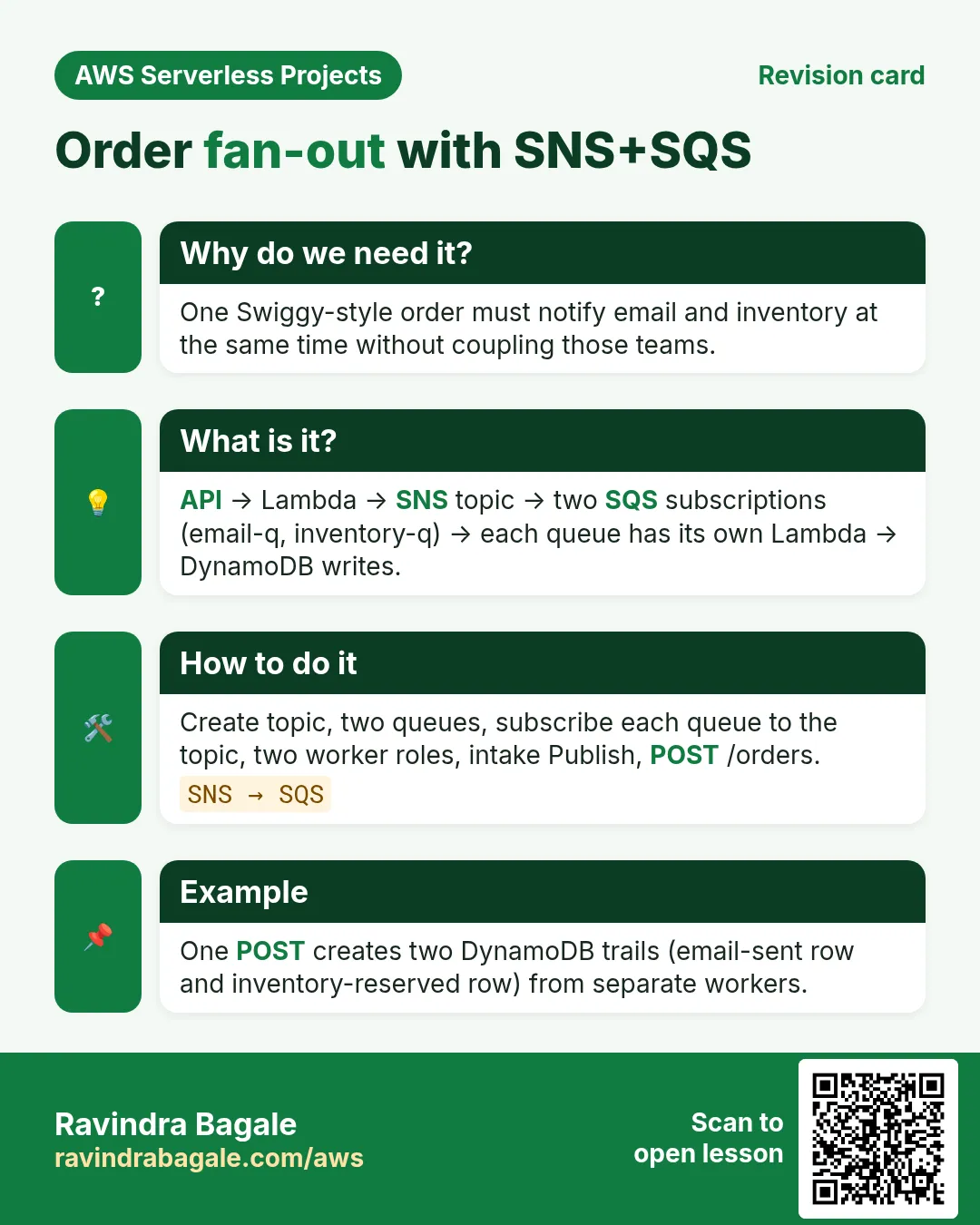
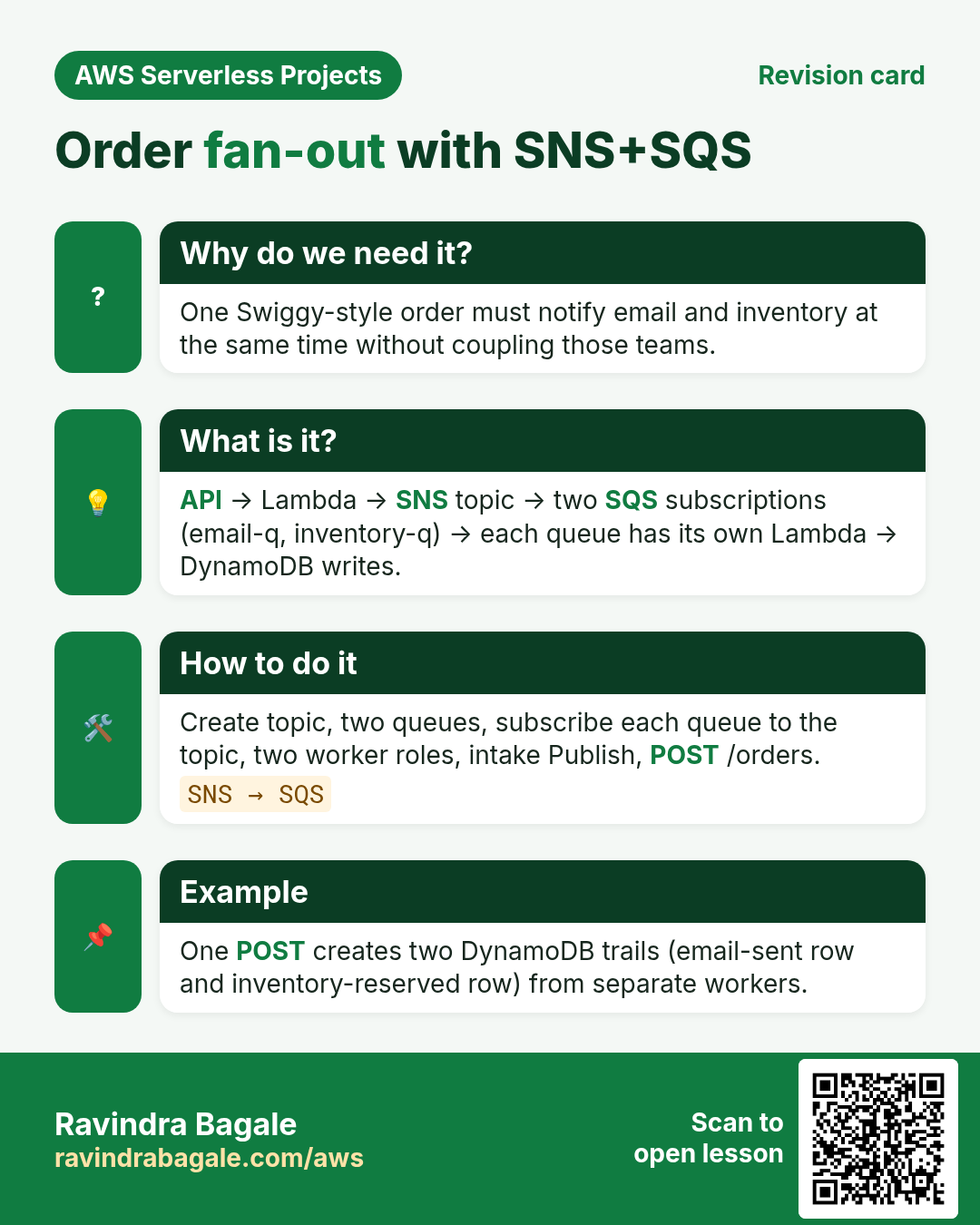
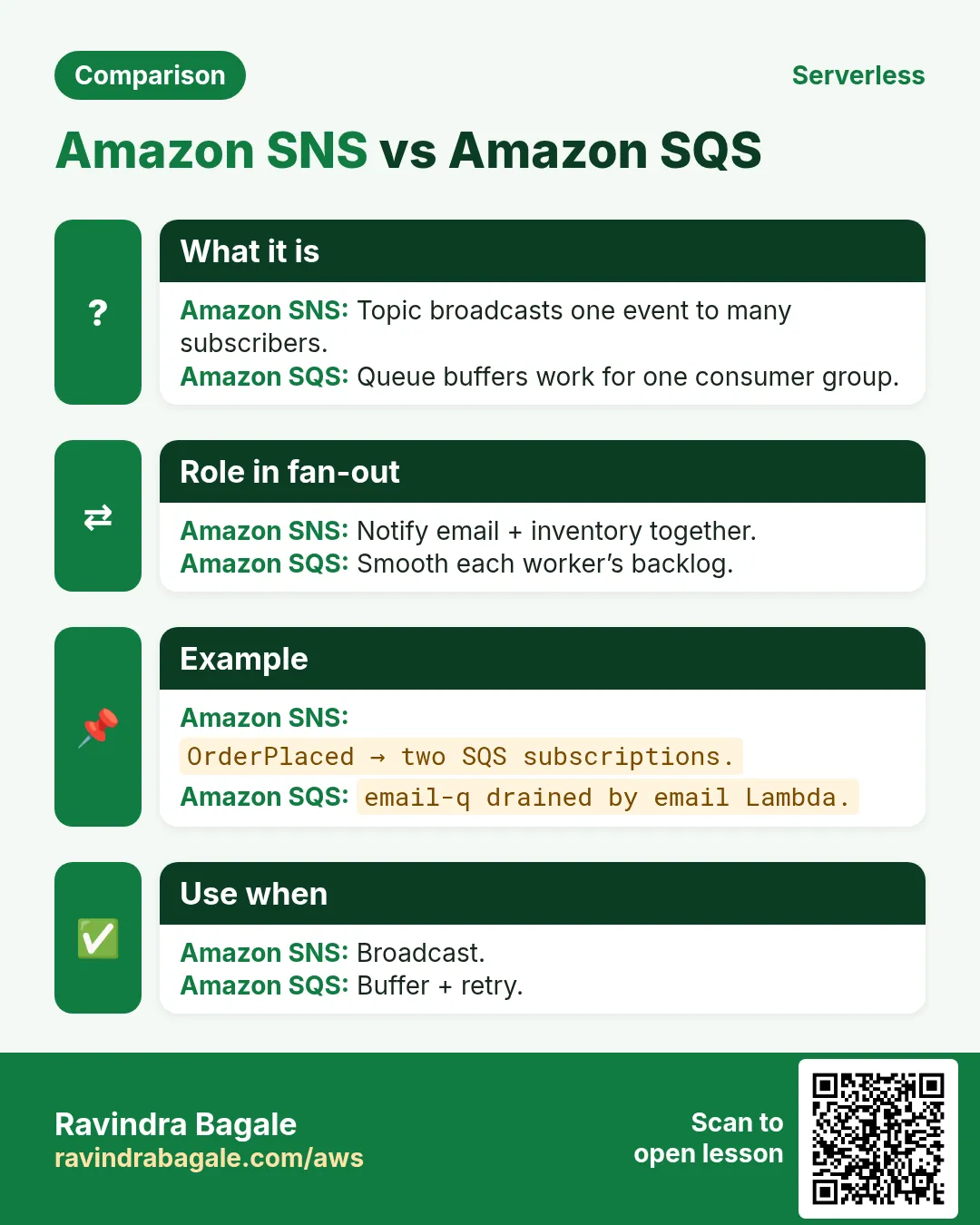
One Swiggy order must notify email and inventory at the same time. SNS fans out to two SQS queues; each queue has its own Lambda writing DynamoDB.
What you'll learn in this chapter
- SNS fan-out to two SQS queues
- Publisher API Lambda
- Two worker Lambdas
- Cleanup topic, queues, functions
1. Everyday example
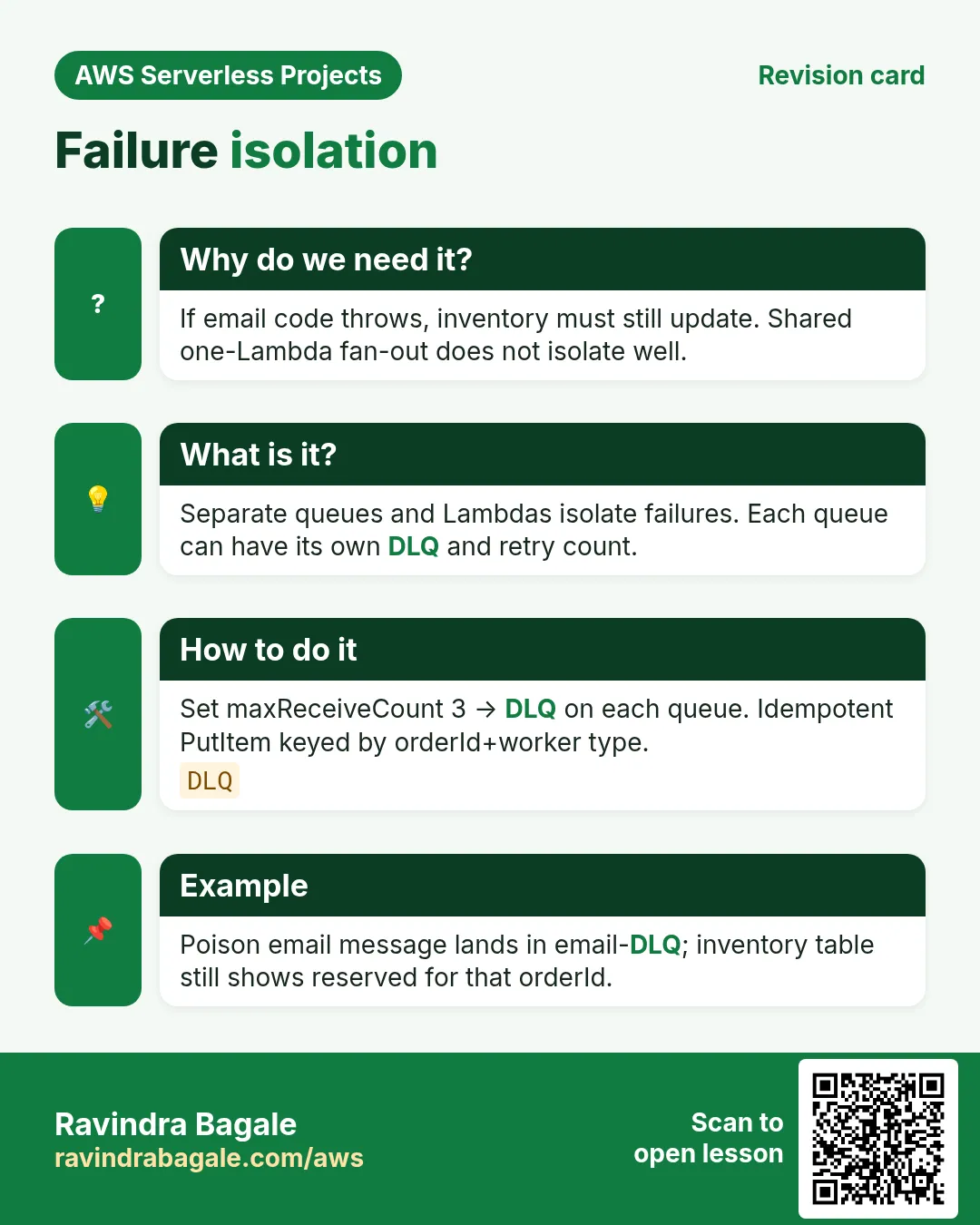
Why do we need this?
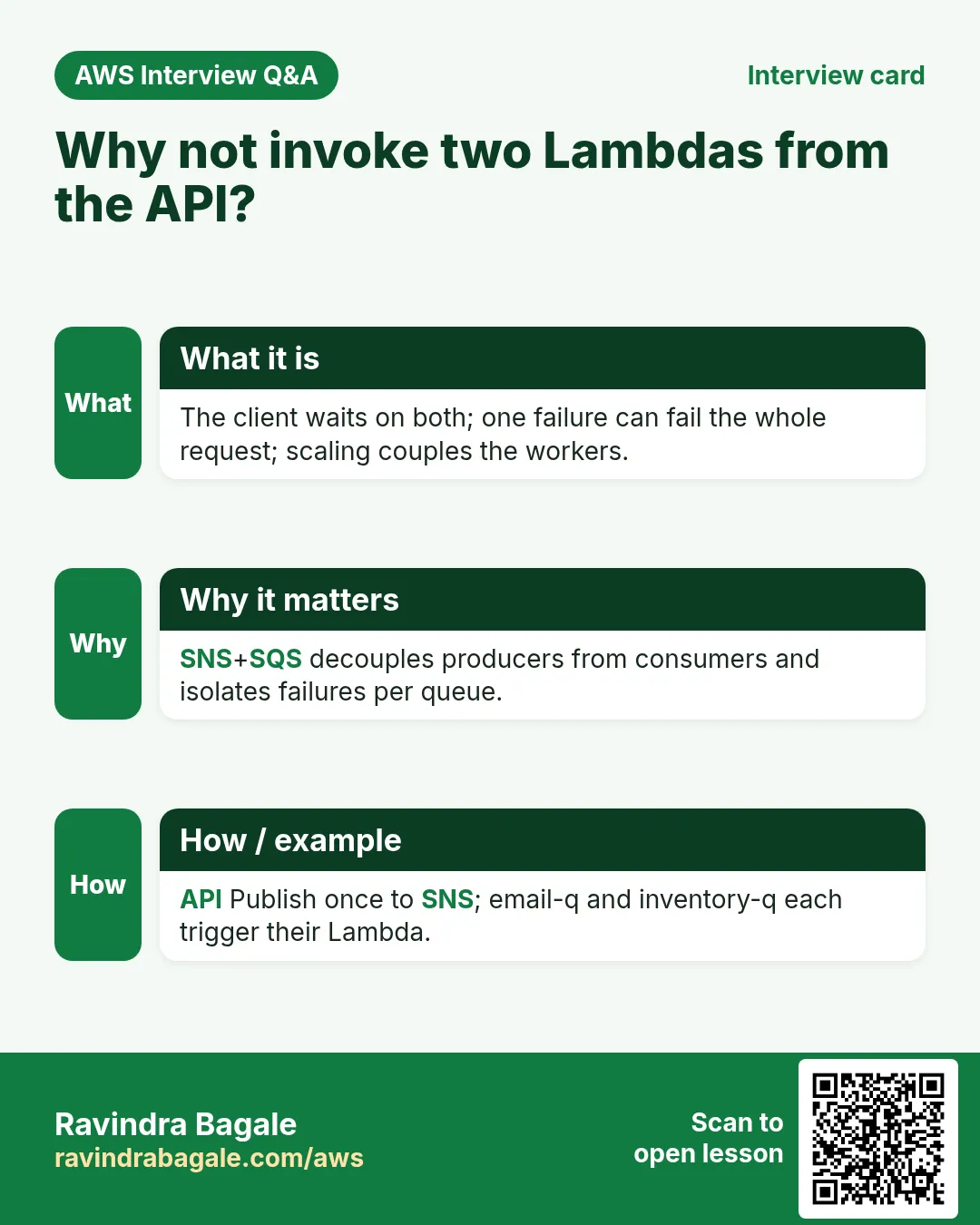
If email code crashes, inventory should still run. Separate queues isolate failures — that is fan-out.
What is it?
POST /orders → publisher Lambda → SNS topic → email-queue + inventory-queue → email_worker + inventory_worker → DynamoDB.
Download: order-fanout.zip
2. Lab
How to do it (step by step)
A. SNS + SQS + table
- SNS topic
yourname-orders-topic. - SQS queues
yourname-email-qandyourname-inv-q. Subscribe both to the topic. - DynamoDB
yourname-fanout, PKpkString.
B. Workers + publisher
- Deploy email_worker.py and inventory_worker.py with SQS triggers. Env TABLE_NAME.
- Publisher.py with TOPIC_ARN. HTTP API POST /orders.
curl -s -X POST "$API_BASE/orders" -H 'content-type: application/json' \
  -d '{"sku":"TEE-RED","qty":1}'
# DynamoDB should show EMAIL#... and INV#... rows
Cleanup
- Delete API, publisher, workers, subscriptions, topic, queues, table, roles.
3. Interview
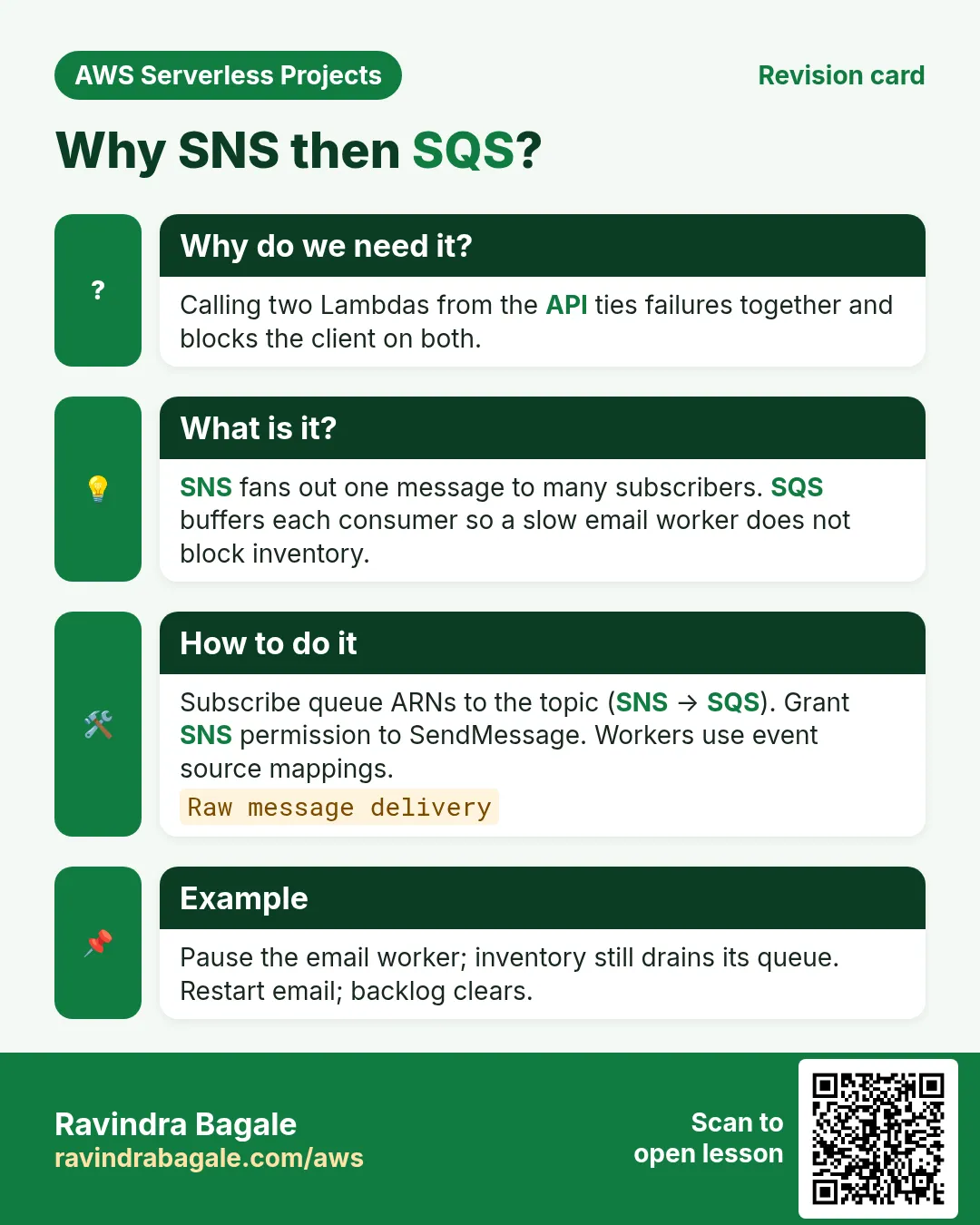
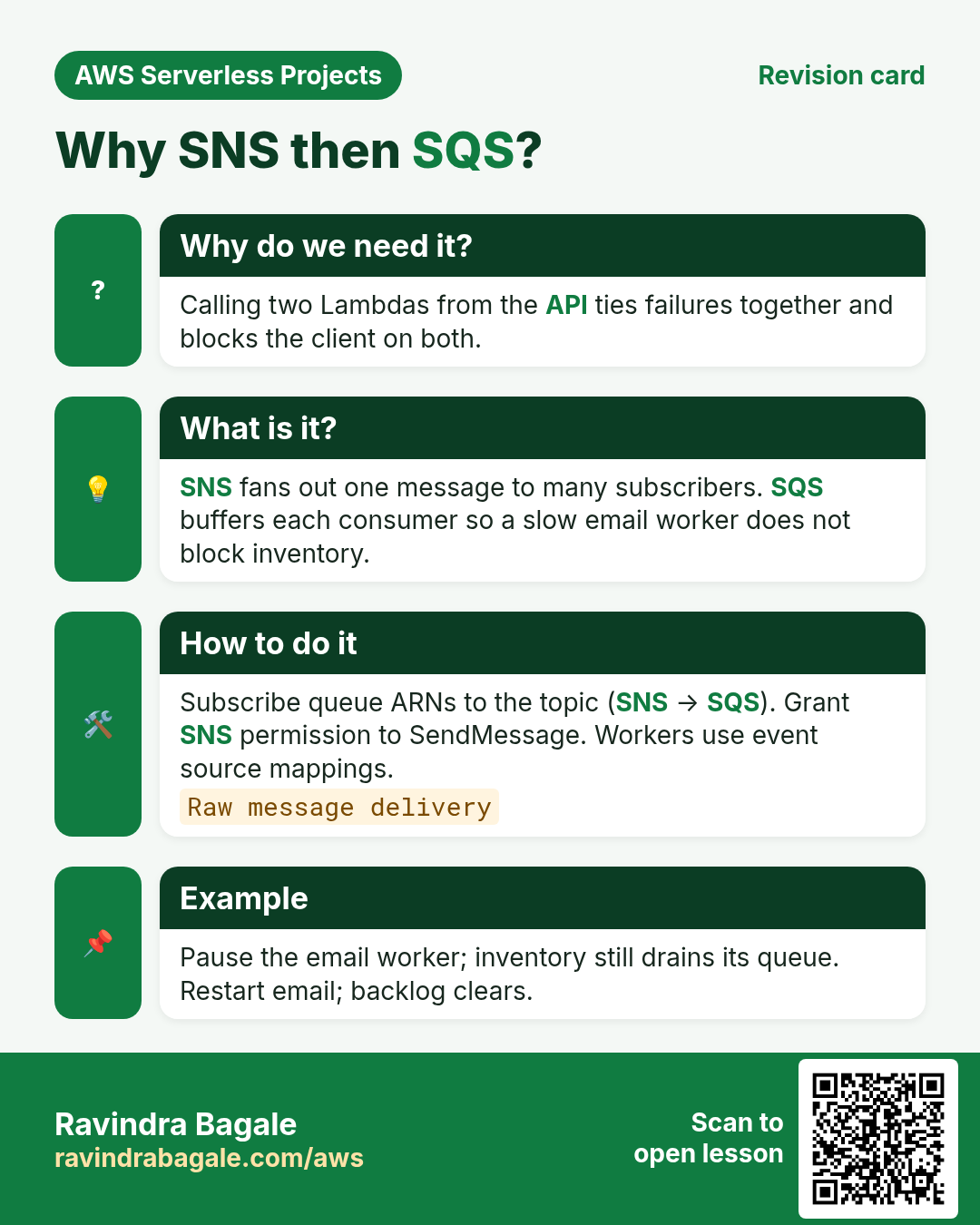
Q. Why not two publishes from the API Lambda?
SNS subscription list grows without redeploying the API.
Q. SNS to SQS wrapper?
Workers parse Message JSON inside the SQS body.
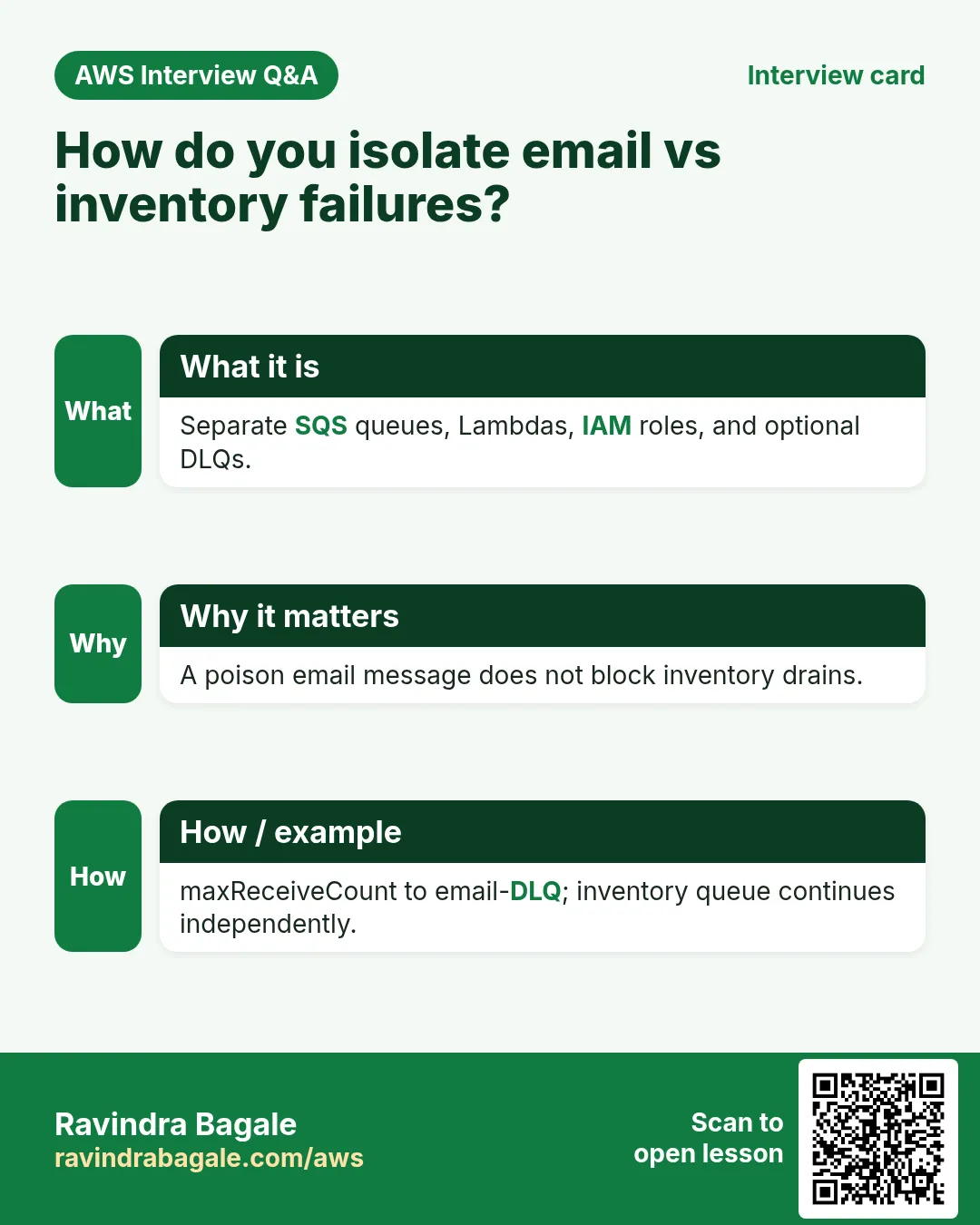
Q. Failure isolation?
Poison email queue does not block inventory queue.
Q. Filter policies?
SNS can route by message attributes later.
Q. Cleanup?
Topic, queues, Lambdas, table.
Try at home
- Add a third analytics queue.
- Use message attributes for VIP orders.
In short
- Fan-out = SNS to many SQS workers.
- One publish, many subscribers.
- Isolate failures per queue.
- Clean up.
Practice Tasks
Hyderabad Biryani Hub is a cloud kitchen business in Hyderabad. Syed Imran looks after its IT and cloud work. They count money in INR and run their AWS resources in the ap-south-2 Region. In the tasks below you do real jobs for them using what this lesson teaches. All names, account IDs, IP addresses and numbers are made up for practice.
0 / 12
Easy List functions
Why: See which functions exist in this Region.
What to do: List the Lambda functions in ap-south-2.
- Read the task and decide which AWS service it is about.
- Write aws, then the service name, then the operation (the action word).
- Add each needed flag (--name) followed by its value from the task.
- Flags can be in any order. Click Check answer.
Medium Invoke a function
Why: Invoke runs the function now and saves its answer in a file.
What to do: Invoke hydbiryani-orders-fn and save the response to out.json.
- Read the task and decide which AWS service it is about.
- Write aws, then the service name, then the operation (the action word).
- Add each needed flag (--name) followed by its value from the task.
- Flags can be in any order. Click Check answer.
Medium Trust policy for a Lambda role
Why: The trust policy says WHO may take the role.
What to do: Write a trust policy that lets lambda.amazonaws.com assume the role.
- Start with { "Version": "2012-10-17", "Statement": [ ... ] }.
- In each statement write Effect, Action and Resource.
- Give only what the task needs (least privilege).
- Use double quotes and commas correctly. Click Check answer.
Medium Put an item
Why: DynamoDB JSON shows the type of each value: S for string, N for number.
What to do: Put an item into hydbiryani-orders with orderId "o-101" (string) and amount 2500 (number).
- Read the task and decide which AWS service it is about.
- Write aws, then the service name, then the operation (the action word).
- Add each needed flag (--name) followed by its value from the task.
- Flags can be in any order. Click Check answer.
Medium Change timeout and memory
Why: More memory also gives more CPU; timeout stops runaway runs.
What to do: Set hydbiryani-orders-fn to timeout 30 seconds and memory 512 MB.
- Read the task and decide which AWS service it is about.
- Write aws, then the service name, then the operation (the action word).
- Add each needed flag (--name) followed by its value from the task.
- Flags can be in any order. Click Check answer.
Hard Connect an SQS queue to Lambda
Why: An event source mapping makes Lambda poll the queue and process messages in batches.
What to do: Create an event source mapping from queue arn:aws:sqs:ap-south-2:130300927383:hydbiryani-orders to hydbiryani-orders-fn with batch size 10.
- Read the task and decide which AWS service it is about.
- Write aws, then the service name, then the operation (the action word).
- Add each needed flag (--name) followed by its value from the task.
- Flags can be in any order. Click Check answer.
Hard Create a Lambda function
Why: Lambda needs the code zip, a runtime, a handler name and an execution role.
What to do: Create function hydbiryani-orders-fn: runtime python3.12, handler app.handler, role arn:aws:iam::130300927383:role/lambda-basic, code in function.zip.
- Read the task and decide which AWS service it is about.
- Write aws, then the service name, then the operation (the action word).
- Add each needed flag (--name) followed by its value from the task.
- Flags can be in any order. Click Check answer.
Hard Set environment variables
Why: Keep settings like table names out of the code.
What to do: Set the environment variable TABLE=hydbiryani-orders on hydbiryani-orders-fn.
- Read the task and decide which AWS service it is about.
- Write aws, then the service name, then the operation (the action word).
- Add each needed flag (--name) followed by its value from the task.
- Flags can be in any order. Click Check answer.
Hard Invoke with a JSON payload
Why: In CLI v2, raw JSON needs --cli-binary-format raw-in-base64-out.
What to do: Invoke hydbiryani-orders-fn with payload {"orderId":"o-101"} (raw JSON) and save the reply in out.json.
- Read the task and decide which AWS service it is about.
- Write aws, then the service name, then the operation (the action word).
- Add each needed flag (--name) followed by its value from the task.
- Flags can be in any order. Click Check answer.
Hard Lambda GB-seconds
Why: Lambda bills memory × time.
What to do: 1,000,000 invocations, 512 MB memory, 200 ms each. How many GB-seconds?
- Write down the numbers the task gives you.
- Work it out step by step on paper.
- Type only the final answer in the box.
- Click Check answer.
Hard Read capacity units
Why: Provisioned tables need the right RCU.
What to do: Strongly consistent reads of 6 KB items, 10 reads per second. How many RCUs?
- Write down the numbers the task gives you.
- Work it out step by step on paper.
- Type only the final answer in the box.
- Click Check answer.
Hard Let S3 call your function
Why: A resource-based permission is needed before S3 can invoke the function.
What to do: Add permission statement s3invoke to hydbiryani-orders-fn so s3.amazonaws.com can call lambda:InvokeFunction from bucket arn:aws:s3:::hydbiryani-uploads.
- Read the task and decide which AWS service it is about.
- Write aws, then the service name, then the operation (the action word).
- Add each needed flag (--name) followed by its value from the task.
- Flags can be in any order. Click Check answer.
Revision, comparison and interview cards
Revise this lesson in a few minutes. Save the cards on your phone or download them as PNG files. The QR code on each card opens this lesson.
More cards: Ravi Sir's Cards.