What Is Amazon Aurora? vs RDS MySQL and PostgreSQL
RDS MySQL is a managed restaurant kitchen with a fixed fridge size. Aurora is a cloud-native kitchen where the fridge grows as you store more food, and standby cooks share the same fridge. Same MySQL/PostgreSQL language — different engine under the hood.
What you'll learn in this chapter
- What Aurora is compatible with
- How Aurora storage differs from RDS
- Aurora vs RDS MySQL/PostgreSQL table
- Replicas, Serverless v2, cost sense
1. Everyday example
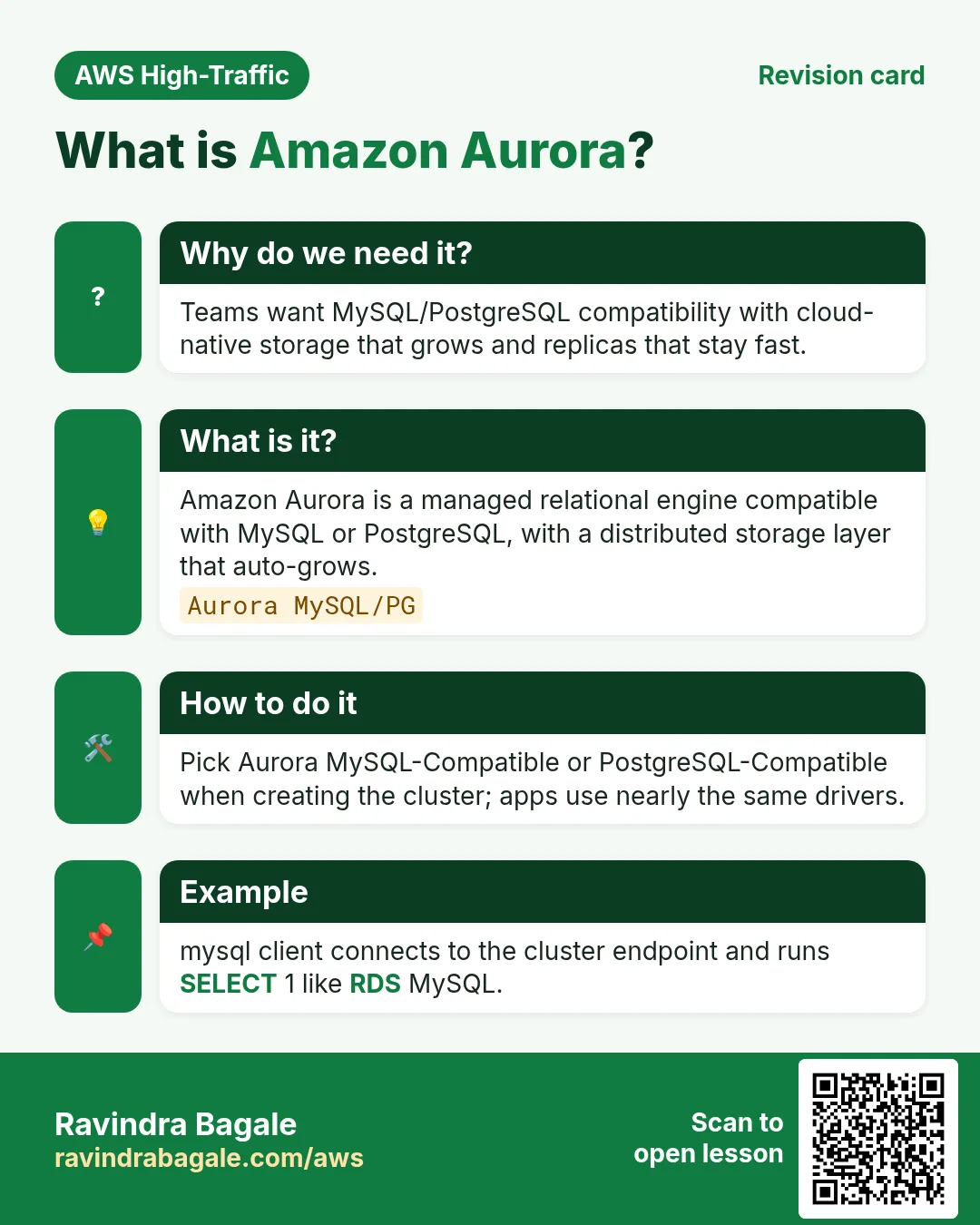
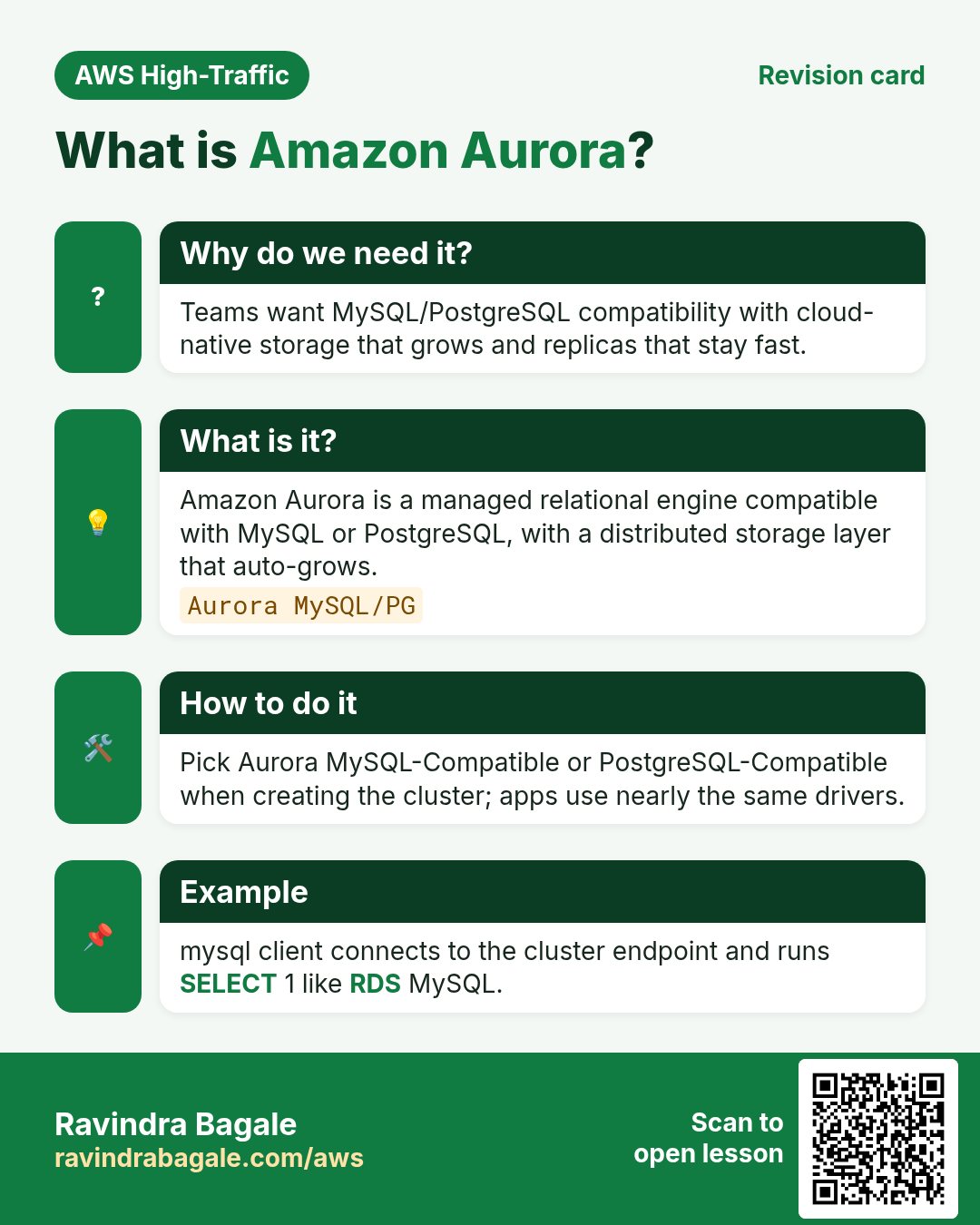
Why do we need this?
PhonePe-style apps need MySQL compatibility, fast failovers, and storage that does not make you guess disk size at 2 AM.
What is it?
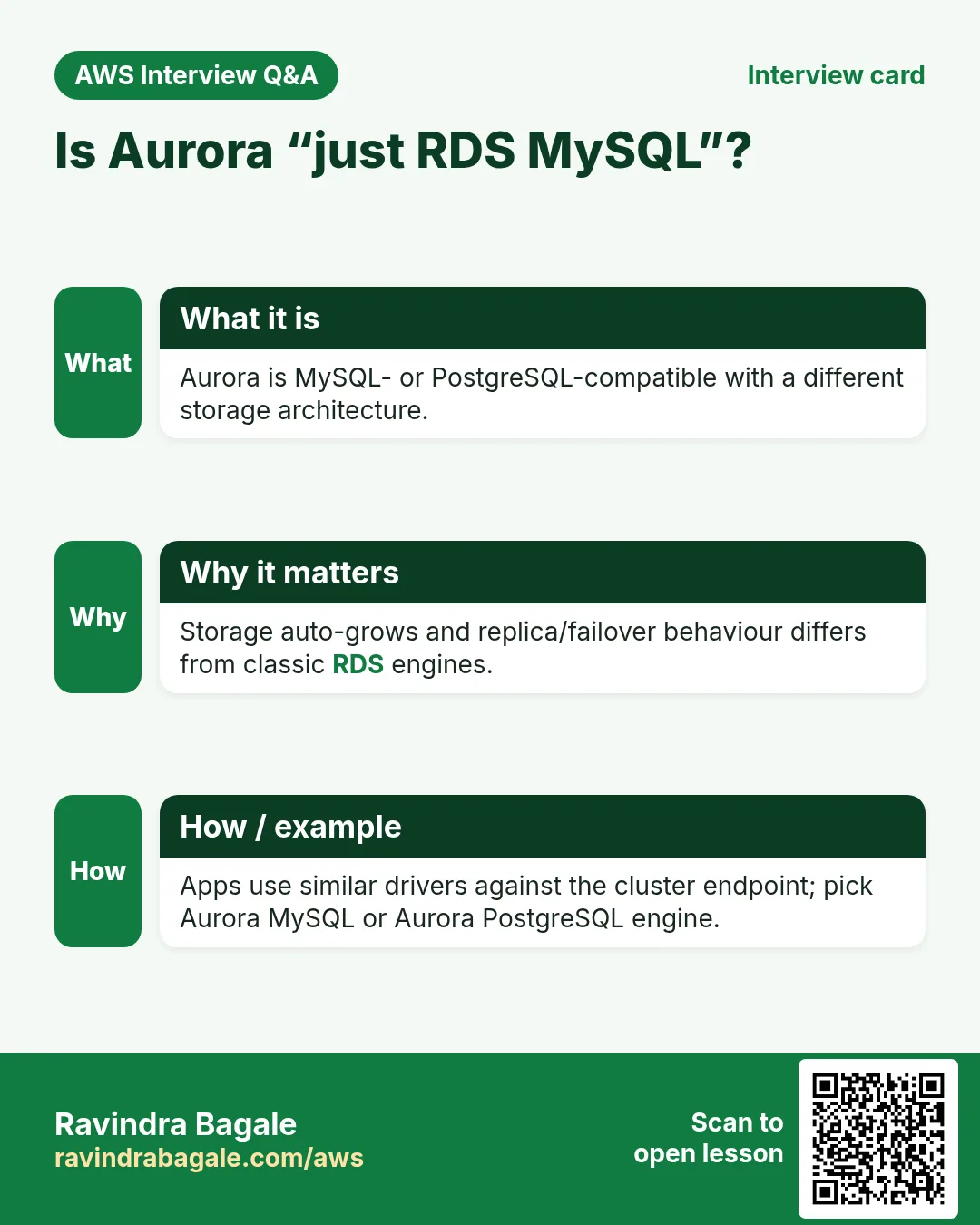
Amazon Aurora is a managed relational database compatible with MySQL and PostgreSQL. Storage is distributed, grows in 10 GB steps, and is replicated across AZs.
2. Aurora vs RDS MySQL / PostgreSQL
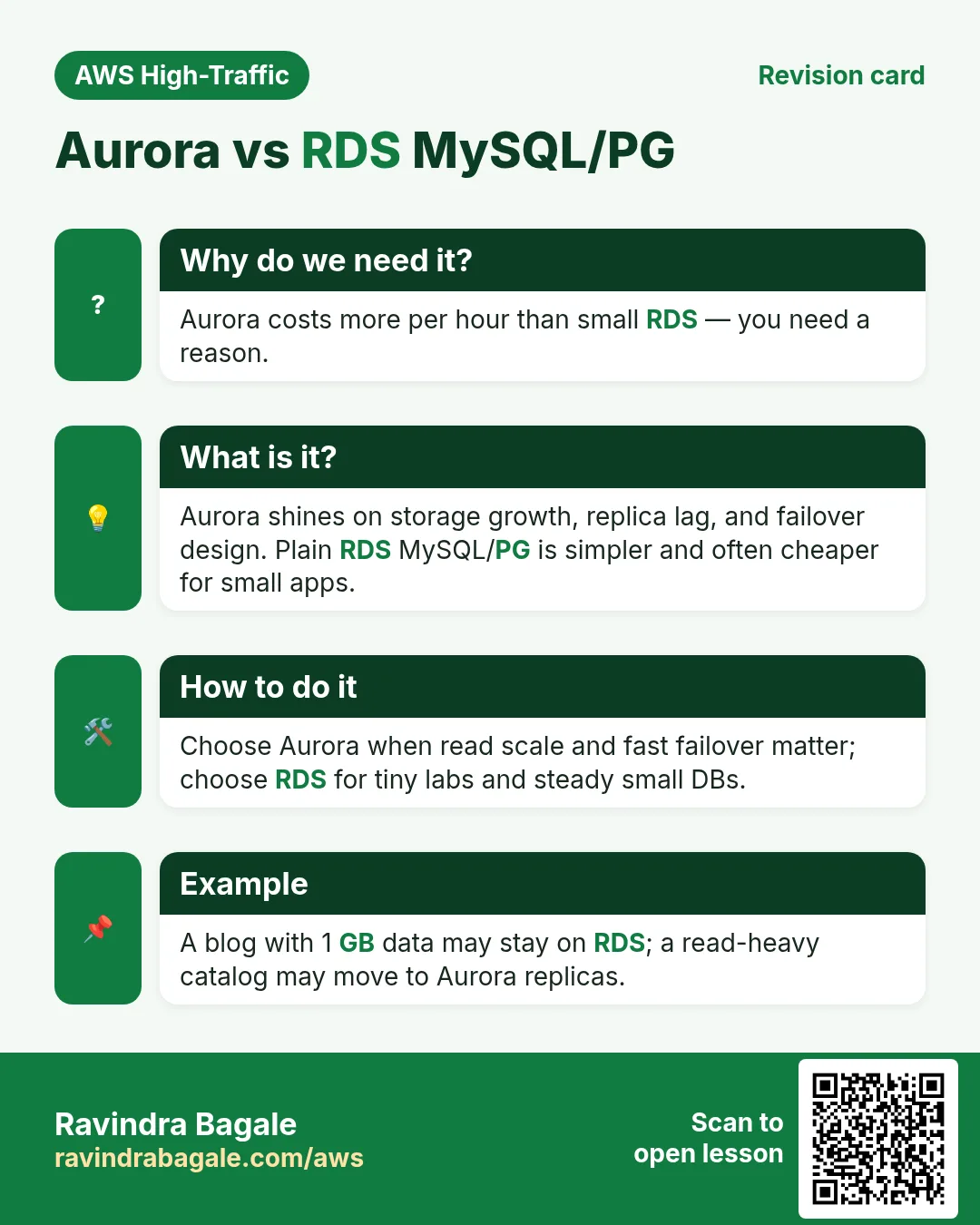
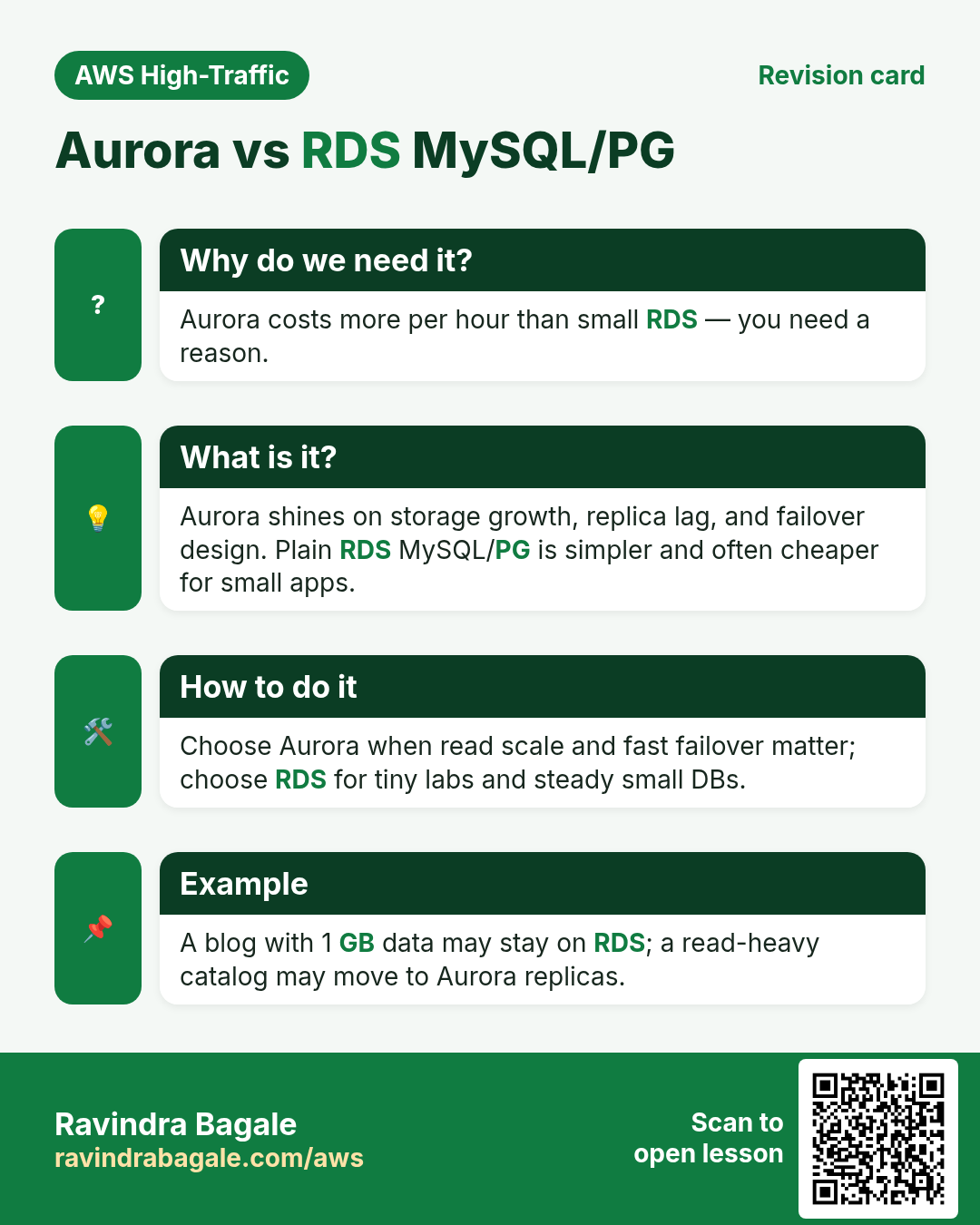
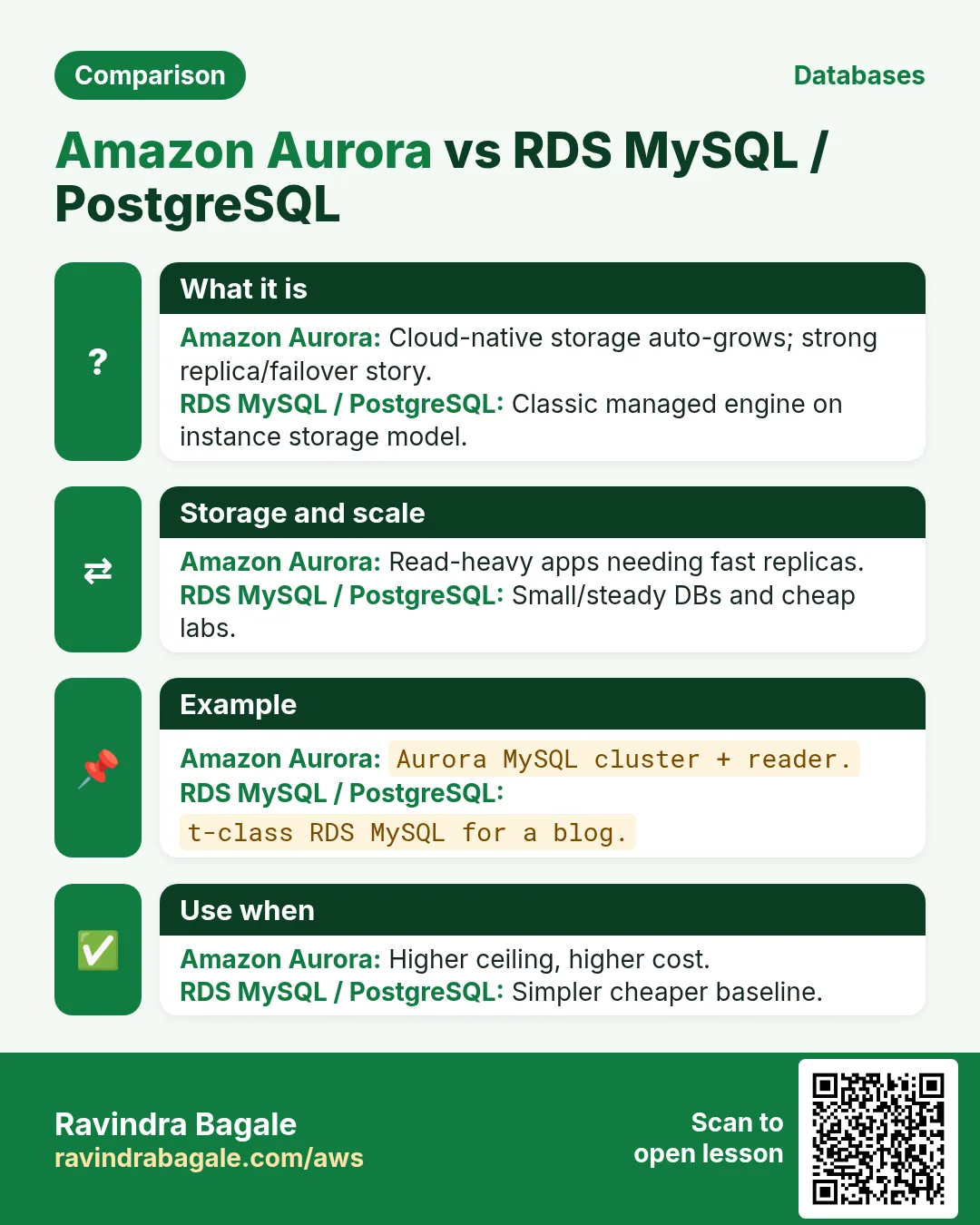
| Topic | RDS MySQL/PG | Aurora |
|---|---|---|
| Storage | You choose allocated GB (+autoscaling options) | Auto-grows; pay for used space |
| Replica | Read replica = often extra storage copy | Up to 15 Aurora replicas, same volume |
| Failover | Multi-AZ standby (engine dependent) | Typically faster promotion of a replica |
| Compatibility | Community MySQL / PostgreSQL engines | Aurora MySQL / Aurora PostgreSQL wire-compatible |
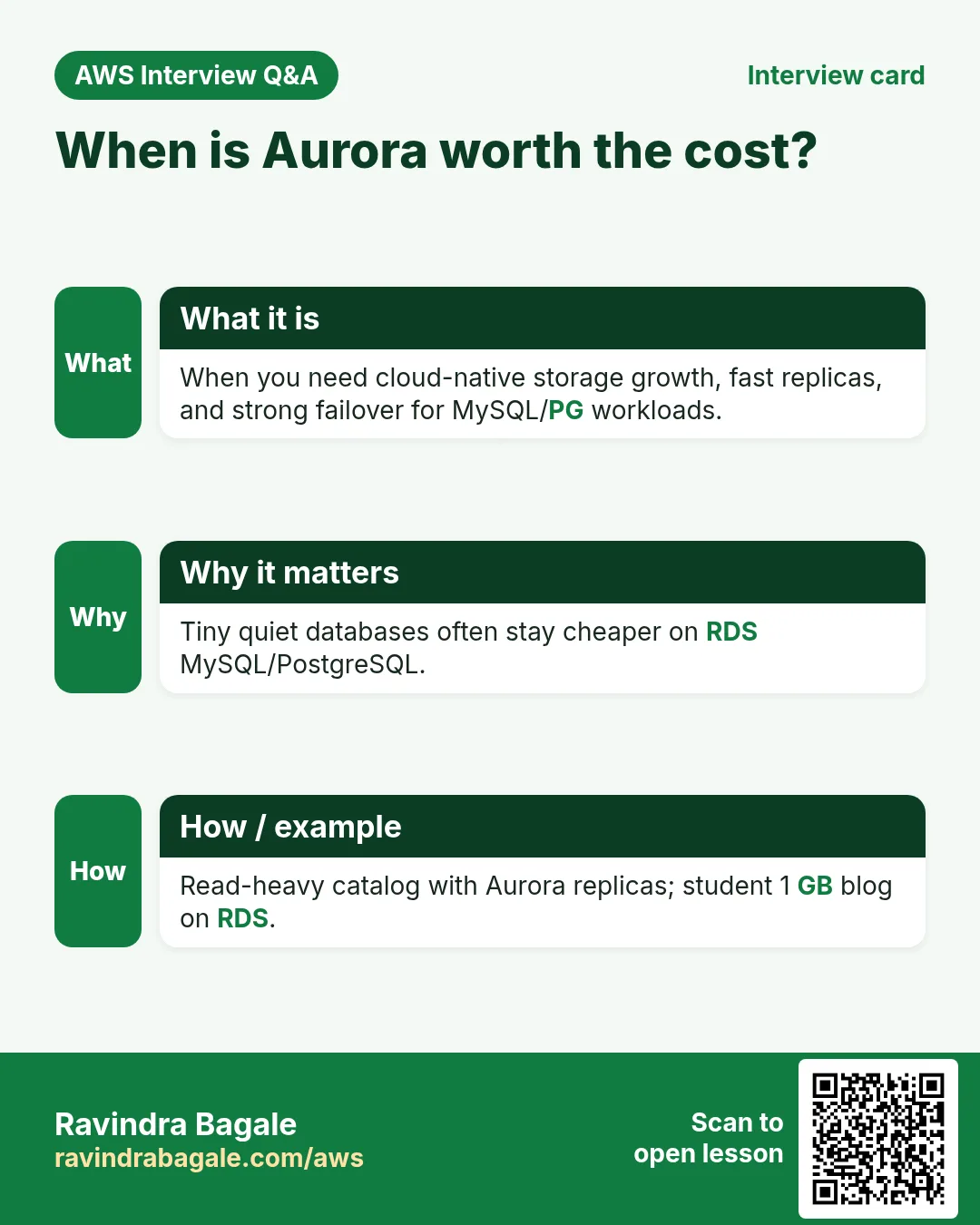
| Cost | Often cheaper for small steady DBs | Higher for small labs; shines at scale/HA |
Ravindra Bagale's Tip
For a student blog with 1 GB data, RDS MySQL free-tier/dev instance is enough. Pick Aurora when you need its storage/replica model or company standard.
3. Serverless v2 (short)
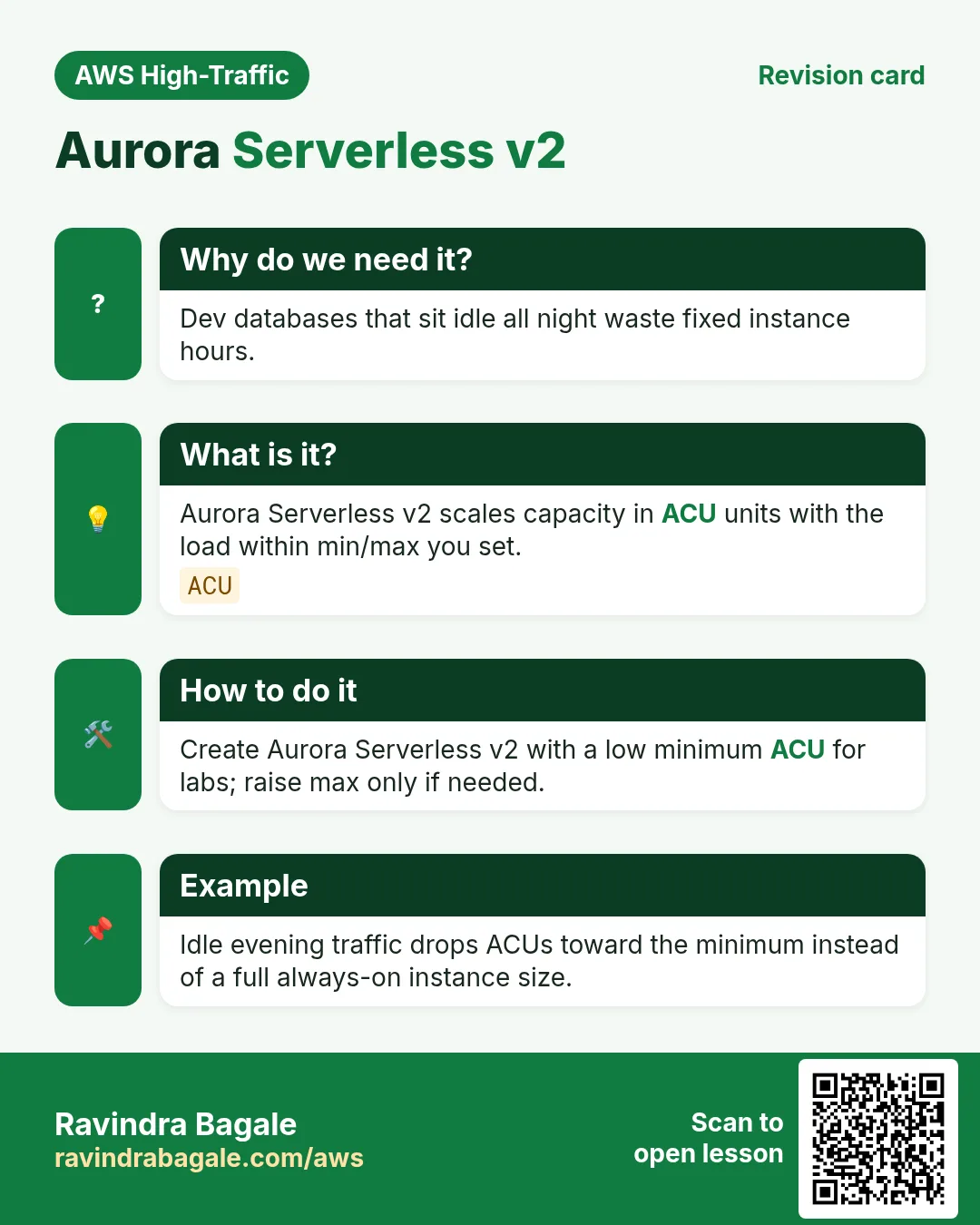
Aurora Serverless v2 scales ACU capacity up and down. Good for spiky or uncertain load. Still not “free when idle” like Lambda — know the minimum ACU you set.
4. Interview angles
Q. MySQL compatible?
Aurora MySQL speaks the MySQL wire protocol (version matters).
Q. Storage growth unit?
Typically 10 GB increments.
Q. Writer vs reader endpoint?
Writer for writes; reader endpoint load-balances readers.
Q. When RDS over Aurora?
Small/simple/cheaper labs; exact community engine needs.
Q. Backup?
Continuous backups to S3 + snapshots — similar habit to RDS.
Try at home
- Price a db.t3.medium RDS MySQL vs Aurora MySQL in ap-south-1 for 1 month (docs calculator).
- Next chapter: create and delete an Aurora cluster.
In short
- Aurora = MySQL/PG compatible, cloud-native storage.
- Replicas share storage; failover is a strength.
- Costs more than tiny RDS for small labs.
- Always delete lab clusters.
Practice Tasks
Thane Housing Society is a real estate business in Thane. Mahesh Patwardhan looks after its IT and cloud work. They count money in INR and run their AWS resources in the ap-south-1 Region. In the tasks below you do real jobs for them using what this lesson teaches. All names, account IDs, IP addresses and numbers are made up for practice.
0 / 12
Easy Biggest orders first
Why: Querying the database is daily work after you set up RDS.
What to do: Show order id and amount, biggest amount first.
Tables: customers(id, name, city) and orders(id, customer_id, amount, odate).
- Find the table the task is about (see the table list above the box).
- Write the SQL statement step by step: what, from where, which rows.
- End the statement with ;
- Click Check answer. Your query runs on a practice copy of the table.
Easy Filter customers by city
Why: Querying the database is daily work after you set up RDS.
What to do: List the names of customers in Pune.
Tables: customers(id, name, city) and orders(id, customer_id, amount, odate).
- Find the table the task is about (see the table list above the box).
- Write the SQL statement step by step: what, from where, which rows.
- End the statement with ;
- Click Check answer. Your query runs on a practice copy of the table.
Easy Find the database endpoint
Why: Your app connects using the endpoint name, not an IP.
What to do: Describe DB instance thanehousing-db.
- Read the task and decide which AWS service it is about.
- Write aws, then the service name, then the operation (the action word).
- Add each needed flag (--name) followed by its value from the task.
- Flags can be in any order. Click Check answer.
Medium Total sales
Why: Querying the database is daily work after you set up RDS.
What to do: Show the total of all order amounts as one number.
Tables: customers(id, name, city) and orders(id, customer_id, amount, odate).
- Find the table the task is about (see the table list above the box).
- Write the SQL statement step by step: what, from where, which rows.
- End the statement with ;
- Click Check answer. Your query runs on a practice copy of the table.
Medium Orders with customer names
Why: Querying the database is daily work after you set up RDS.
What to do: Show each customer name with each order amount.
Tables: customers(id, name, city) and orders(id, customer_id, amount, odate).
- Find the table the task is about (see the table list above the box).
- Write the SQL statement step by step: what, from where, which rows.
- End the statement with ;
- Click Check answer. Your query runs on a practice copy of the table.
Medium Remove small orders
Why: Querying the database is daily work after you set up RDS.
What to do: Delete orders with amount below 200.
Tables: customers(id, name, city) and orders(id, customer_id, amount, odate).
- Find the table the task is about (see the table list above the box).
- Write the SQL statement step by step: what, from where, which rows.
- End the statement with ;
- Click Check answer. Your query runs on a practice copy of the table.
Medium Fix a city
Why: Querying the database is daily work after you set up RDS.
What to do: Customer 5 moved to Rome. Update the record.
Tables: customers(id, name, city) and orders(id, customer_id, amount, odate).
- Find the table the task is about (see the table list above the box).
- Write the SQL statement step by step: what, from where, which rows.
- End the statement with ;
- Click Check answer. Your query runs on a practice copy of the table.
Medium Turn on Multi-AZ
Why: Multi-AZ keeps a standby copy in another AZ and fails over automatically.
What to do: Modify thanehousing-db to be Multi-AZ and apply the change immediately.
- Read the task and decide which AWS service it is about.
- Write aws, then the service name, then the operation (the action word).
- Add each needed flag (--name) followed by its value from the task.
- Flags can be in any order. Click Check answer.
Hard Sales per customer
Why: Querying the database is daily work after you set up RDS.
What to do: Show customer_id and total amount per customer, only where total is above 1000.
Tables: customers(id, name, city) and orders(id, customer_id, amount, odate).
- Find the table the task is about (see the table list above the box).
- Write the SQL statement step by step: what, from where, which rows.
- End the statement with ;
- Click Check answer. Your query runs on a practice copy of the table.
Hard Customers with no orders
Why: Querying the database is daily work after you set up RDS.
What to do: List names of customers who have never ordered.
Tables: customers(id, name, city) and orders(id, customer_id, amount, odate).
- Find the table the task is about (see the table list above the box).
- Write the SQL statement step by step: what, from where, which rows.
- End the statement with ;
- Click Check answer. Your query runs on a practice copy of the table.
Hard Create a MySQL database
Why: RDS runs the database for you: backups, patches and failover are managed.
What to do: Create RDS instance thanehousing-db: engine mysql, class db.t3.micro, 20 GiB storage, master user admin, master password from $DB_PASS.
- Read the task and decide which AWS service it is about.
- Write aws, then the service name, then the operation (the action word).
- Add each needed flag (--name) followed by its value from the task.
- Flags can be in any order. Click Check answer.
Hard Create a read replica
Why: Read replicas take report and read traffic off the main database.
What to do: Create read replica thanehousing-db-ro from source thanehousing-db.
- Read the task and decide which AWS service it is about.
- Write aws, then the service name, then the operation (the action word).
- Add each needed flag (--name) followed by its value from the task.
- Flags can be in any order. Click Check answer.
Revision, comparison and interview cards
Revise this lesson in a few minutes. Save the cards on your phone or download them as PNG files. The QR code on each card opens this lesson.
More cards: Ravi Sir's Cards.