Project: Build a WebSocket Chat Room with API Gateway, Lambda and DynamoDB (Source Code)
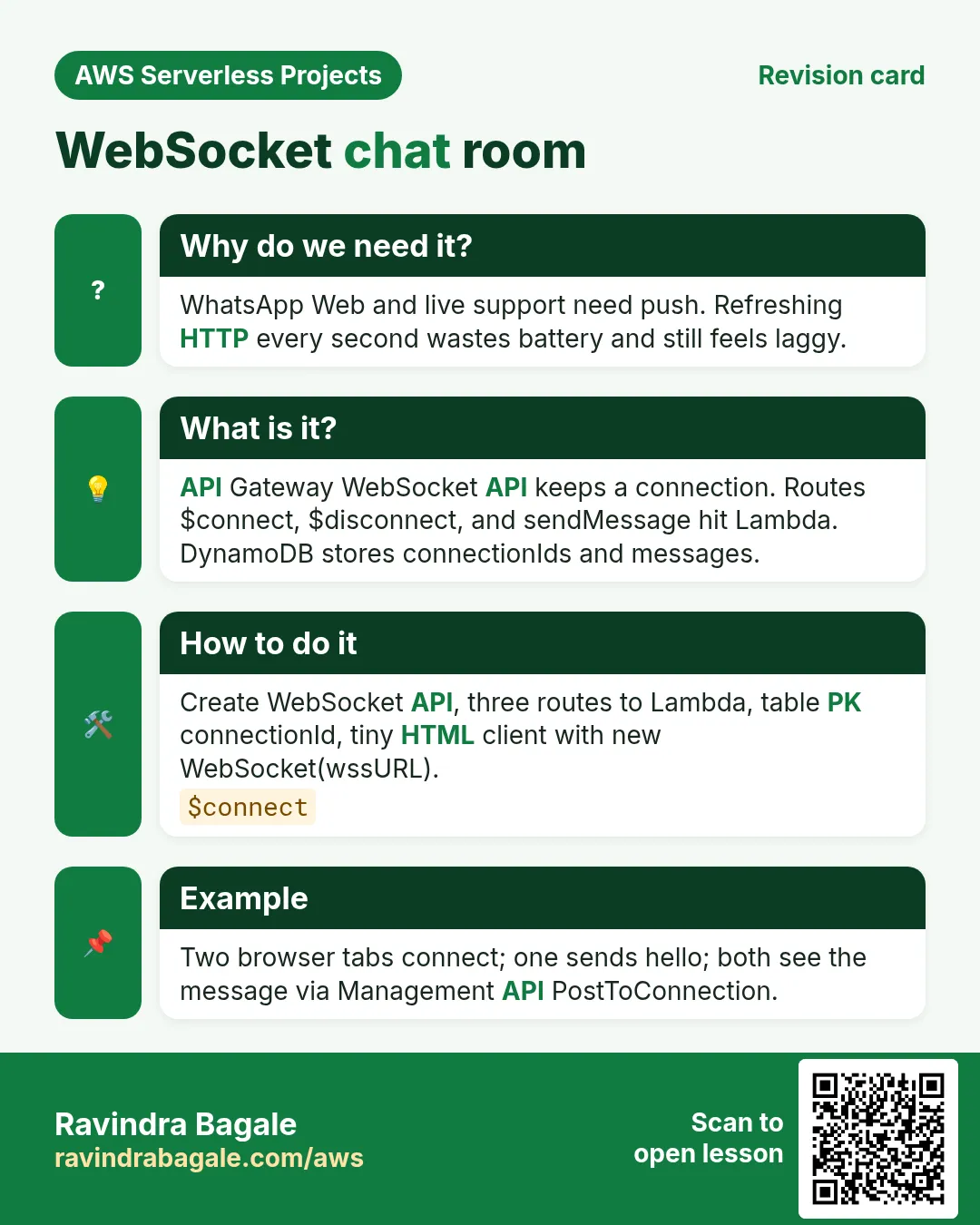
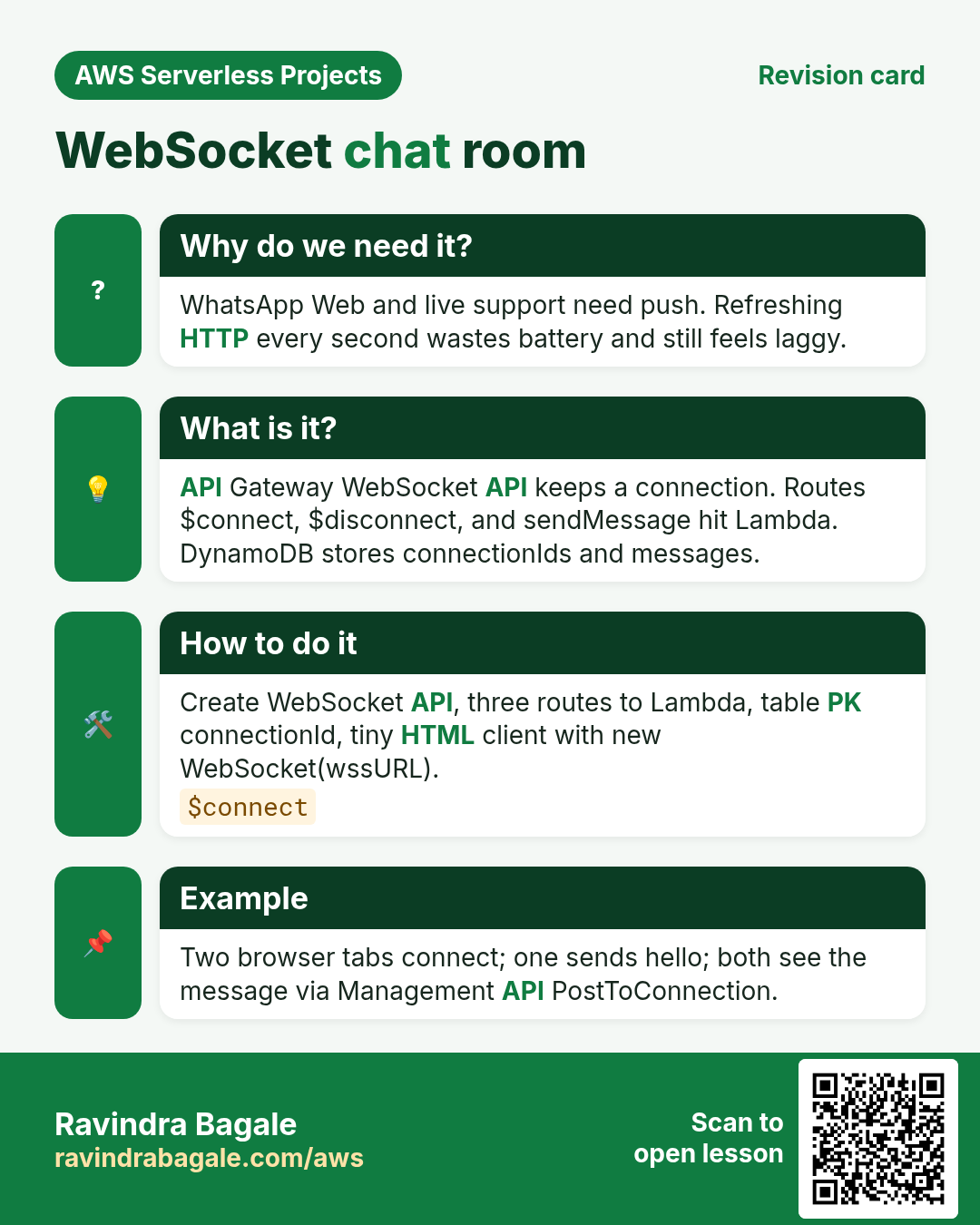
WhatsApp Web and live support chat need a push channel, not refresh. API Gateway WebSocket keeps a connection; Lambda handles connect, disconnect and message; DynamoDB stores connection IDs.
What you'll learn in this chapter
- Create WebSocket API routes
- Track connections in DynamoDB
- Broadcast with ManageConnections
- Test with the HTML client and cleanup
1. Everyday example
Why do we need this?
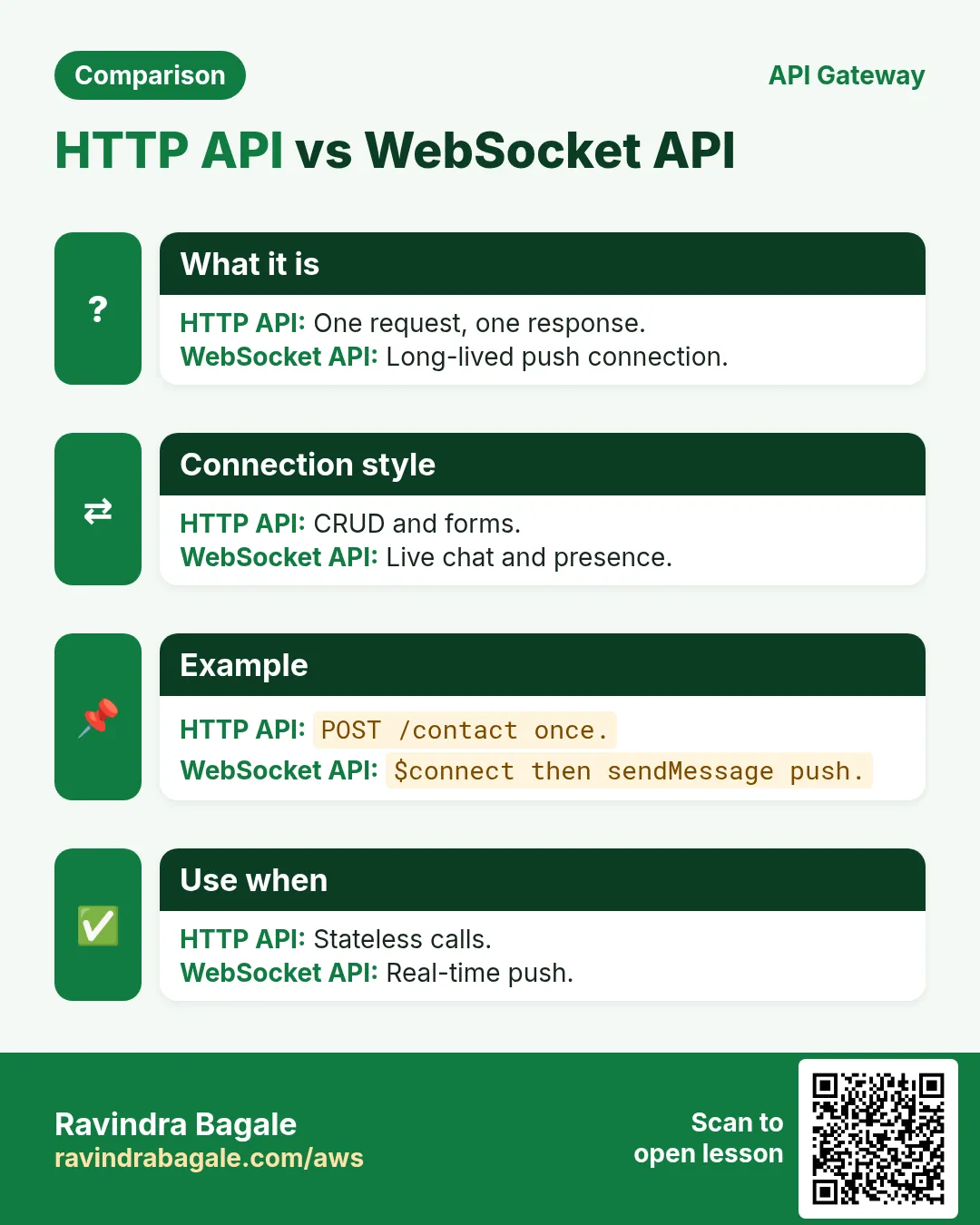
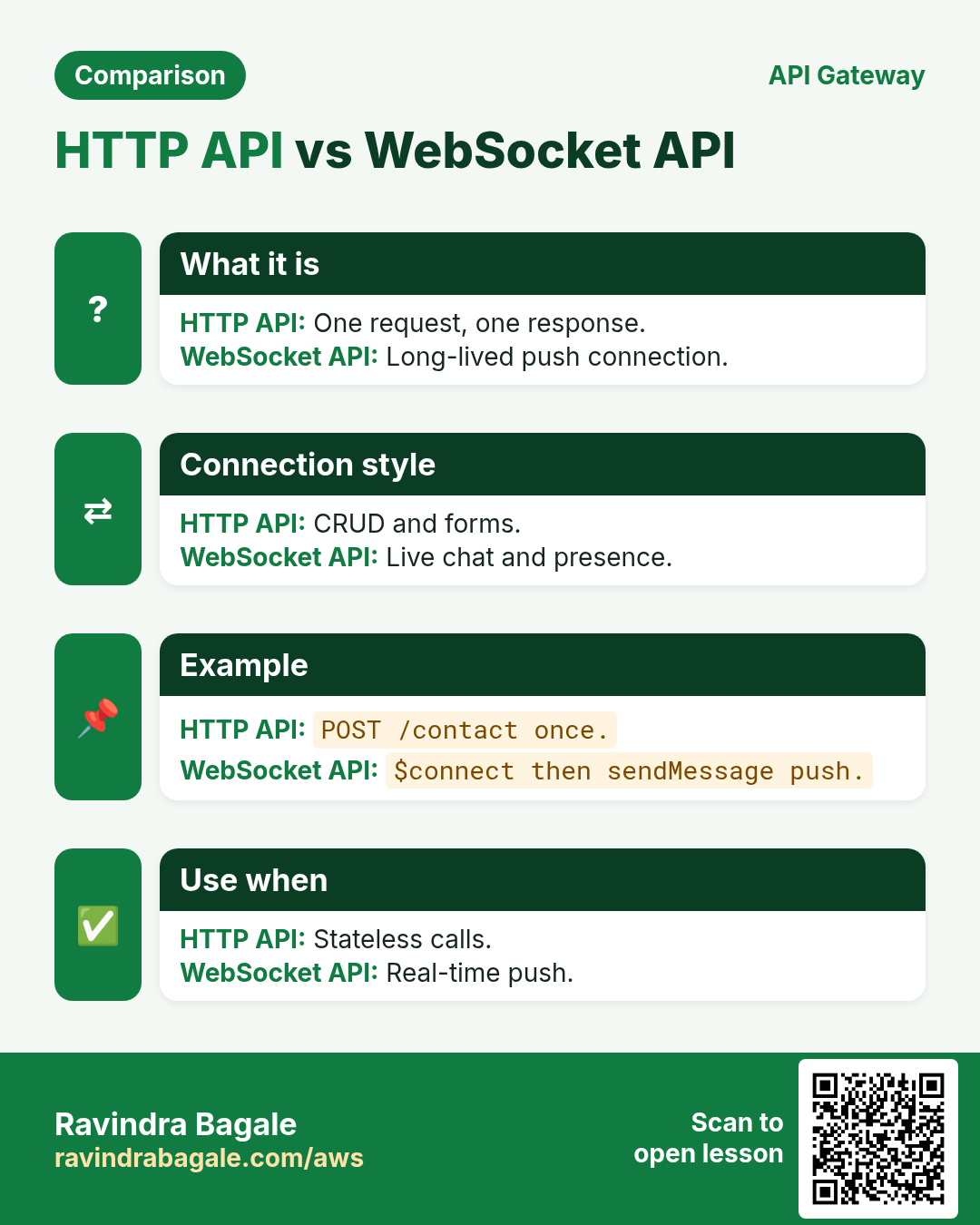
HTTP request/response cannot push a new chat line to everyone already on the page. WebSocket stays open both ways.
What is it?
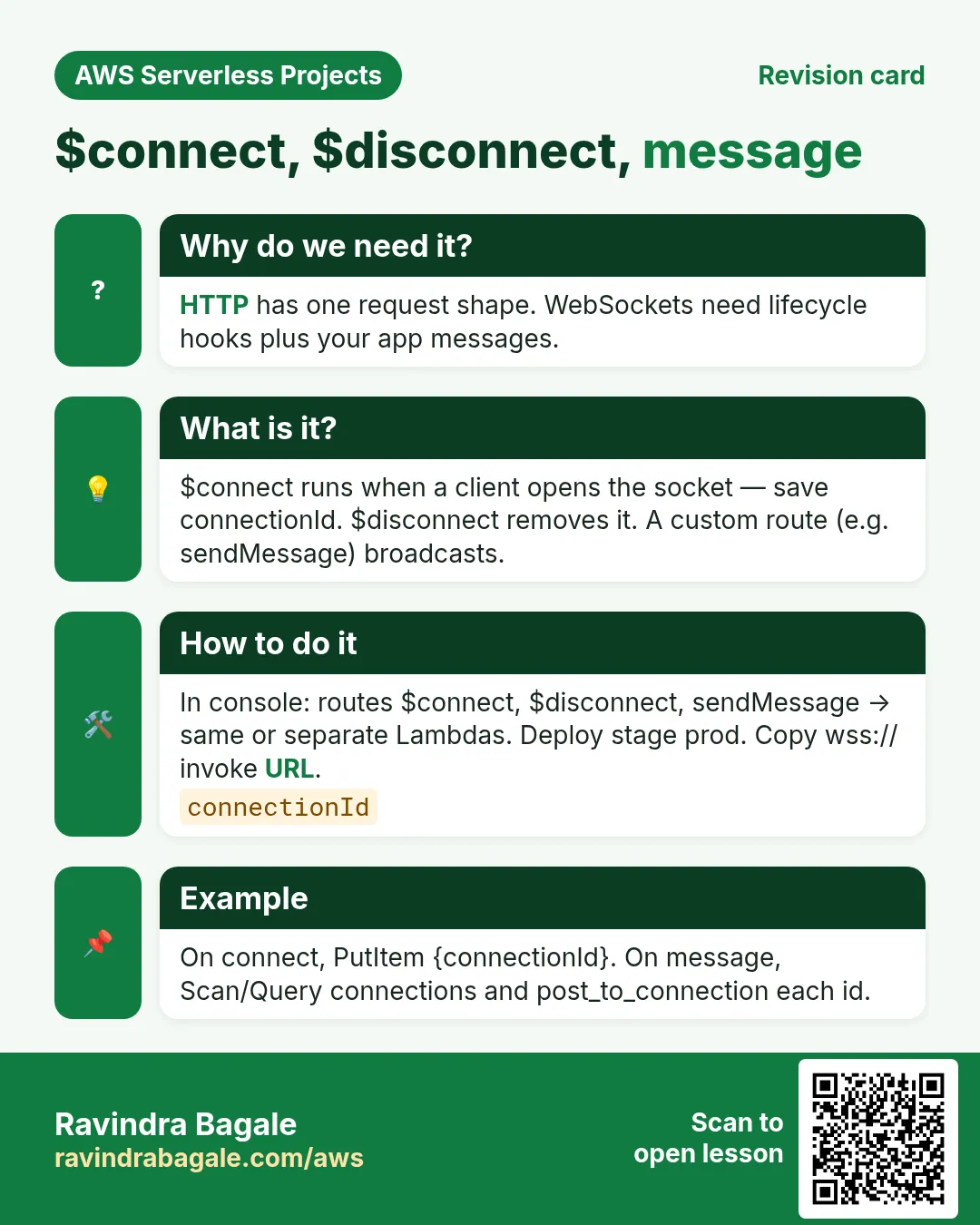
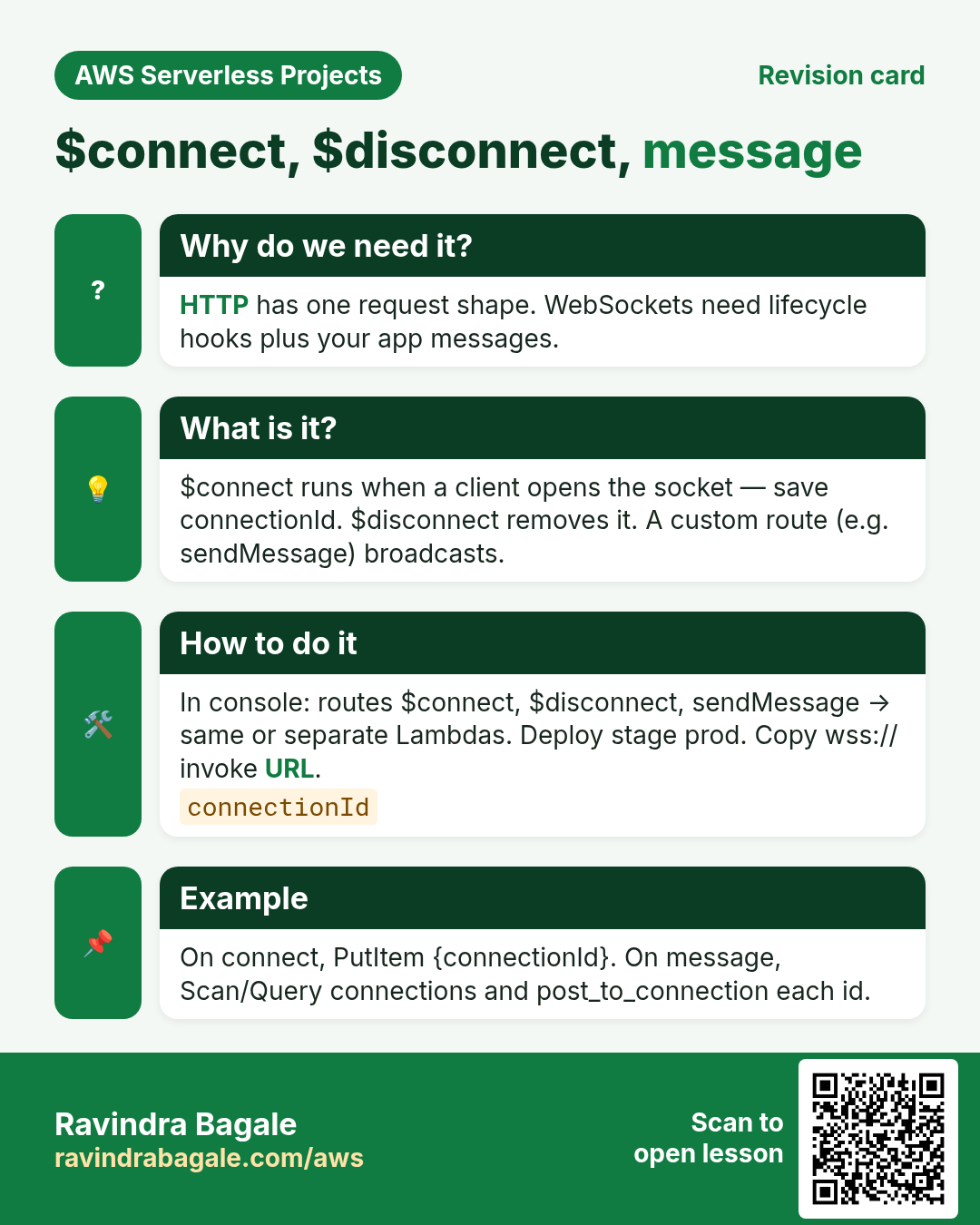
$connect → save connectionId. $disconnect → delete. Custom route sendmessage → save chat row + post_to_connection to all.
Download: websocket-chat.zip — connect/disconnect/message + public/index.html
2. Lab
How to do it (step by step)
A. Tables
- Table
yourname-chat-conn, PKconnectionId. - Table
yourname-chat-msg, PKmessageId.
B. Lambdas
- Three functions from the zip (or one router — lab uses three). Env CONNECTIONS_TABLE, MESSAGES_TABLE on message Lambda.
- IAM: DynamoDB access + execute-api:ManageConnections for the message role.
C. WebSocket API
- API Gateway → Create WebSocket API. Routes:
$connect,$disconnect,sendmessage(route selection expression$request.body.actionOR integrate sendmessage as default — lab: set route key sendmessage and client sends {"action":"sendmessage","text":"..."} ). Simpler lab path: use route selection$request.body.actionand body action sendmessage. - Deploy stage
prod. Copywss://URL. - Open public/index.html locally, paste wss URL, Connect, Send from two browser tabs.
// client send body example
{"action":"sendmessage","room":"lobby","text":"hello lab"}
Cleanup
- Delete WebSocket API (stages first), three Lambdas, both tables, roles.
- Closed connections leave stale IDs — deleting the table clears them.
3. Interview
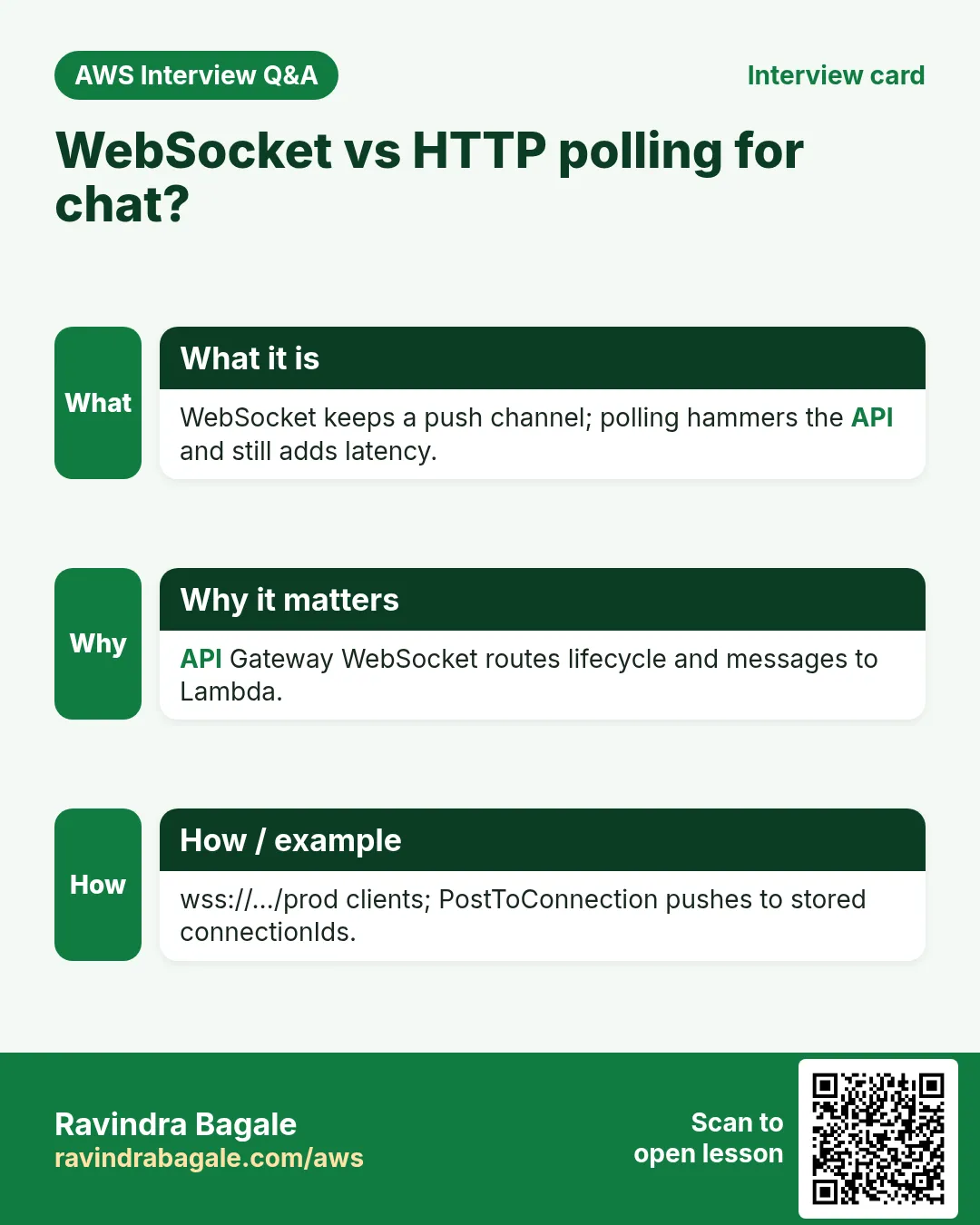
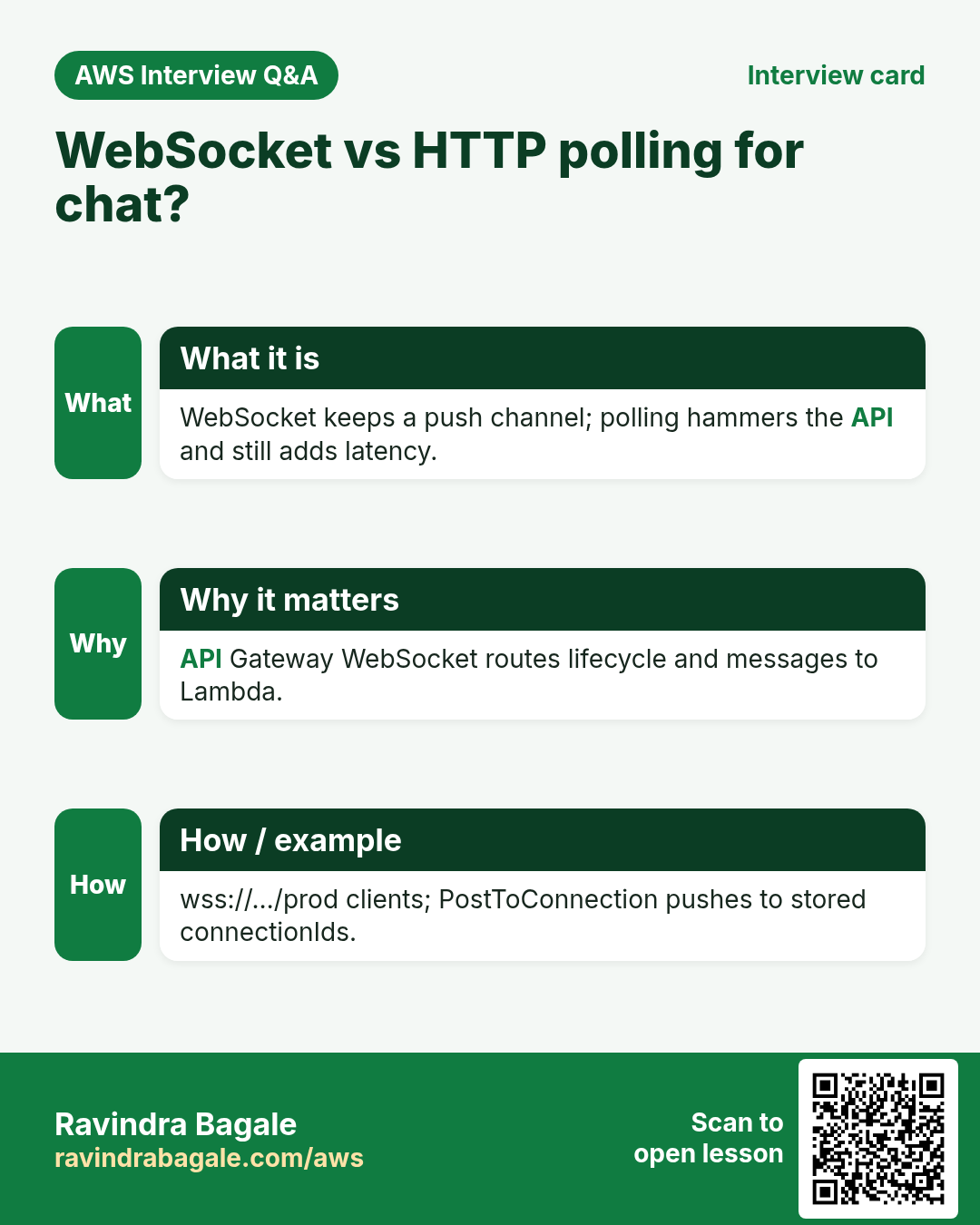
Q. WebSocket vs HTTP polling?
Push is cheaper and faster for chat.
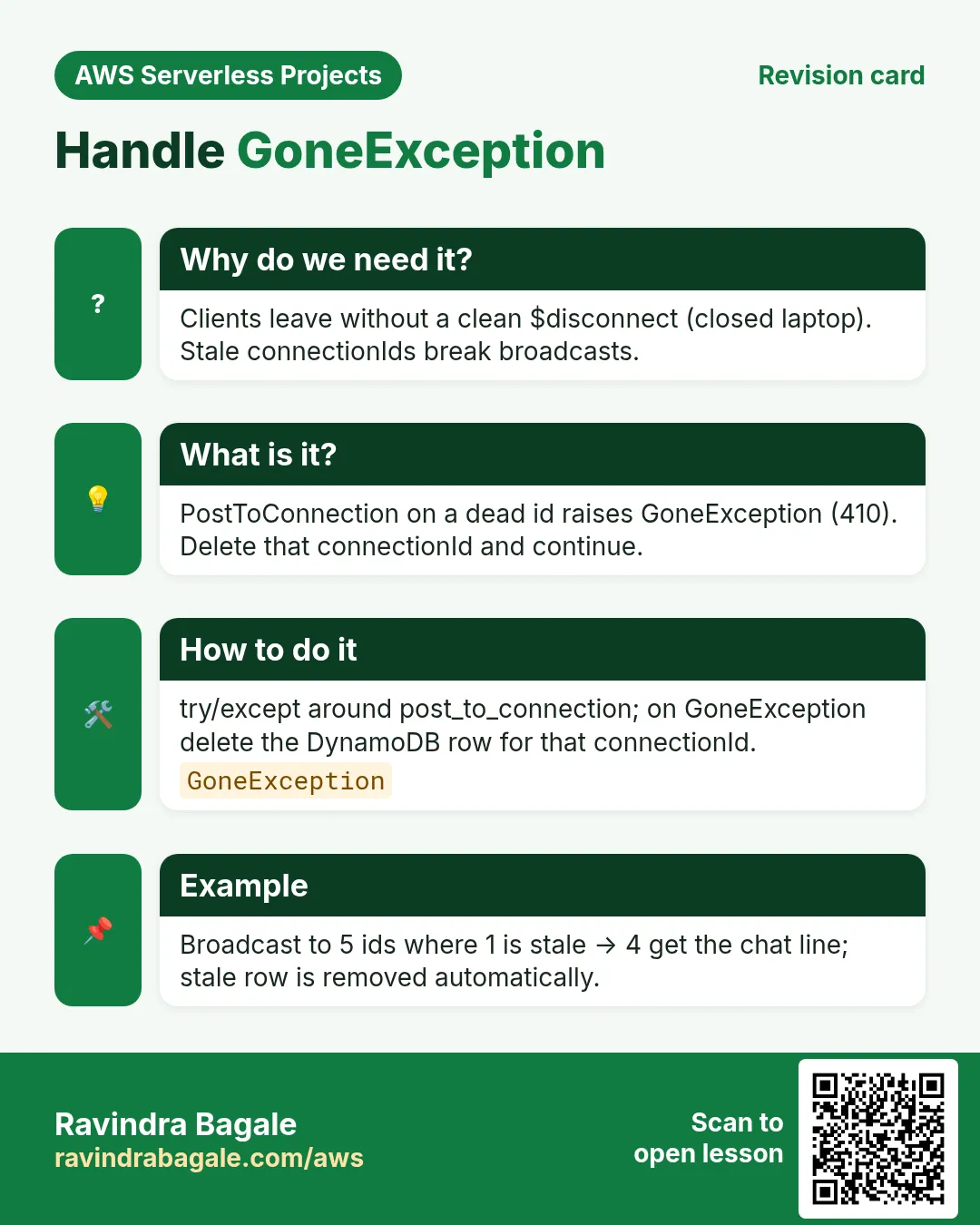
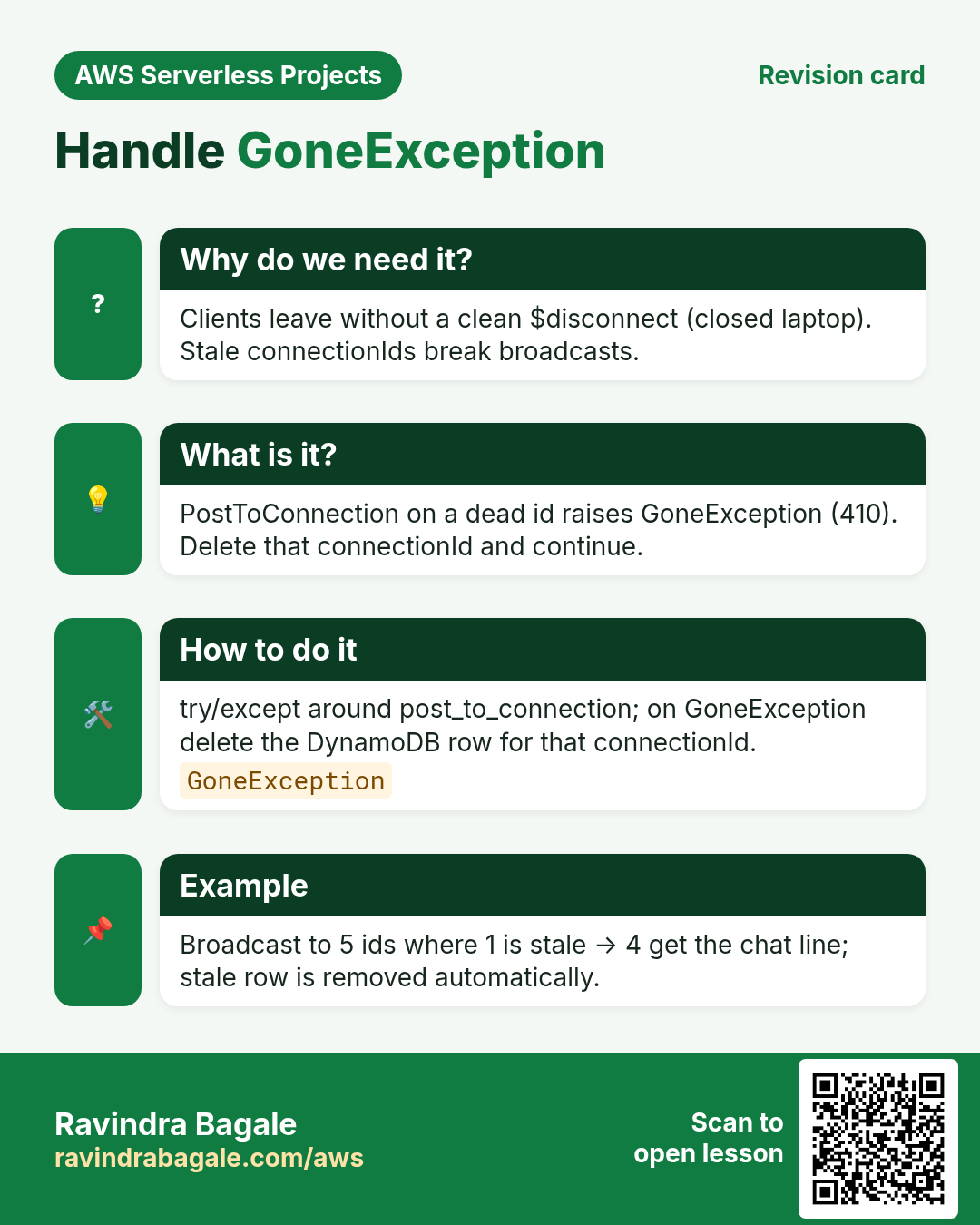
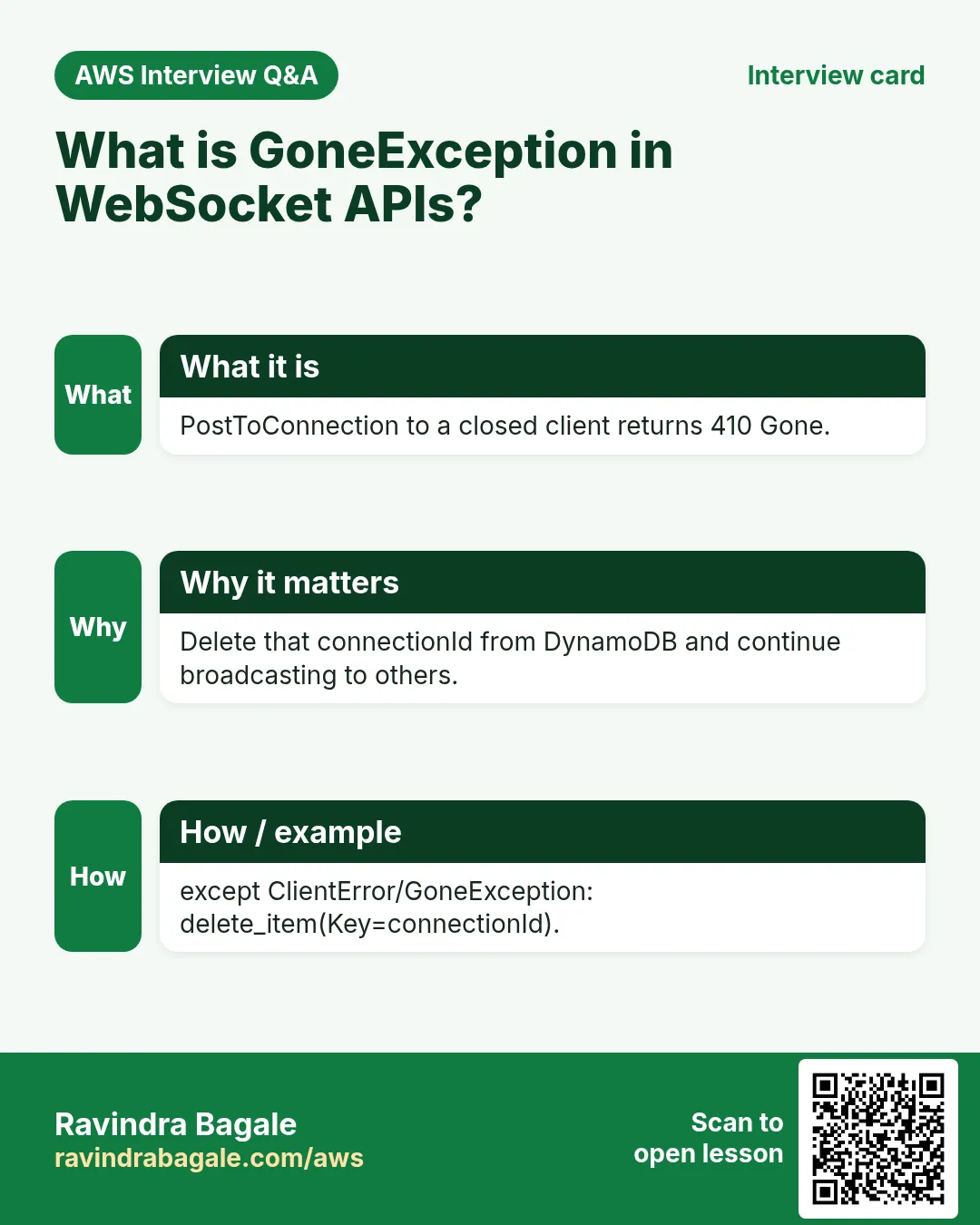
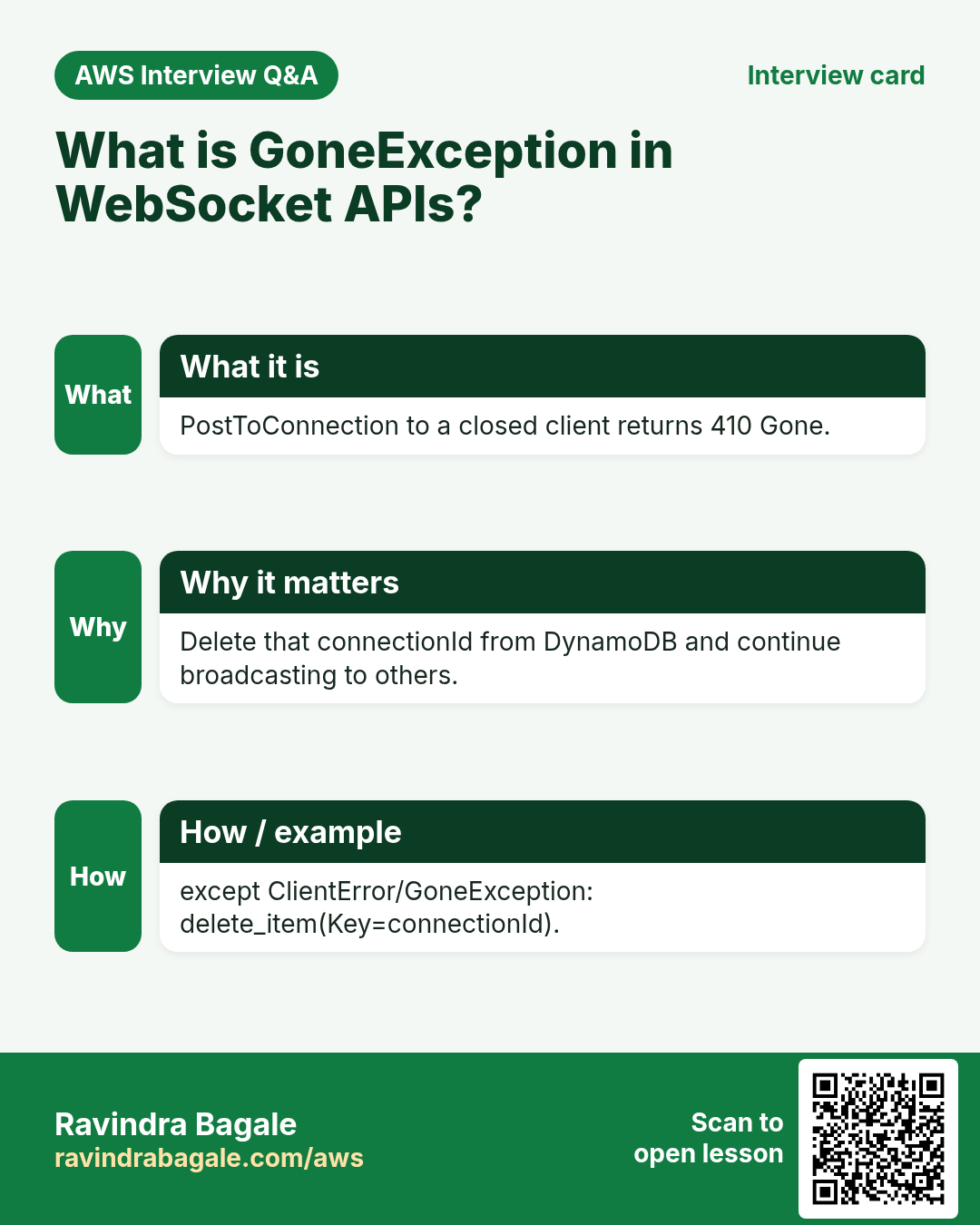
Q. GoneException?
Connection already closed — delete from table.
Q. Why store connectionId?
post_to_connection needs it.
Q. Auth?
Connect route authorizer / JWT query param — next step after lab.
Q. Cleanup?
API + Lambdas + tables.
Try at home
- Filter broadcast by roomId.
- Add a history GET via HTTP API.
In short
- WebSocket API + Lambda + DynamoDB connections.
- ManageConnections broadcasts.
- Handle GoneException.
- Clean up.
Practice Tasks
Vidarbha Cotton Mills is a textiles business in Nagpur. Ganesh Wankhede looks after its IT and cloud work. They count money in INR and run their AWS resources in the ap-south-1 Region. In the tasks below you do real jobs for them using what this lesson teaches. All names, account IDs, IP addresses and numbers are made up for practice.
0 / 12
Easy List functions
Why: See which functions exist in this Region.
What to do: List the Lambda functions in ap-south-1.
- Read the task and decide which AWS service it is about.
- Write aws, then the service name, then the operation (the action word).
- Add each needed flag (--name) followed by its value from the task.
- Flags can be in any order. Click Check answer.
Medium Invoke a function
Why: Invoke runs the function now and saves its answer in a file.
What to do: Invoke vidarbhacotton-orders-fn and save the response to out.json.
- Read the task and decide which AWS service it is about.
- Write aws, then the service name, then the operation (the action word).
- Add each needed flag (--name) followed by its value from the task.
- Flags can be in any order. Click Check answer.
Medium Trust policy for a Lambda role
Why: The trust policy says WHO may take the role.
What to do: Write a trust policy that lets lambda.amazonaws.com assume the role.
- Start with { "Version": "2012-10-17", "Statement": [ ... ] }.
- In each statement write Effect, Action and Resource.
- Give only what the task needs (least privilege).
- Use double quotes and commas correctly. Click Check answer.
Medium Change timeout and memory
Why: More memory also gives more CPU; timeout stops runaway runs.
What to do: Set vidarbhacotton-orders-fn to timeout 30 seconds and memory 512 MB.
- Read the task and decide which AWS service it is about.
- Write aws, then the service name, then the operation (the action word).
- Add each needed flag (--name) followed by its value from the task.
- Flags can be in any order. Click Check answer.
Medium Put an item
Why: DynamoDB JSON shows the type of each value: S for string, N for number.
What to do: Put an item into vidarbhacotton-orders with orderId "o-101" (string) and amount 2500 (number).
- Read the task and decide which AWS service it is about.
- Write aws, then the service name, then the operation (the action word).
- Add each needed flag (--name) followed by its value from the task.
- Flags can be in any order. Click Check answer.
Medium Let a function write logs
Why: Without these actions, Lambda logs never appear in CloudWatch.
What to do: Allow logs:CreateLogGroup, logs:CreateLogStream, logs:PutLogEvents on arn:aws:logs:*:*:* only.
- Start with { "Version": "2012-10-17", "Statement": [ ... ] }.
- In each statement write Effect, Action and Resource.
- Give only what the task needs (least privilege).
- Use double quotes and commas correctly. Click Check answer.
Hard Let S3 call your function
Why: A resource-based permission is needed before S3 can invoke the function.
What to do: Add permission statement s3invoke to vidarbhacotton-orders-fn so s3.amazonaws.com can call lambda:InvokeFunction from bucket arn:aws:s3:::vidarbhacotton-uploads.
- Read the task and decide which AWS service it is about.
- Write aws, then the service name, then the operation (the action word).
- Add each needed flag (--name) followed by its value from the task.
- Flags can be in any order. Click Check answer.
Hard Quick-create an HTTP API for Lambda
Why: Quick create builds an HTTP API, a default route and stage pointing at your function.
What to do: Create an HTTP API named vidarbhacotton-api whose target is arn:aws:lambda:ap-south-1:108737854657:function:vidarbhacotton-orders-fn.
- Read the task and decide which AWS service it is about.
- Write aws, then the service name, then the operation (the action word).
- Add each needed flag (--name) followed by its value from the task.
- Flags can be in any order. Click Check answer.
Hard Create a Lambda function
Why: Lambda needs the code zip, a runtime, a handler name and an execution role.
What to do: Create function vidarbhacotton-orders-fn: runtime python3.12, handler app.handler, role arn:aws:iam::108737854657:role/lambda-basic, code in function.zip.
- Read the task and decide which AWS service it is about.
- Write aws, then the service name, then the operation (the action word).
- Add each needed flag (--name) followed by its value from the task.
- Flags can be in any order. Click Check answer.
Hard Set environment variables
Why: Keep settings like table names out of the code.
What to do: Set the environment variable TABLE=vidarbhacotton-orders on vidarbhacotton-orders-fn.
- Read the task and decide which AWS service it is about.
- Write aws, then the service name, then the operation (the action word).
- Add each needed flag (--name) followed by its value from the task.
- Flags can be in any order. Click Check answer.
Hard Invoke with a JSON payload
Why: In CLI v2, raw JSON needs --cli-binary-format raw-in-base64-out.
What to do: Invoke vidarbhacotton-orders-fn with payload {"orderId":"o-101"} (raw JSON) and save the reply in out.json.
- Read the task and decide which AWS service it is about.
- Write aws, then the service name, then the operation (the action word).
- Add each needed flag (--name) followed by its value from the task.
- Flags can be in any order. Click Check answer.
Hard Lambda GB-seconds
Why: Lambda bills memory × time.
What to do: 1,000,000 invocations, 512 MB memory, 200 ms each. How many GB-seconds?
- Write down the numbers the task gives you.
- Work it out step by step on paper.
- Type only the final answer in the box.
- Click Check answer.
Revision, comparison and interview cards
Revise this lesson in a few minutes. Save the cards on your phone or download them as PNG files. The QR code on each card opens this lesson.
More cards: Ravi Sir's Cards.