AWS SDK Step Functions and EventBridge: Start Workflows and Publish Events (Python, PHP, Node.js)
Many apps are really workflows: take an order, charge the card, wait for a human, then ship. Step Functions runs those steps for you, and EventBridge carries events and schedules between services. From Python, PHP and Node.js we start and watch executions, finish a waiting task with a task token, publish custom events and create schedules. The example: a travel agency with Aiko in Osaka and Rohan in Jaipur.
What you'll learn in this chapter
- Start a state machine execution
- Watch execution status and output
- Resume with a task token
- Publish events with PutEvents
- Create schedules
1. The big picture: the tour checklist
Why do we need this?
A tour desk has a checklist: book hotel, book train, wait for the guide to say yes, send tickets. A manager ticks each box and retries if the hotel line is busy. Step Functions is that manager. EventBridge is the notice board where anyone can pin "booking confirmed" and the right teams react.
What is it?
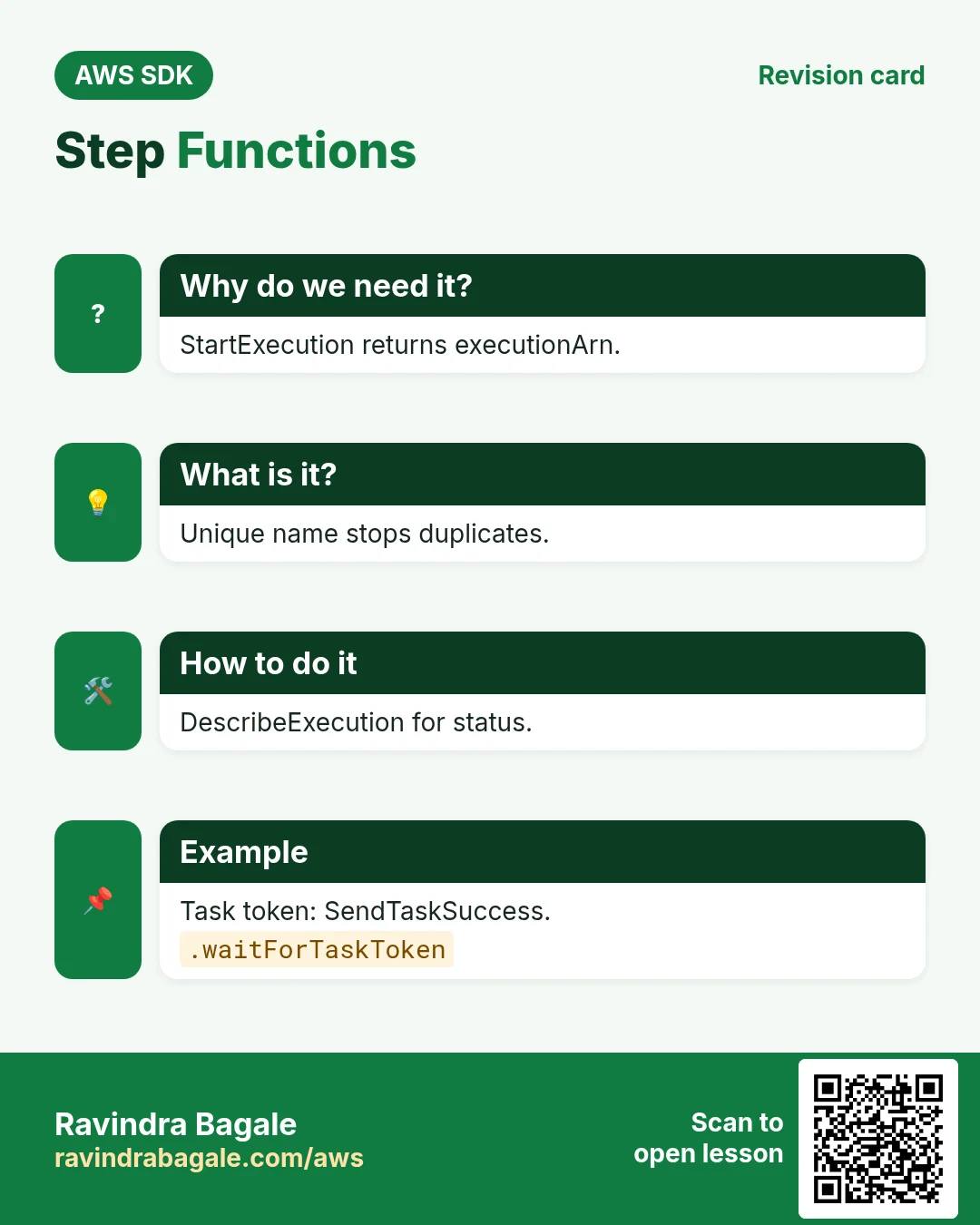
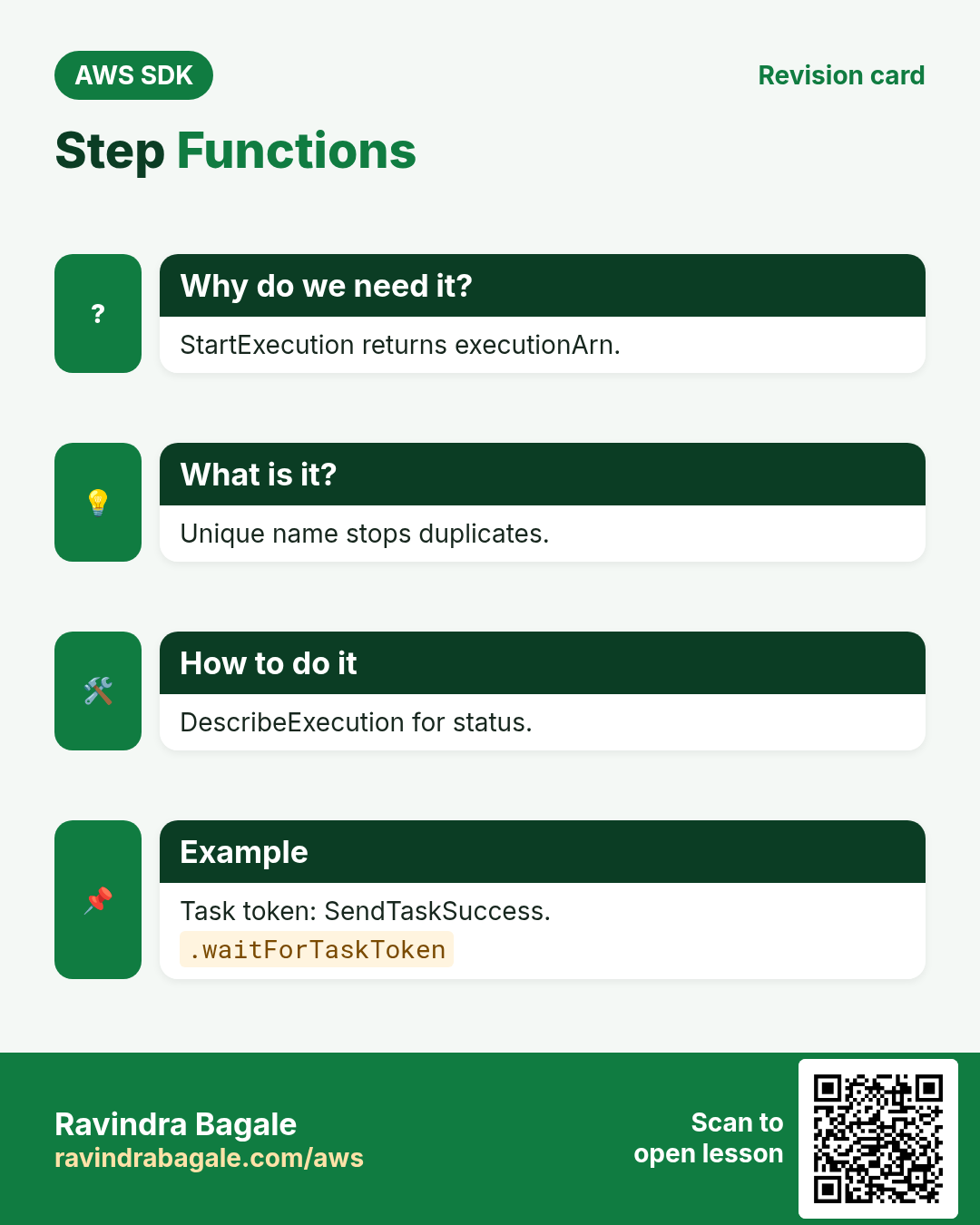
A state machine is written in Amazon States Language (JSON). StartExecution returns an executionArn; DescribeExecution gives status RUNNING, SUCCEEDED or FAILED. EventBridge PutEvents sends events to a bus; rules match patterns and call targets; EventBridge Scheduler runs targets on cron or rate.
How to do it (step by step)
2. Start an execution
Why do we need this?
Aiko books a Kyoto trip for ¥84,000 and wants the booking workflow to start the moment the customer pays.
What is it?
StartExecution takes stateMachineArn, an optional unique name (stops duplicates) and input as a JSON string.
How to do it (step by step)
- Python.
import boto3, json
sf = boto3.client("stepfunctions", region_name="ap-northeast-1")
r = sf.start_execution(
    stateMachineArn="arn:aws:states:ap-northeast-1:111122223333:stateMachine:TripBooking",
    name="trip-kyoto-5012",
    input=json.dumps({"tripId": "5012", "amount": 84000, "currency": "JPY"}))
print(r["executionArn"].split(":")[-1])
Expected output:
trip-kyoto-5012- Node.js.
import { SFNClient, StartExecutionCommand } from "@aws-sdk/client-sfn";
const sf = new SFNClient({ region: "ap-south-1" });
const r = await sf.send(new StartExecutionCommand({
  stateMachineArn: "arn:aws:states:ap-south-1:111122223333:stateMachine:TripBooking",
  name: "trip-jaipur-7731",
  input: JSON.stringify({ tripId: "7731", amount: 18500, currency: "INR" })
}));
console.log(r.executionArn.split(":").pop());
Expected output:
trip-jaipur-7731- PHP.
<?php
require "vendor/autoload.php";
$sf = new Aws\Sfn\SfnClient(["region" => "eu-west-2"]);
$r = $sf->startExecution([
  "stateMachineArn" => "arn:aws:states:eu-west-2:111122223333:stateMachine:TripBooking",
  "name" => "trip-york-310",
  "input" => json_encode(["tripId" => "310", "amount" => 640, "currency" => "GBP"])]);
echo basename(str_replace(":", "/", $r["executionArn"])), PHP_EOL;
Expected output:
trip-york-310- Verify with the CLI.
aws stepfunctions list-executions --state-machine-arn arn:aws:states:ap-northeast-1:111122223333:stateMachine:TripBooking --max-results 1 --query "executions[0].name" --output textExpected output:
trip-kyoto-50123. Watch status and output
Why do we need this?
Rohan shows customers "Booking in progress" until the workflow finishes.
What is it?
DescribeExecution returns status, and output (a JSON string) once SUCCEEDED. Poll with a delay, or better, react to the Step Functions status event in EventBridge.
How to do it (step by step)
- Python: poll until done.
import time
arn = r["executionArn"]
while (d := sf.describe_execution(executionArn=arn))["status"] == "RUNNING":
    time.sleep(2)
print(d["status"], json.loads(d["output"])["ticket"])
Expected output:
SUCCEEDED KYO-5012-A- Node.js.
import { DescribeExecutionCommand } from "@aws-sdk/client-sfn";
const d = await sf.send(new DescribeExecutionCommand({ executionArn: r.executionArn }));
console.log(d.status);
Expected output:
RUNNING- PHP: show the failed reason.
$d = $sf->describeExecution(["executionArn" => $r["executionArn"]]);
echo $d["status"], " ", $d["error"] ?? "-", PHP_EOL;
Expected output:
FAILED HotelSoldOut- Verify with the CLI.
aws stepfunctions describe-execution --execution-arn arn:aws:states:ap-northeast-1:111122223333:execution:TripBooking:trip-kyoto-5012 --query status --output textExpected output:
SUCCEEDED4. Resume with a task token
Why do we need this?
The tour guide in Jaipur must accept the group before tickets go out. The workflow pauses and waits for his tap.
What is it?
A task with ".waitForTaskToken" passes $$.Task.Token to (for example) SQS. Your app later calls SendTaskSuccess with that token and an output, or SendTaskFailure.
How to do it (step by step)
- Python: guide accepts.
sf.send_task_success(taskToken=token, output=json.dumps({"guide": "Rohan", "accepted": True}))
print("resumed")
Expected output:
resumed- Node.js: guide declines.
import { SendTaskFailureCommand } from "@aws-sdk/client-sfn";
await sf.send(new SendTaskFailureCommand({ taskToken: token, error: "GuideBusy", cause: "Festival week" }));
console.log("failed GuideBusy");
Expected output:
failed GuideBusy- PHP: keep a long wait alive.
$sf->sendTaskHeartbeat(["taskToken" => $token]);
echo "heartbeat sent", PHP_EOL;
Expected output:
heartbeat sent- Verify with the CLI.
aws stepfunctions get-execution-history --execution-arn arn:aws:states:ap-south-1:111122223333:execution:TripBooking:trip-jaipur-7731 --reverse-order --max-results 1 --query "events[0].type" --output textExpected output:
ExecutionSucceeded5. Events and schedules
Why do we need this?
When a booking is confirmed, the invoice team in Lyon (€1,250) and the SMS team both need to know, and reminders must go out every morning at 9.
What is it?
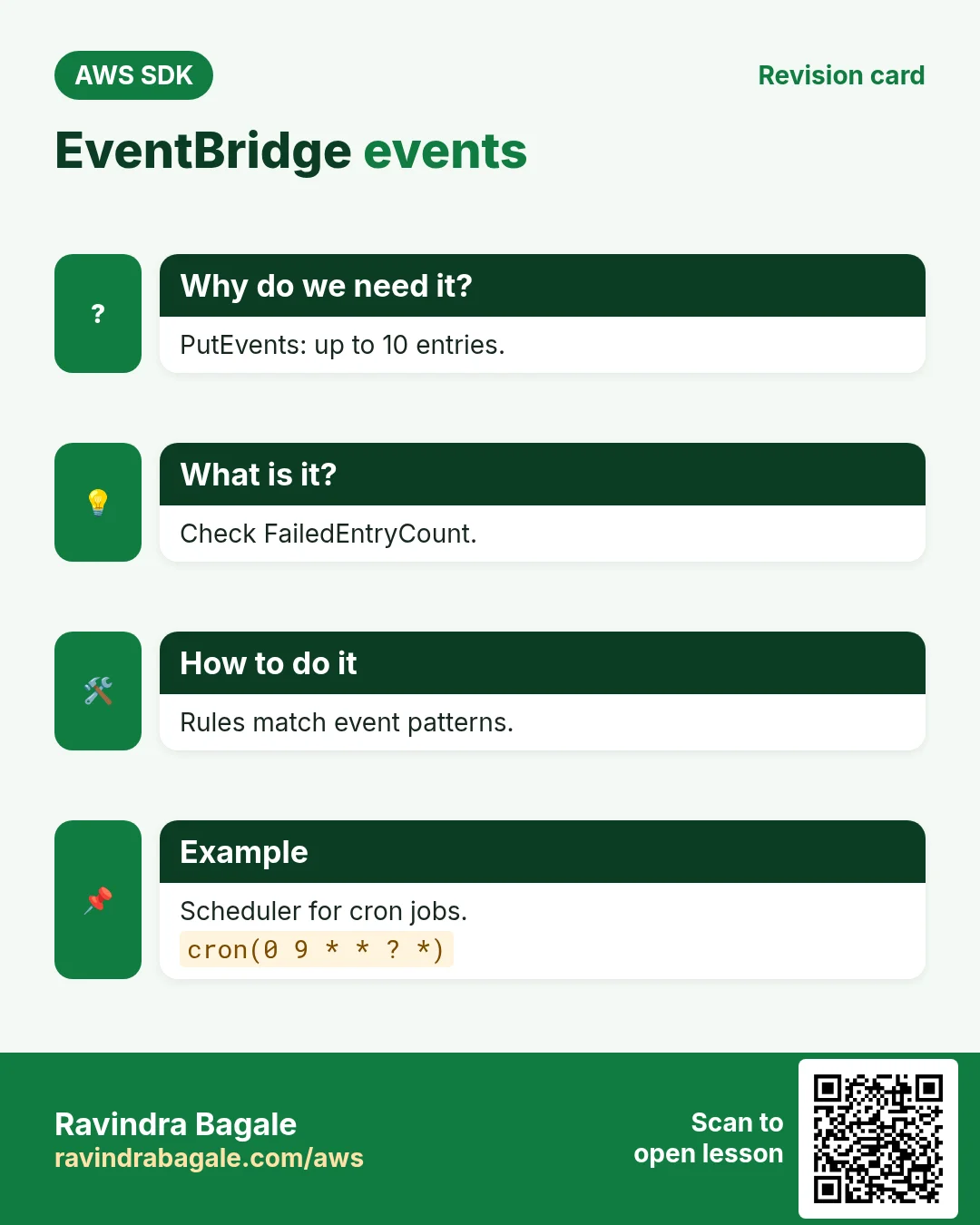
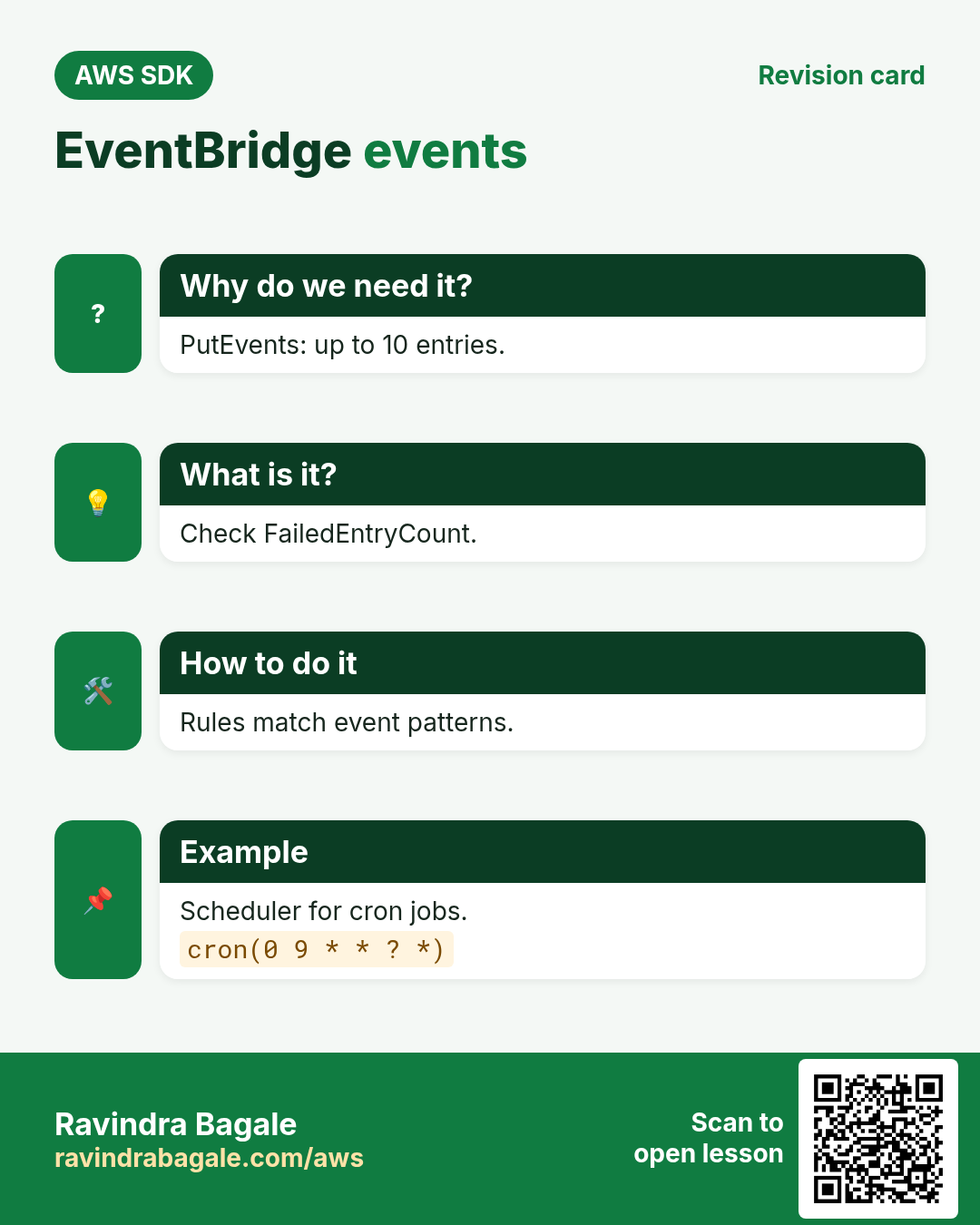
PutEvents sends up to 10 entries (Source, DetailType, Detail JSON). A rule with an event pattern routes them to targets. EventBridge Scheduler CreateSchedule runs a target on cron/rate in a time zone.
How to do it (step by step)
- Python: publish an event.
eb = boto3.client("events", region_name="eu-west-3")
r = eb.put_events(Entries=[{"Source": "travel.bookings", "DetailType": "BookingConfirmed",
    "Detail": json.dumps({"tripId": "88", "amount": 1250, "currency": "EUR"}), "EventBusName": "default"}])
print("failed:", r["FailedEntryCount"])
Expected output:
failed: 0- Node.js: rule and target.
import { EventBridgeClient, PutRuleCommand, PutTargetsCommand } from "@aws-sdk/client-eventbridge";
const eb = new EventBridgeClient({ region: "eu-west-3" });
await eb.send(new PutRuleCommand({ Name: "booking-confirmed",
  EventPattern: JSON.stringify({ source: ["travel.bookings"], "detail-type": ["BookingConfirmed"] }) }));
const t = await eb.send(new PutTargetsCommand({ Rule: "booking-confirmed",
  Targets: [{ Id: "sms", Arn: "arn:aws:sqs:eu-west-3:111122223333:sms-queue" }] }));
console.log("target failures:", t.FailedEntryCount);
Expected output:
target failures: 0- PHP: daily schedule.
$sc = new Aws\Scheduler\SchedulerClient(["region" => "ap-south-1"]);
$sc->createSchedule(["Name" => "trip-reminders", "ScheduleExpression" => "cron(0 9 * * ? *)",
  "ScheduleExpressionTimezone" => "Asia/Kolkata", "FlexibleTimeWindow" => ["Mode" => "OFF"],
  "Target" => ["Arn" => "arn:aws:sqs:ap-south-1:111122223333:reminders",
               "RoleArn" => "arn:aws:iam::111122223333:role/scheduler-sqs"]]);
echo "schedule created", PHP_EOL;
Expected output:
schedule created- Verify with the CLI.
aws scheduler get-schedule --name trip-reminders --region ap-south-1 --query ScheduleExpression --output textExpected output:
cron(0 9 * * ? *)6. Same action in Python, Node.js, Java, Go, .NET and PHP
Why do we need this?
Scripts start in the CLI. Apps call the same API through an SDK. Knowing both helps you move a tested command into real code.
What is it?
Each CLI command maps to one API call. For example aws stepfunctions start-execution ... maps to the StartExecution API.
How to do it (step by step)
Same action (PutEvents) from code. Every SDK reads the same profile, region and credentials as the CLI.
| Stack | Code |
|---|---|
| AWS CLI | aws stepfunctions start-execution --state-machine-arn arn:aws:states:...:stateMachine:TripBooking --input '{"tripId":"5012"}' |
| Java v2 | sfn.startExecution(b -> b.stateMachineArn(arn).input("{\"tripId\":\"5012\"}")); |
| Go v2 | client.StartExecution(ctx, &sfn.StartExecutionInput{StateMachineArn: aws.String(arn), Input: aws.String(in)}) |
| .NET | await sfn.StartExecutionAsync(new StartExecutionRequest { StateMachineArn = arn, Input = json }); |
7. Clean up so nothing keeps costing
Why do we need this?
Lab resources left running cost money and can be a security risk.
What is it?
Delete in reverse order: children first, then parents.
How to do it (step by step)
- Delete the schedule, rule targets and rule.
aws scheduler delete-schedule --name trip-reminders --region ap-south-1
aws events remove-targets --rule booking-confirmed --ids sms --region eu-west-3
aws events delete-rule --name booking-confirmed --region eu-west-3
Expected output:
(no output means success)- Delete the test state machine.
aws stepfunctions delete-state-machine --state-machine-arn arn:aws:states:ap-northeast-1:111122223333:stateMachine:TripBookingExpected output:
(no output means success)Ravindra Bagale's Tip
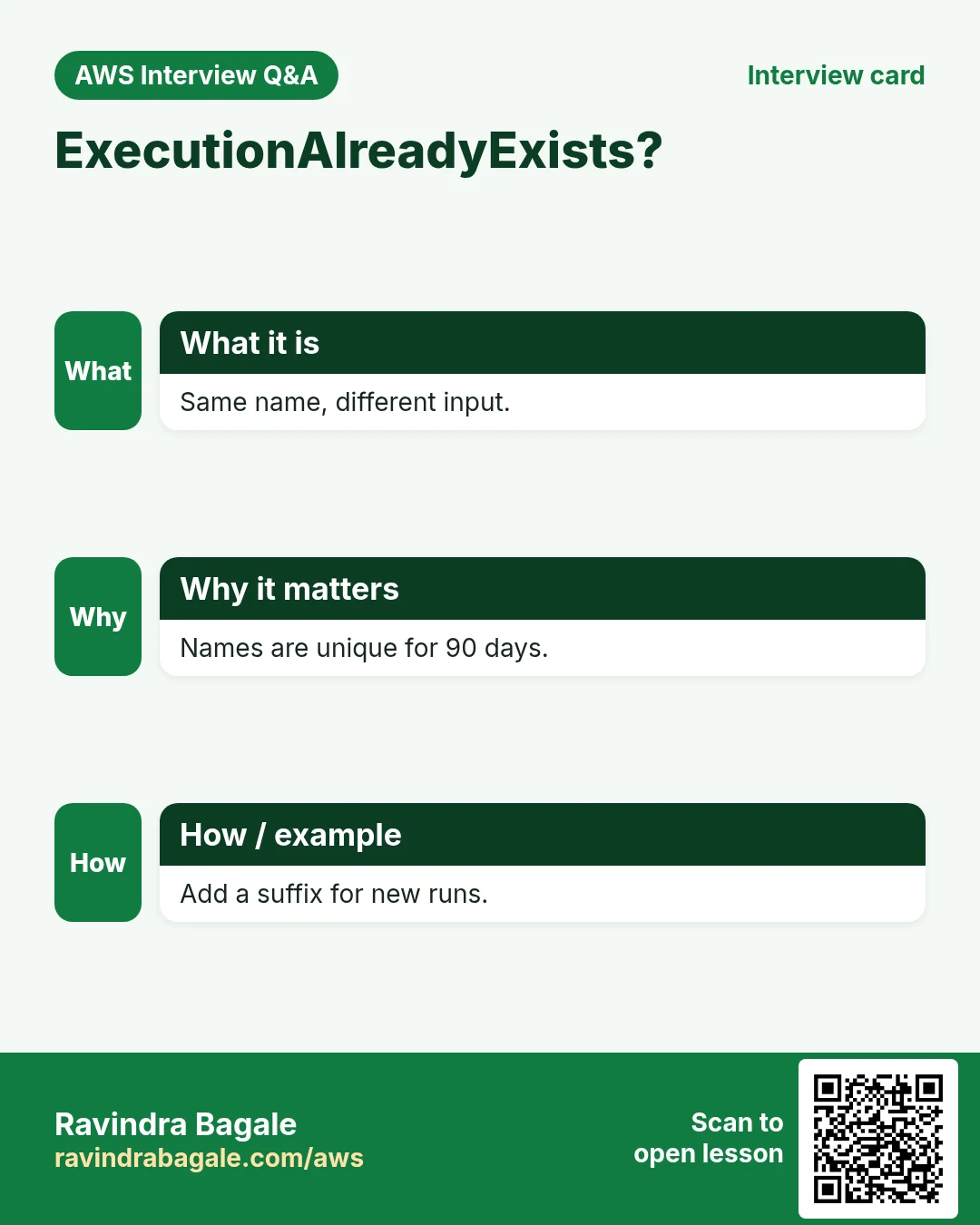
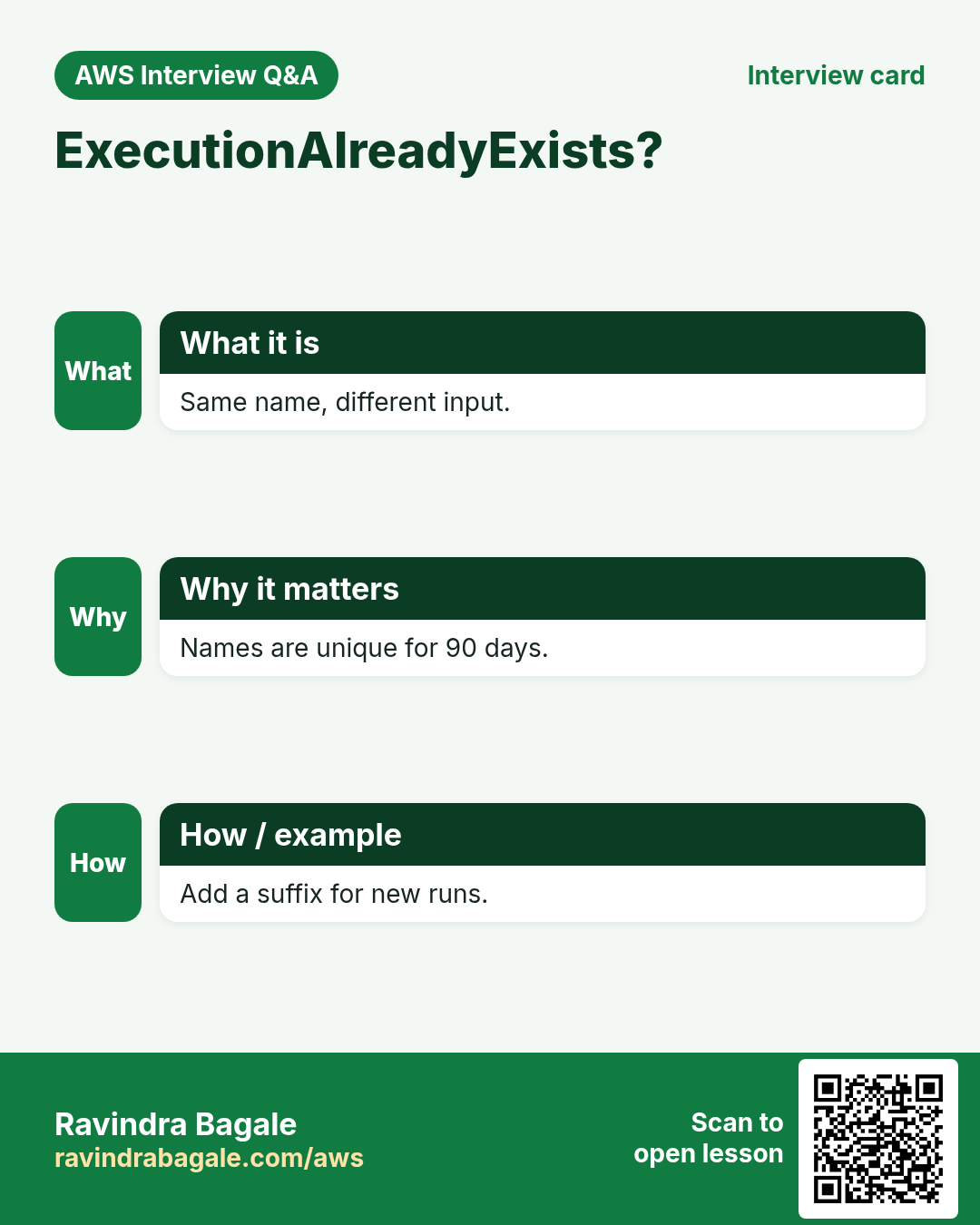
Give every execution a business name like trip-5012. A second StartExecution with the same name and input is ignored, so retries never double-book.
8. Interview questions and answers
Q. What does StartExecution return?
executionArn and startDate.
Q. How do you resume a paused task?
SendTaskSuccess or SendTaskFailure with the task token.
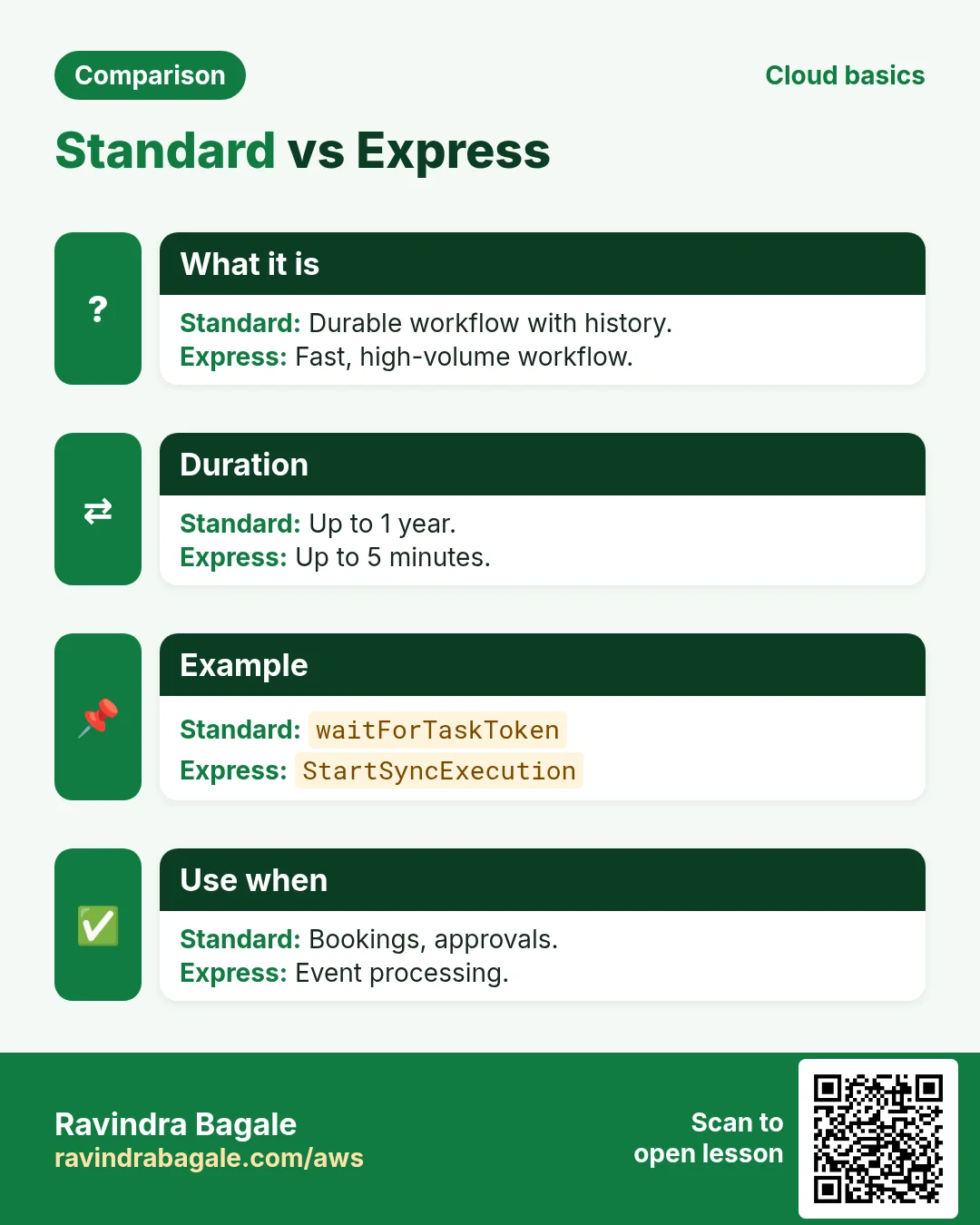
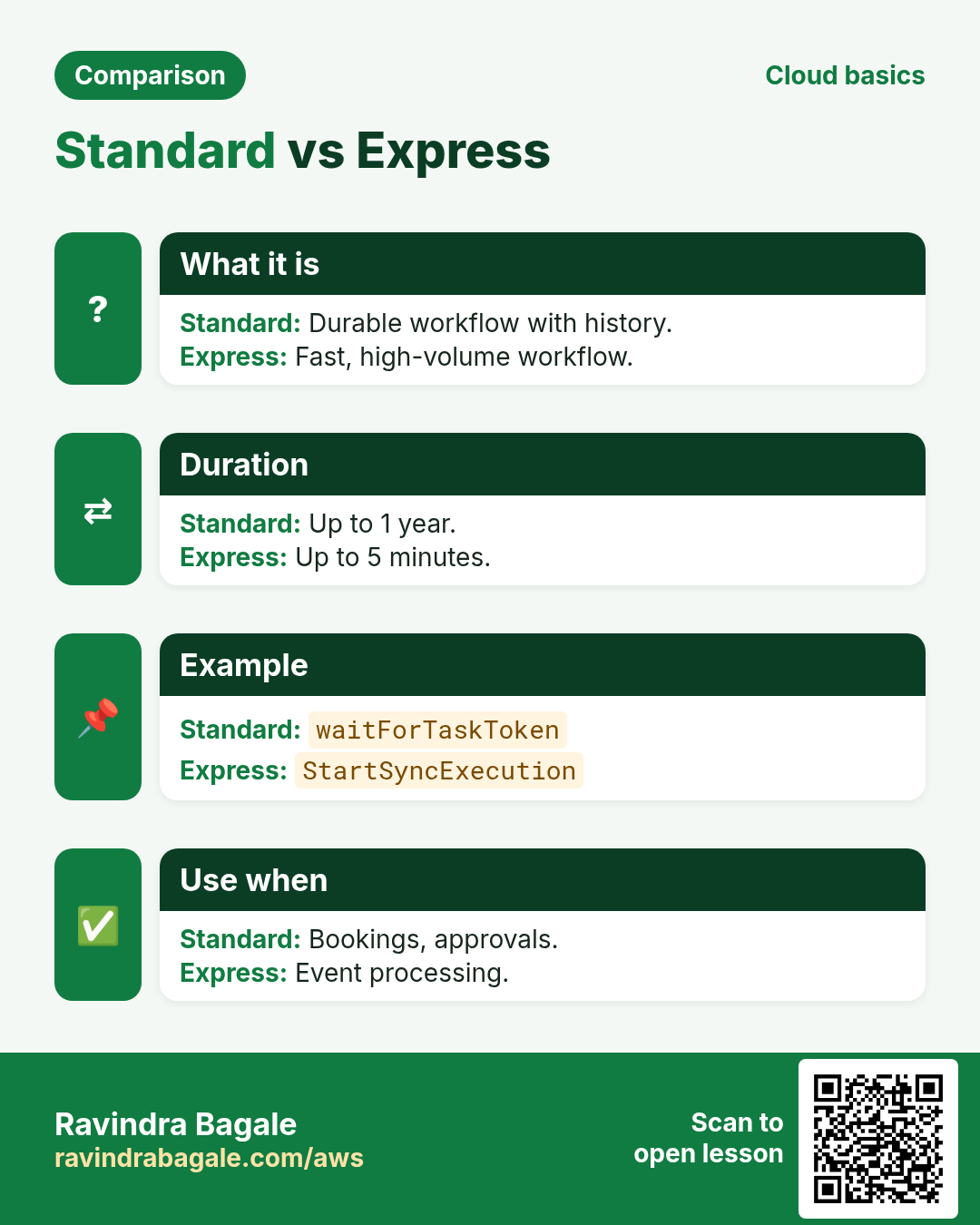
Q. Standard vs Express?
Standard: long, exactly-once, history. Express: short, high volume, cheaper.
Q. Max entries per PutEvents?
10.
Q. Rules vs Scheduler?
Rules react to events; Scheduler runs on time.
Try at home
- Write a Python script that starts 3 executions for Paris, Pune and Perth trips and prints each final status.
- In Node.js, publish a BookingCancelled event and add a rule that sends it to an SQS queue.
In short
- StartExecution with a unique name.
- DescribeExecution for status.
- Task token pauses for humans.
- PutEvents + rules route events.
- Scheduler runs on cron.
Practice Tasks
Zurich Insurance Partners is a insurance business in Zurich. Anna Müller looks after its IT and cloud work. They count money in CHF and run their AWS resources in the eu-central-2 Region. In the tasks below you do real jobs for them using what this lesson teaches. All names, account IDs, IP addresses and numbers are made up for practice.
0 / 12
Easy List functions
Why: See which functions exist in this Region.
What to do: List the Lambda functions in eu-central-2.
- Read the task and decide which AWS service it is about.
- Write aws, then the service name, then the operation (the action word).
- Add each needed flag (--name) followed by its value from the task.
- Flags can be in any order. Click Check answer.
Easy Invoke one function
Why: A caller should invoke only the function it needs.
What to do: Allow lambda:InvokeFunction on arn:aws:lambda:eu-central-2:131130276334:function:zurichinsure-orders-fn only.
- Start with { "Version": "2012-10-17", "Statement": [ ... ] }.
- In each statement write Effect, Action and Resource.
- Give only what the task needs (least privilege).
- Use double quotes and commas correctly. Click Check answer.
Medium Create a scheduled rule
Why: A schedule rule runs a job every day without any server.
What to do: Create rule zurichinsure-nightly that runs every day at 02:00 UTC: cron(0 2 * * ? *).
- Read the task and decide which AWS service it is about.
- Write aws, then the service name, then the operation (the action word).
- Add each needed flag (--name) followed by its value from the task.
- Flags can be in any order. Click Check answer.
Medium Change timeout and memory
Why: More memory also gives more CPU; timeout stops runaway runs.
What to do: Set zurichinsure-orders-fn to timeout 30 seconds and memory 512 MB.
- Read the task and decide which AWS service it is about.
- Write aws, then the service name, then the operation (the action word).
- Add each needed flag (--name) followed by its value from the task.
- Flags can be in any order. Click Check answer.
Medium Invoke a function
Why: Invoke runs the function now and saves its answer in a file.
What to do: Invoke zurichinsure-orders-fn and save the response to out.json.
- Read the task and decide which AWS service it is about.
- Write aws, then the service name, then the operation (the action word).
- Add each needed flag (--name) followed by its value from the task.
- Flags can be in any order. Click Check answer.
Hard Point the rule at a Lambda
Why: A rule does nothing without a target.
What to do: Add target Id=1 with Arn arn:aws:lambda:eu-central-2:131130276334:function:zurichinsure-cleanup to rule zurichinsure-nightly.
- Read the task and decide which AWS service it is about.
- Write aws, then the service name, then the operation (the action word).
- Add each needed flag (--name) followed by its value from the task.
- Flags can be in any order. Click Check answer.
Hard Publish a custom event
Why: Apps publish events to a bus; rules decide who reacts.
What to do: Put the events listed in events.json onto EventBridge.
- Read the task and decide which AWS service it is about.
- Write aws, then the service name, then the operation (the action word).
- Add each needed flag (--name) followed by its value from the task.
- Flags can be in any order. Click Check answer.
Hard Step Functions: two tasks
Why: A state machine runs steps in order with retries.
What to do: Write ASL JSON: StartAt Validate; Validate is a Task that goes Next to Charge; Charge is a Task with End true.
- Start from the top-level keys the task names.
- Indent child keys with 2 spaces (no tabs).
- Fill in each property with the value from the task.
- Click Check answer. Key order does not matter.
Hard Lambda GB-seconds
Why: Lambda bills memory × time.
What to do: 1,000,000 invocations, 512 MB memory, 200 ms each. How many GB-seconds?
- Write down the numbers the task gives you.
- Work it out step by step on paper.
- Type only the final answer in the box.
- Click Check answer.
Hard Create a Lambda function
Why: Lambda needs the code zip, a runtime, a handler name and an execution role.
What to do: Create function zurichinsure-orders-fn: runtime python3.12, handler app.handler, role arn:aws:iam::131130276334:role/lambda-basic, code in function.zip.
- Read the task and decide which AWS service it is about.
- Write aws, then the service name, then the operation (the action word).
- Add each needed flag (--name) followed by its value from the task.
- Flags can be in any order. Click Check answer.
Hard Set environment variables
Why: Keep settings like table names out of the code.
What to do: Set the environment variable TABLE=zurichinsure-orders on zurichinsure-orders-fn.
- Read the task and decide which AWS service it is about.
- Write aws, then the service name, then the operation (the action word).
- Add each needed flag (--name) followed by its value from the task.
- Flags can be in any order. Click Check answer.
Hard Invoke with a JSON payload
Why: In CLI v2, raw JSON needs --cli-binary-format raw-in-base64-out.
What to do: Invoke zurichinsure-orders-fn with payload {"orderId":"o-101"} (raw JSON) and save the reply in out.json.
- Read the task and decide which AWS service it is about.
- Write aws, then the service name, then the operation (the action word).
- Add each needed flag (--name) followed by its value from the task.
- Flags can be in any order. Click Check answer.
Revision, comparison and interview cards
Revise this lesson in a few minutes. Save the cards on your phone or download them as PNG files. The QR code on each card opens this lesson.
More cards: Ravi Sir's Cards.