Build and Test an AWS SDK App with Mocks (moto, aws-sdk-client-mock, MockHandler) and Best Practices
Now we put it all together. We build a small receipts app that saves a file to S3, a row to DynamoDB and a job to SQS, in Python, PHP and Node.js. Then we test it without touching AWS: moto for Python, aws-sdk-client-mock for Node.js and MockHandler for PHP. We end with the best practices that keep SDK code safe, fast and cheap. The example: an expense app used by Olivia in Sydney and Siddharth in Nagpur.
What you'll learn in this chapter
- Build an S3 + DynamoDB + SQS flow
- Inject clients for testing
- Mock AWS in Python, Node.js, PHP
- Run against LocalStack
- Apply best practices
1. The big picture: the practice kitchen
Why do we need this?
A chef practises a new dish in a test kitchen with fake ingredients before cooking for paying guests. Mocks are that test kitchen: your code "calls AWS", but a fake answers instantly, costs nothing and never breaks real data.
What is it?
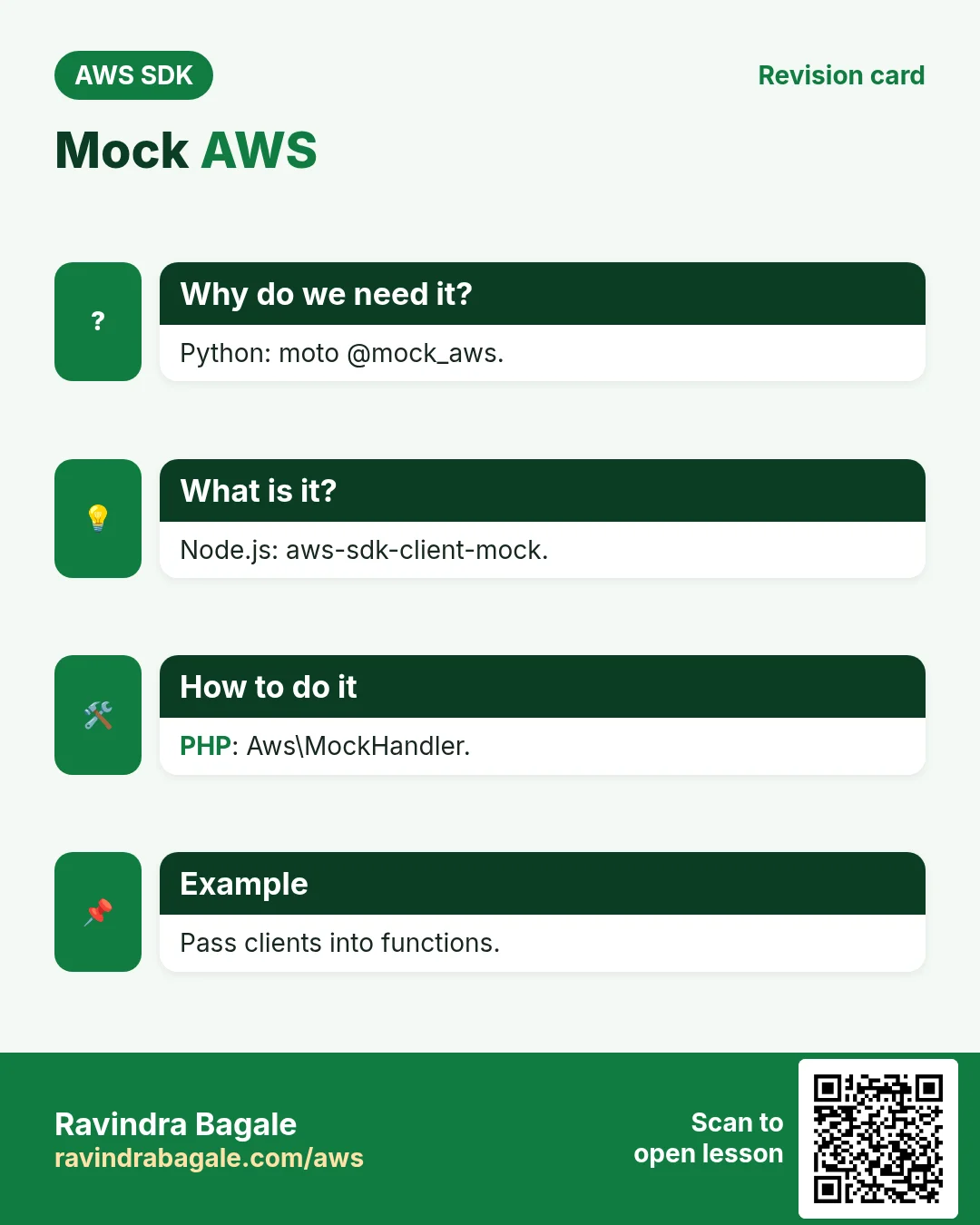
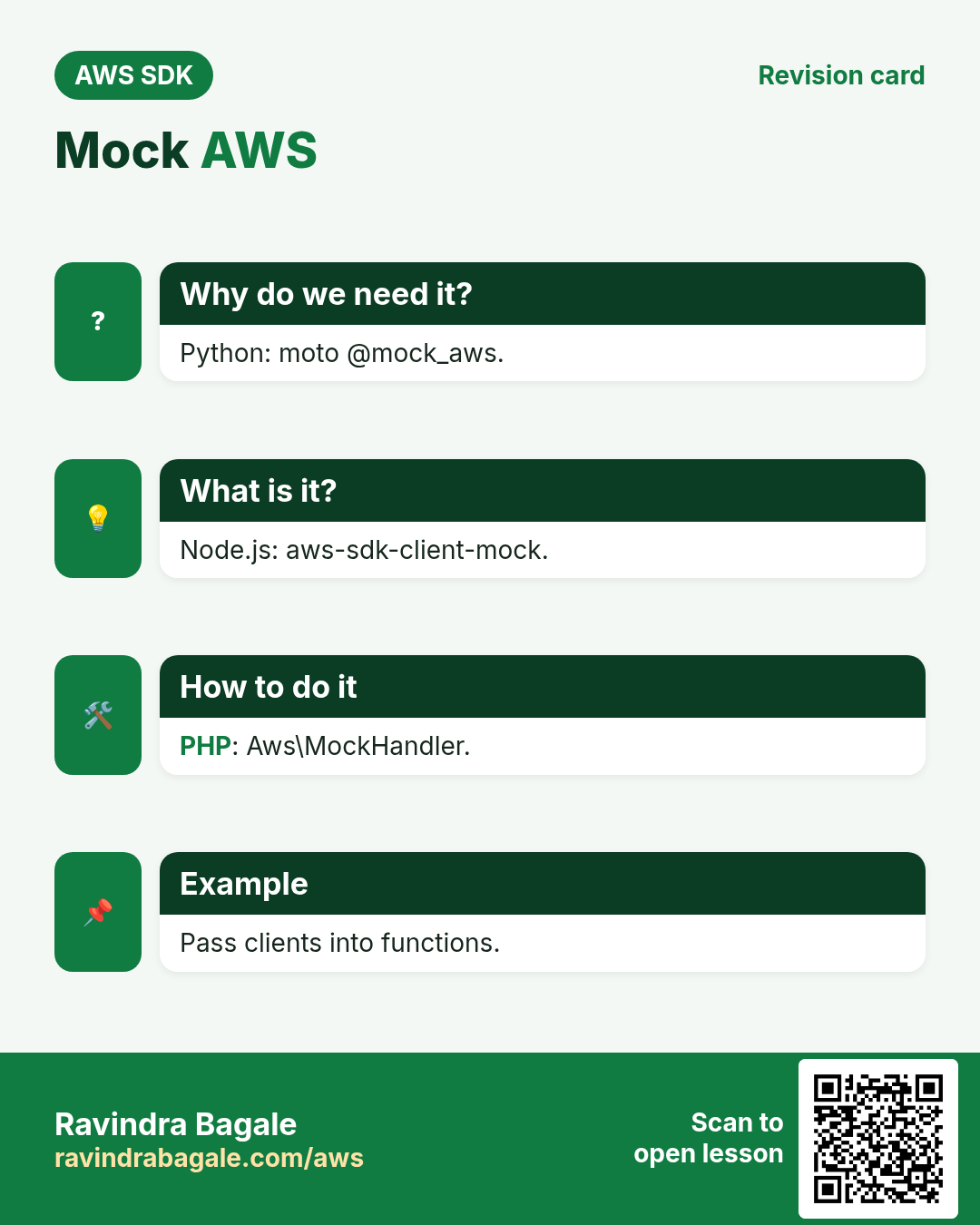
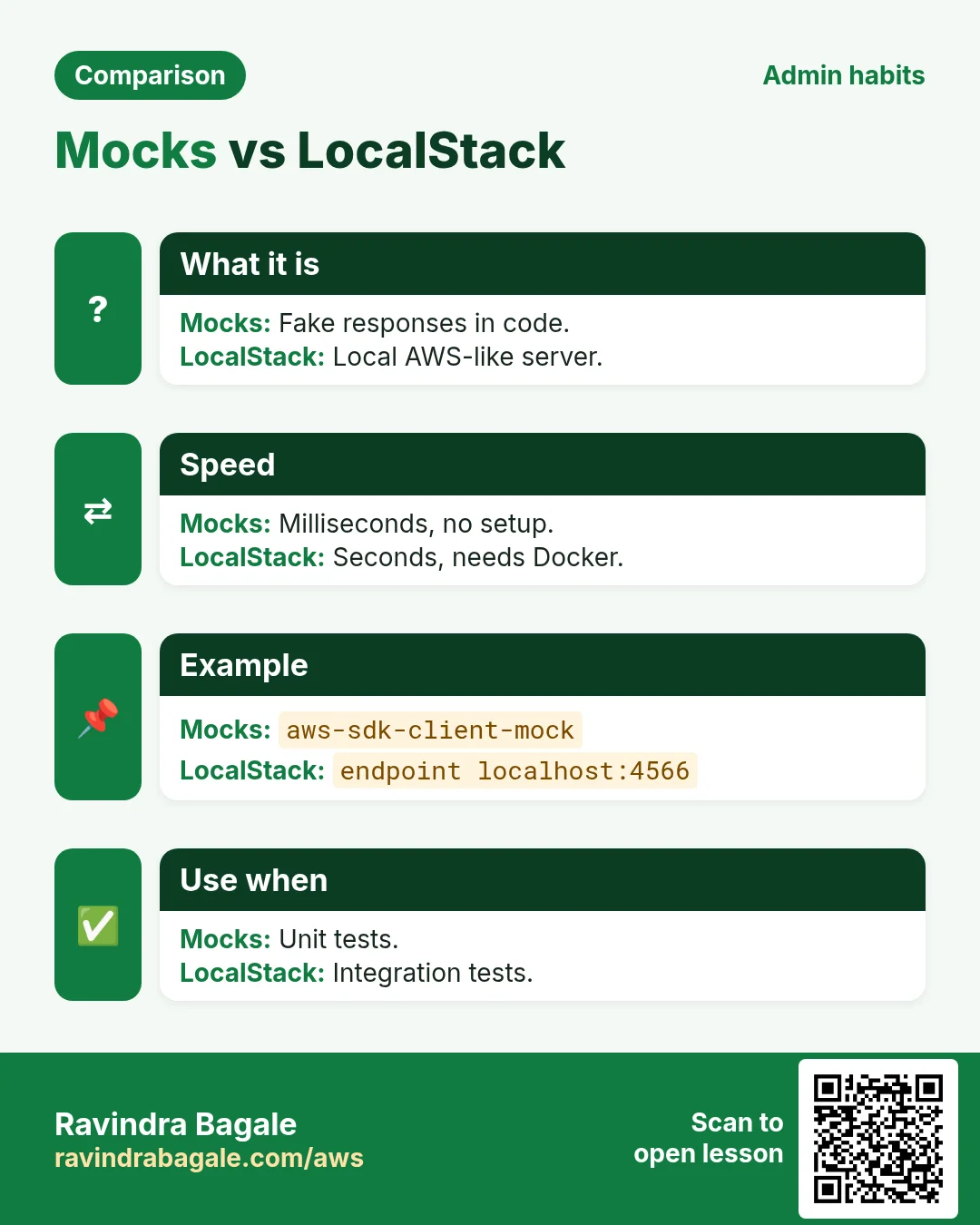
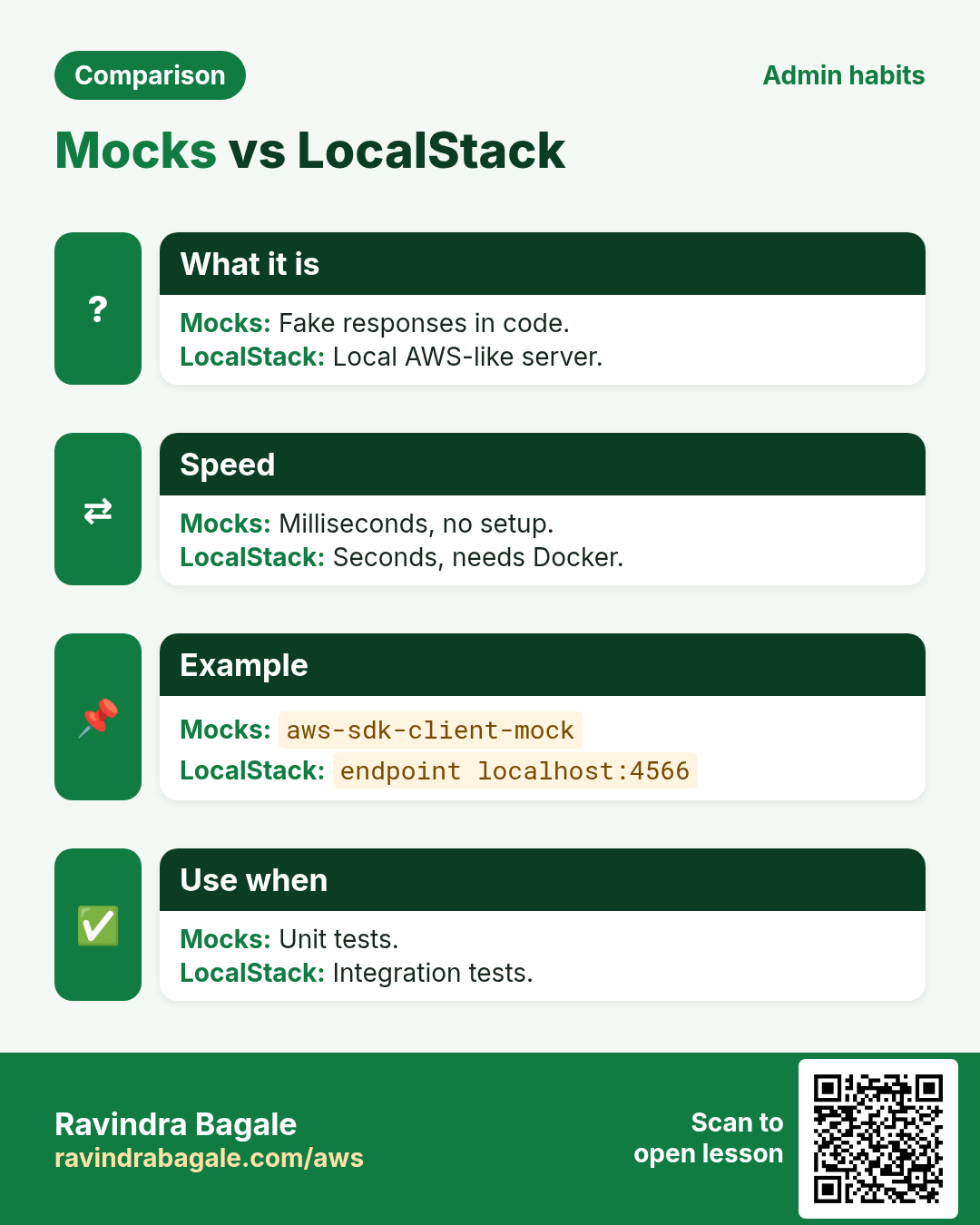
Write a function that takes the client as a parameter. In production pass a real client; in tests pass a mocked one. moto fakes AWS in memory, aws-sdk-client-mock stubs send() per Command, PHP MockHandler queues fake Result objects.
How to do it (step by step)
2. Build the receipts flow
Why do we need this?
Olivia snaps a A$42.50 taxi receipt. The app must store the image, record the expense and queue text reading.
What is it?
One function, three calls, clients passed in. The same shape in every language makes it easy to test.
How to do it (step by step)
- Python.
import uuid, json
def save_receipt(s3, ddb, sqs, user, amount, body):
    rid = "r-" + uuid.uuid4().hex[:6]
    s3.put_object(Bucket="receipts-syd", Key=f"{user}/{rid}.jpg", Body=body)
    ddb.put_item(TableName="Expenses", Item={"pk": {"S": user}, "sk": {"S": rid},
        "amount": {"N": str(amount)}})
    sqs.send_message(QueueUrl=QUEUE_URL, MessageBody=json.dumps({"rid": rid}))
    return rid
print(save_receipt(s3, ddb, sqs, "olivia", 42.50, b"jpg")[:2])
Expected output:
r-- Node.js.
import { PutObjectCommand } from "@aws-sdk/client-s3";
import { PutItemCommand } from "@aws-sdk/client-dynamodb";
import { SendMessageCommand } from "@aws-sdk/client-sqs";
export async function saveReceipt({ s3, ddb, sqs }, user, amount, body) {
  const rid = "r-" + Math.random().toString(16).slice(2, 8);
  await s3.send(new PutObjectCommand({ Bucket: "receipts-ngp", Key: `${user}/${rid}.jpg`, Body: body }));
  await ddb.send(new PutItemCommand({ TableName: "Expenses",
    Item: { pk: { S: user }, sk: { S: rid }, amount: { N: String(amount) } } }));
  await sqs.send(new SendMessageCommand({ QueueUrl: process.env.QUEUE_URL, MessageBody: JSON.stringify({ rid }) }));
  return rid;
}
console.log((await saveReceipt(clients, "siddharth", 780, Buffer.from("jpg"))).length);
Expected output:
8- PHP.
<?php
function saveReceipt($s3, $ddb, $sqs, string $user, float $amount, string $body): string {
  $rid = "r-" . bin2hex(random_bytes(3));
  $s3->putObject(["Bucket" => "receipts-ldn", "Key" => "$user/$rid.jpg", "Body" => $body]);
  $ddb->putItem(["TableName" => "Expenses", "Item" => ["pk" => ["S" => $user],
    "sk" => ["S" => $rid], "amount" => ["N" => (string)$amount]]]);
  $sqs->sendMessage(["QueueUrl" => getenv("QUEUE_URL"), "MessageBody" => json_encode(["rid" => $rid])]);
  return $rid;
}
echo strlen(saveReceipt($s3, $ddb, $sqs, "amelia", 18.20, "jpg")), PHP_EOL;
Expected output:
8- Verify with the CLI.
aws dynamodb query --table-name Expenses --key-condition-expression "pk = :u" --expression-attribute-values '{":u":{"S":"olivia"}}' --query CountExpected output:
13. Test Python with moto
Why do we need this?
Siddharth wants tests to run on every commit, offline, in two seconds, for ₹0.
What is it?
pip install "moto[s3,dynamodb,sqs]" pytest. The @mock_aws decorator (moto 5) fakes every service; create the bucket, table and queue inside the test.
How to do it (step by step)
- Python test.
import boto3
from moto import mock_aws
from app import save_receipt
import app
@mock_aws
def test_save_receipt():
    kw = dict(region_name="ap-southeast-2")
    s3, ddb, sqs = boto3.client("s3", **kw), boto3.client("dynamodb", **kw), boto3.client("sqs", **kw)
    s3.create_bucket(Bucket="receipts-syd", CreateBucketConfiguration={"LocationConstraint": "ap-southeast-2"})
    ddb.create_table(TableName="Expenses", BillingMode="PAY_PER_REQUEST",
        KeySchema=[{"AttributeName": "pk", "KeyType": "HASH"}, {"AttributeName": "sk", "KeyType": "RANGE"}],
        AttributeDefinitions=[{"AttributeName": "pk", "AttributeType": "S"}, {"AttributeName": "sk", "AttributeType": "S"}])
    app.QUEUE_URL = sqs.create_queue(QueueName="ocr")["QueueUrl"]
    rid = save_receipt(s3, ddb, sqs, "olivia", 42.50, b"jpg")
    assert s3.get_object(Bucket="receipts-syd", Key=f"olivia/{rid}.jpg")["Body"].read() == b"jpg"
    assert ddb.get_item(TableName="Expenses", Key={"pk": {"S": "olivia"}, "sk": {"S": rid}})["Item"]["amount"]["N"] == "42.5"
Expected output:
(no output; test passes)- Node.js: moto as a server for any language.
// terminal: moto_server -p 5000
import { S3Client, ListBucketsCommand } from "@aws-sdk/client-s3";
const s3 = new S3Client({ region: "us-east-1", endpoint: "http://localhost:5000", forcePathStyle: true,
  credentials: { accessKeyId: "test", secretAccessKey: "test" } });
console.log((await s3.send(new ListBucketsCommand({}))).Buckets.length);
Expected output:
0- PHP: same server.
$s3 = new Aws\S3\S3Client(["region" => "us-east-1", "endpoint" => "http://localhost:5000",
  "use_path_style_endpoint" => true, "credentials" => ["key" => "test", "secret" => "test"]]);
echo count($s3->listBuckets()["Buckets"]), PHP_EOL;
Expected output:
0- Verify: run pytest.
pytest -q test_app.pyExpected output:
1 passed in 1.84s4. Mock Node.js and PHP
Why do we need this?
Amelia in London (£18.20 lunch) wants unit tests that also check what was sent to AWS.
What is it?
npm i -D aws-sdk-client-mock. mockClient(S3Client) stubs every instance; .on(Command).resolves({...}); commandCalls() returns what was sent. In PHP push Result objects into a MockHandler and pass it as "handler".
How to do it (step by step)
- Python: stub a single error with botocore Stubber.
from botocore.stub import Stubber
s3 = boto3.client("s3", region_name="ap-southeast-2")
with Stubber(s3) as st:
    st.add_client_error("put_object", "AccessDenied")
    try: s3.put_object(Bucket="receipts-syd", Key="x", Body=b"1")
    except s3.exceptions.ClientError as e: print(e.response["Error"]["Code"])
Expected output:
AccessDenied- Node.js test (node:test).
import { test } from "node:test";
import assert from "node:assert";
import { mockClient } from "aws-sdk-client-mock";
import { S3Client, PutObjectCommand } from "@aws-sdk/client-s3";
import { DynamoDBClient, PutItemCommand } from "@aws-sdk/client-dynamodb";
import { SQSClient, SendMessageCommand } from "@aws-sdk/client-sqs";
import { saveReceipt } from "./app.mjs";
const s3m = mockClient(S3Client), ddbm = mockClient(DynamoDBClient), sqsm = mockClient(SQSClient);
s3m.on(PutObjectCommand).resolves({}); ddbm.on(PutItemCommand).resolves({});
sqsm.on(SendMessageCommand).resolves({ MessageId: "m-1" });
test("saves receipt", async () => {
  await saveReceipt({ s3: new S3Client({}), ddb: new DynamoDBClient({}), sqs: new SQSClient({}) }, "siddharth", 780, "jpg");
  assert.equal(ddbm.commandCalls(PutItemCommand)[0].args[0].input.Item.amount.N, "780");
});
Expected output:
✔ saves receipt- PHP: MockHandler.
use Aws\MockHandler; use Aws\Result;
$mock = new MockHandler();
$mock->append(new Result([]));                      // putObject
$mock->append(new Result([]));                      // putItem
$mock->append(new Result(["MessageId" => "m-9"]));  // sendMessage
$cfg = ["region" => "eu-west-2", "handler" => $mock, "credentials" => ["key" => "k", "secret" => "s"]];
$rid = saveReceipt(new Aws\S3\S3Client($cfg), new Aws\DynamoDb\DynamoDbClient($cfg), new Aws\Sqs\SqsClient($cfg), "amelia", 18.20, "jpg");
echo count($mock), " left, rid ", strlen($rid), PHP_EOL;
Expected output:
0 left, rid 8- Verify: run the tests.
node --test && vendor/bin/phpunit testsExpected output:
# pass 1
OK (1 test, 2 assertions)
5. Best practices
Why do we need this?
The app grows from 50 to 50,000 receipts a day across Sydney, Nagpur and London. Small habits now save real money and outages later.
What is it?
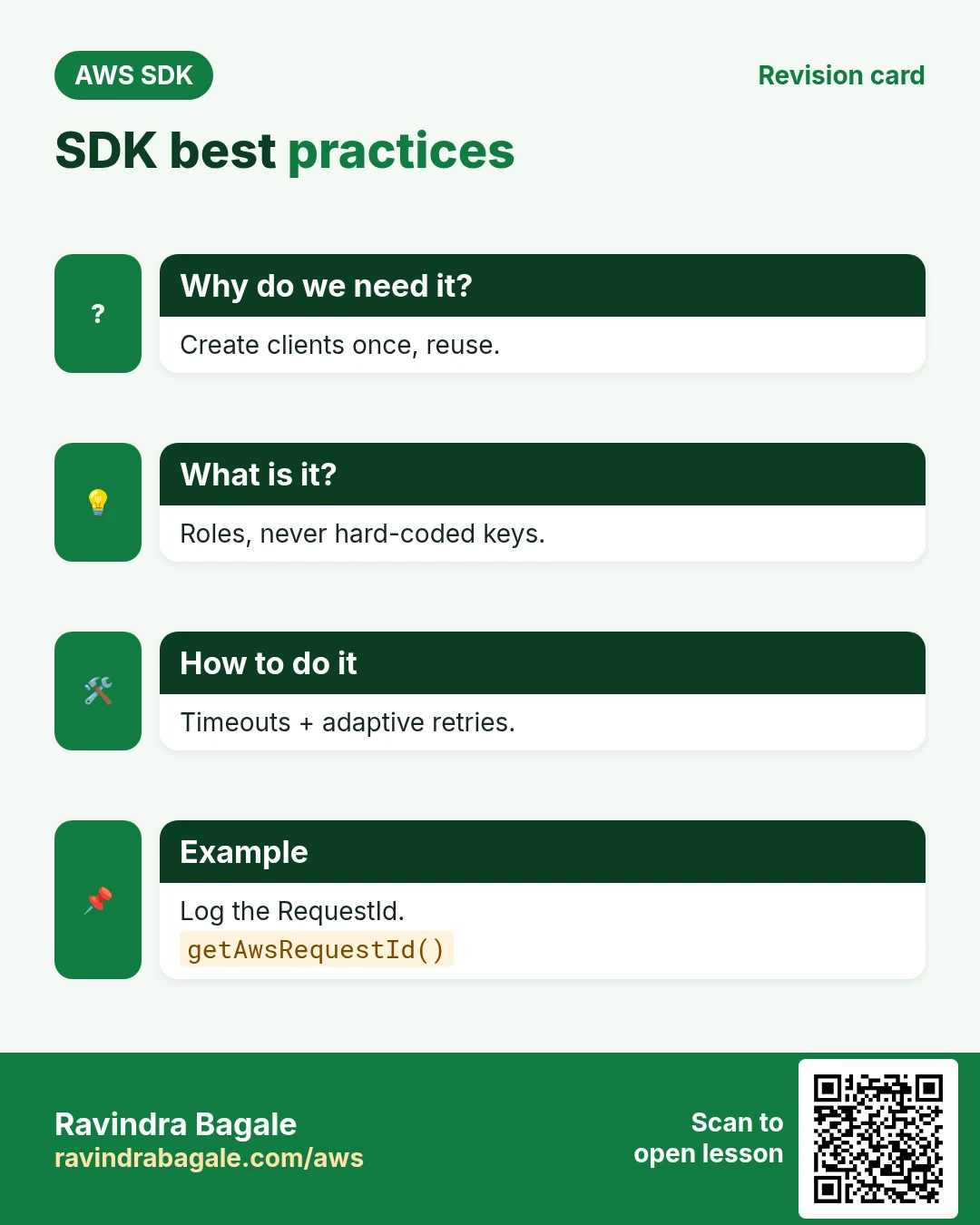
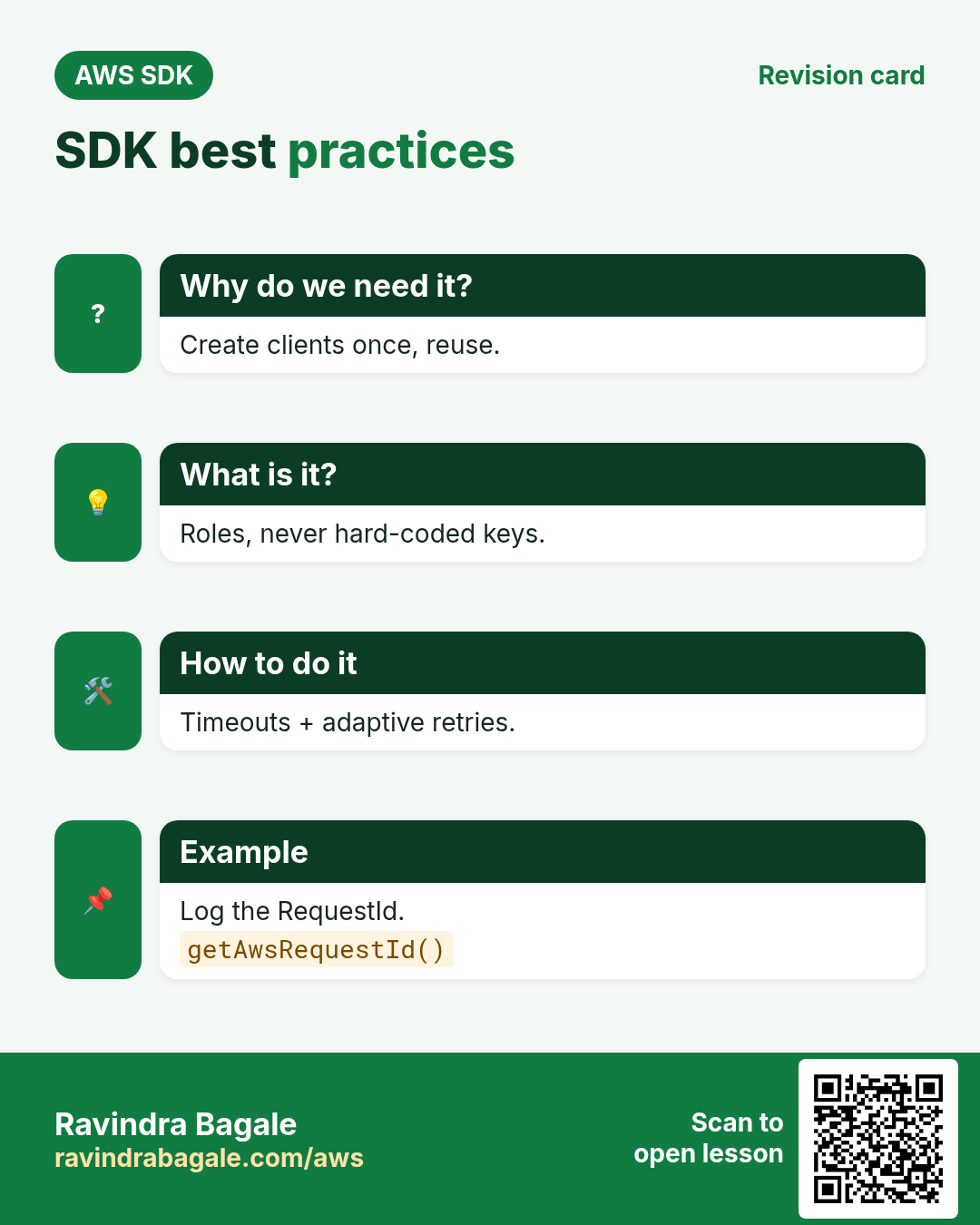
Create clients once and reuse them. Never hard-code keys; use roles and the default credential chain. Set timeouts and adaptive retries. Use paginators. Log RequestId on errors. Grant least-privilege IAM.
How to do it (step by step)
- Python: timeouts and retries.
from botocore.config import Config
cfg = Config(connect_timeout=3, read_timeout=10, retries={"mode": "adaptive", "max_attempts": 5})
s3 = boto3.client("s3", region_name="ap-southeast-2", config=cfg)   # create once, reuse
print(s3.meta.config.retries["mode"])
Expected output:
adaptive- Node.js: reuse client outside the handler.
import { S3Client } from "@aws-sdk/client-s3";
import { NodeHttpHandler } from "@smithy/node-http-handler";
const s3 = new S3Client({ region: "ap-south-1", maxAttempts: 5, retryMode: "adaptive",
  requestHandler: new NodeHttpHandler({ connectionTimeout: 3000, requestTimeout: 10000 }) });
export const handler = async () => ({ ok: true });   // s3 reused across invocations
console.log(await s3.config.retryMode());
Expected output:
adaptive- PHP: log the request id on failure.
try {
  $s3->getObject(["Bucket" => "receipts-ldn", "Key" => "missing.jpg"]);
} catch (Aws\S3\Exception\S3Exception $e) {
  error_log($e->getAwsErrorCode() . " " . $e->getAwsRequestId());
  echo $e->getAwsErrorCode(), PHP_EOL;
}
Expected output:
NoSuchKey- Verify which identity your code uses.
aws sts get-caller-identity --query Arn --output textExpected output:
arn:aws:sts::111122223333:assumed-role/receipts-app/i-0abc6. Same action in Python, Node.js, Java, Go, .NET and PHP
Why do we need this?
Scripts start in the CLI. Apps call the same API through an SDK. Knowing both helps you move a tested command into real code.
What is it?
Each CLI command maps to one API call. For example aws s3api put-object ... maps to the PutObject API.
How to do it (step by step)
Same action (PutItem) from code. Every SDK reads the same profile, region and credentials as the CLI.
| Stack | Code |
|---|---|
| AWS CLI | aws s3api put-object --bucket receipts-syd --key olivia/r-1.jpg --body r.jpg |
| Java v2 | s3.putObject(b -> b.bucket("receipts-syd").key("olivia/r-1.jpg"), RequestBody.fromBytes(bytes)); |
| Go v2 | client.PutObject(ctx, &s3.PutObjectInput{Bucket: aws.String("receipts-syd"), Key: aws.String(key), Body: r}) |
| .NET | await s3.PutObjectAsync(new PutObjectRequest { BucketName = "receipts-syd", Key = key, InputStream = stream }); |
7. Clean up so nothing keeps costing
Why do we need this?
Lab resources left running cost money and can be a security risk.
What is it?
Delete in reverse order: children first, then parents.
How to do it (step by step)
- Delete test bucket, table and queue (mocks need no cleanup).
aws s3 rb s3://receipts-syd --force
aws dynamodb delete-table --table-name Expenses
aws sqs delete-queue --queue-url $QUEUE_URL
Expected output:
(no output means success)Ravindra Bagale's Tip
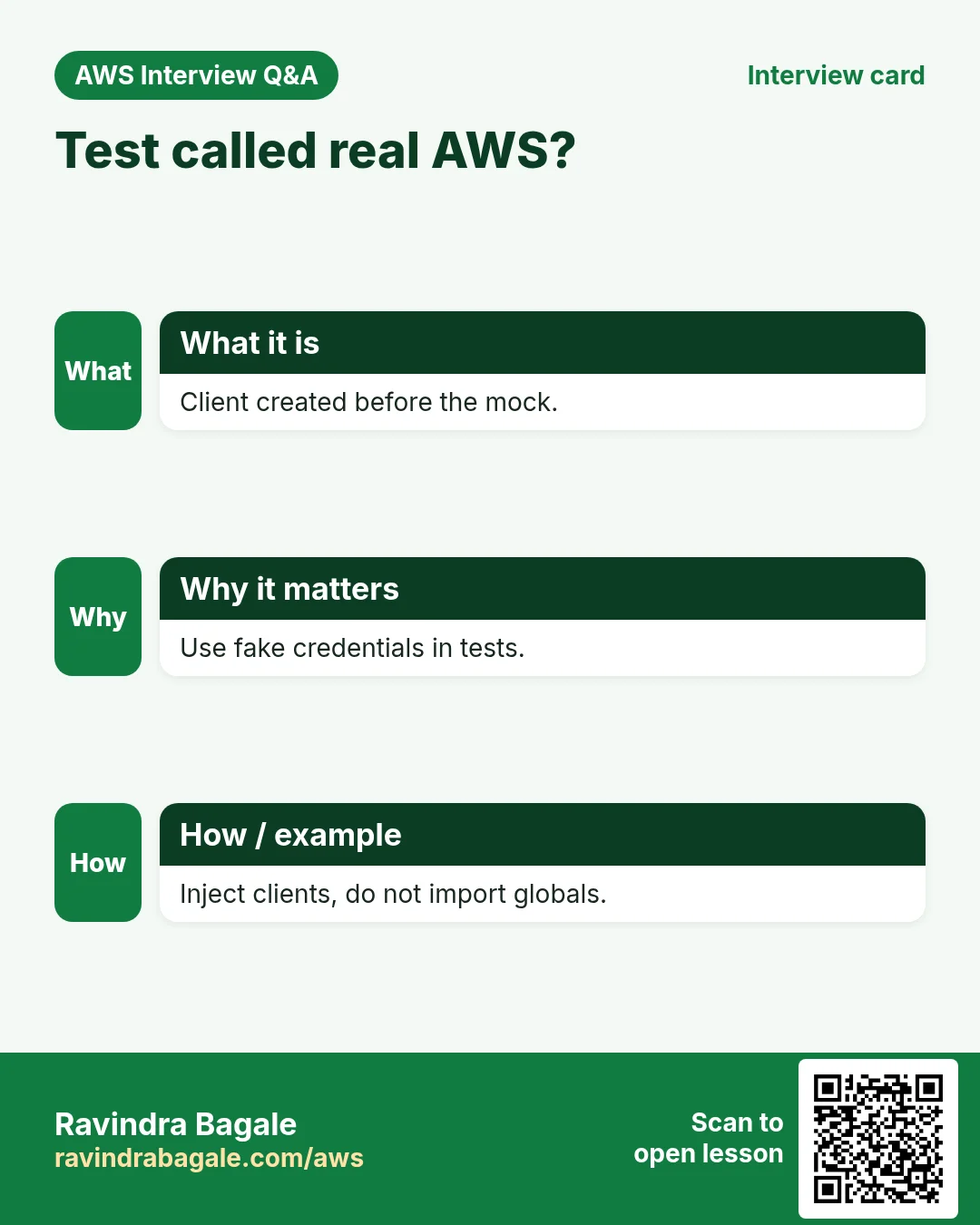
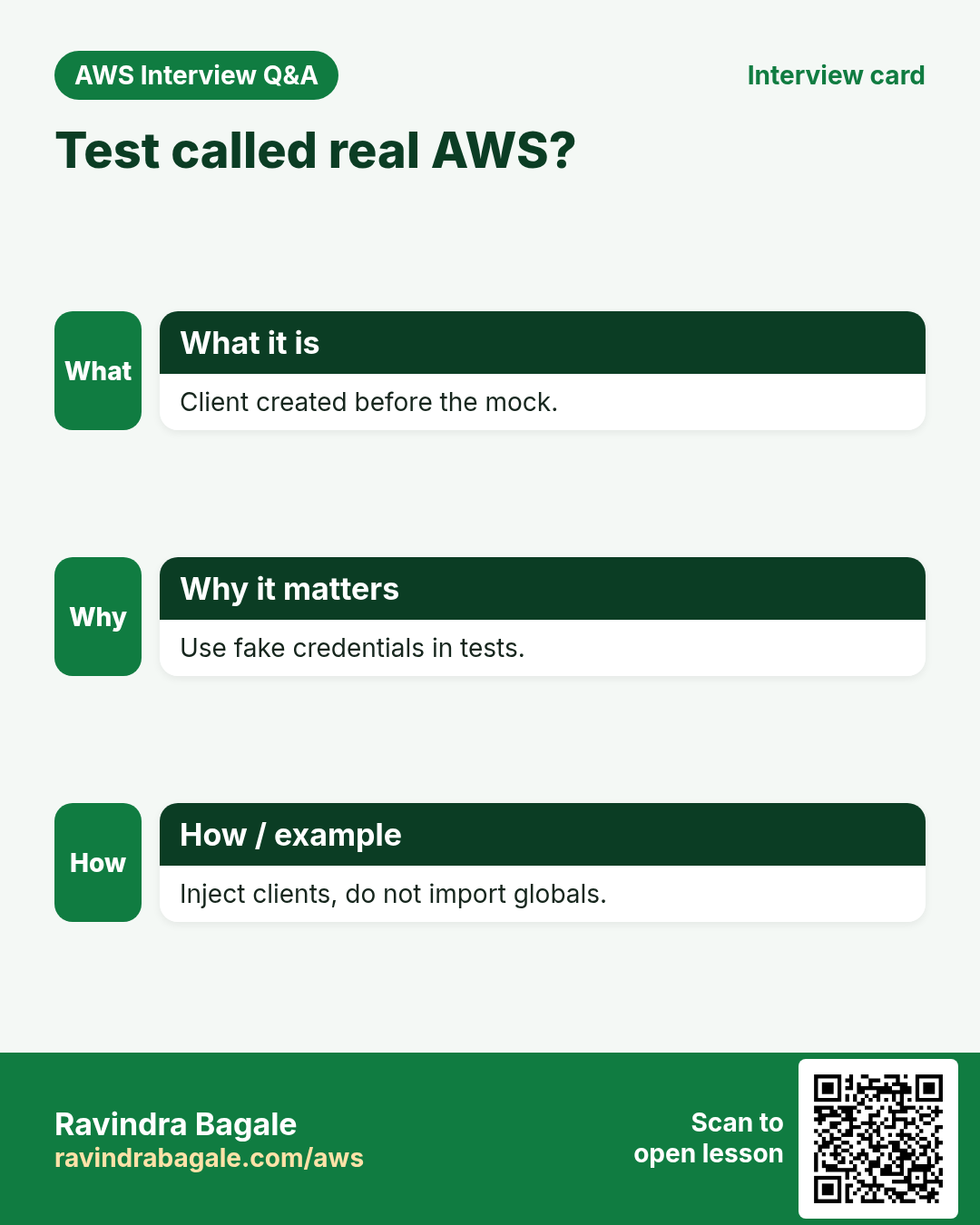
Pass clients into functions instead of creating them inside. That one habit makes every test in every language easy.
8. Interview questions and answers
Q. Python mocking library?
moto (@mock_aws), or botocore Stubber for exact responses.
Q. Node.js v3 mocking library?
aws-sdk-client-mock.
Q. PHP mocking?
Aws\MockHandler passed as handler.
Q. Where to create clients in Lambda?
Outside the handler, reused.
Q. Why log RequestId?
AWS Support can trace the exact call.
Try at home
- Add a moto test that checks the SQS message body contains the receipt id.
- In PHP, make MockHandler return an AccessDenied error and assert your code shows a friendly message.
In short
- Inject clients.
- moto for Python.
- aws-sdk-client-mock for Node.js.
- MockHandler for PHP.
- Reuse clients, set retries, least privilege.
Practice Tasks
Konkan Cashews is a food export business in Ratnagiri. Prakash Sawant looks after its IT and cloud work. They count money in INR and run their AWS resources in the ap-south-1 Region. In the tasks below you do real jobs for them using what this lesson teaches. All names, account IDs, IP addresses and numbers are made up for practice.
0 / 12
Easy Invoke one function
Why: A caller should invoke only the function it needs.
What to do: Allow lambda:InvokeFunction on arn:aws:lambda:ap-south-1:103761760951:function:konkancashew-orders-fn only.
- Start with { "Version": "2012-10-17", "Statement": [ ... ] }.
- In each statement write Effect, Action and Resource.
- Give only what the task needs (least privilege).
- Use double quotes and commas correctly. Click Check answer.
Easy Describe a table
Why: See the keys, indexes, item count and status of a table.
What to do: Describe table konkancashew-orders.
- Read the task and decide which AWS service it is about.
- Write aws, then the service name, then the operation (the action word).
- Add each needed flag (--name) followed by its value from the task.
- Flags can be in any order. Click Check answer.
Medium Lambda access to one table
Why: The function only needs to read and write items in its own table.
What to do: Allow dynamodb:GetItem, dynamodb:PutItem, dynamodb:Query on arn:aws:dynamodb:ap-south-1:103761760951:table/konkancashew-orders only.
- Start with { "Version": "2012-10-17", "Statement": [ ... ] }.
- In each statement write Effect, Action and Resource.
- Give only what the task needs (least privilege).
- Use double quotes and commas correctly. Click Check answer.
Medium Allow one Bedrock model
Why: Limit apps to the approved model so costs stay predictable.
What to do: Allow bedrock:InvokeModel on arn:aws:bedrock:ap-south-1::foundation-model/amazon.nova-lite-v1:0 only.
- Start with { "Version": "2012-10-17", "Statement": [ ... ] }.
- In each statement write Effect, Action and Resource.
- Give only what the task needs (least privilege).
- Use double quotes and commas correctly. Click Check answer.
Medium Start and stop servers only
Why: The night operator may start and stop servers but not terminate them.
What to do: Allow ec2:StartInstances and ec2:StopInstances on all instances in account 103761760951, Region ap-south-1. Also allow ec2:DescribeInstances on *.
- Start with { "Version": "2012-10-17", "Statement": [ ... ] }.
- In each statement write Effect, Action and Resource.
- Give only what the task needs (least privilege).
- Use double quotes and commas correctly. Click Check answer.
Medium Pull images from one repository
Why: CI or servers should pull only the images they run.
What to do: Allow ecr:BatchGetImage and ecr:GetDownloadUrlForLayer on arn:aws:ecr:ap-south-1:103761760951:repository/konkancashew/web, plus ecr:GetAuthorizationToken on *.
- Start with { "Version": "2012-10-17", "Statement": [ ... ] }.
- In each statement write Effect, Action and Resource.
- Give only what the task needs (least privilege).
- Use double quotes and commas correctly. Click Check answer.
Medium Let a function write logs
Why: Without these actions, Lambda logs never appear in CloudWatch.
What to do: Allow logs:CreateLogGroup, logs:CreateLogStream, logs:PutLogEvents on arn:aws:logs:*:*:* only.
- Start with { "Version": "2012-10-17", "Statement": [ ... ] }.
- In each statement write Effect, Action and Resource.
- Give only what the task needs (least privilege).
- Use double quotes and commas correctly. Click Check answer.
Medium CloudFormation: on-demand table
Why: On-demand tables need no capacity planning.
What to do: Template with a DynamoDB table konkancashew-orders, partition key orderId (String), billing mode PAY_PER_REQUEST.
- Start from the top-level keys the task names.
- Indent child keys with 2 spaces (no tabs).
- Fill in each property with the value from the task.
- Click Check answer. Key order does not matter.
Hard Deny access from outside the office
Why: An explicit Deny with aws:SourceIp blocks keys used from anywhere else.
What to do: Write one Deny statement: deny all actions (*) on all resources (*) when the source IP is NOT in 203.0.113.0/24.
- Start with { "Version": "2012-10-17", "Statement": [ ... ] }.
- In each statement write Effect, Action and Resource.
- Give only what the task needs (least privilege).
- Use double quotes and commas correctly. Click Check answer.
Hard Use a key, not manage it
Why: Apps need Encrypt/Decrypt; only admins should change or delete keys.
What to do: Allow kms:Encrypt, kms:Decrypt, kms:GenerateDataKey on arn:aws:kms:ap-south-1:103761760951:key/1234abcd-12ab-34cd-56ef-1234567890ab only.
- Start with { "Version": "2012-10-17", "Statement": [ ... ] }.
- In each statement write Effect, Action and Resource.
- Give only what the task needs (least privilege).
- Use double quotes and commas correctly. Click Check answer.
Hard Allow PassRole for one role
Why: To launch EC2 with a role, the user needs iam:PassRole on that role.
What to do: Allow iam:PassRole on arn:aws:iam::103761760951:role/konkancashew-ec2-role only.
- Start with { "Version": "2012-10-17", "Statement": [ ... ] }.
- In each statement write Effect, Action and Resource.
- Give only what the task needs (least privilege).
- Use double quotes and commas correctly. Click Check answer.
Hard Create a DynamoDB table
Why: On-demand billing means you pay per request, with no capacity to plan.
What to do: Create table konkancashew-orders with partition key orderId (string), on-demand billing.
- Read the task and decide which AWS service it is about.
- Write aws, then the service name, then the operation (the action word).
- Add each needed flag (--name) followed by its value from the task.
- Flags can be in any order. Click Check answer.
Revision, comparison and interview cards
Revise this lesson in a few minutes. Save the cards on your phone or download them as PNG files. The QR code on each card opens this lesson.
More cards: Ravi Sir's Cards.