Ravindra BagaleCourses & study guides मराठी

Ravi Sir's Cards › DevOps

Chapter 12: Terraform Introduction: Cards

मराठी cards · Open the chapter

Revision cards
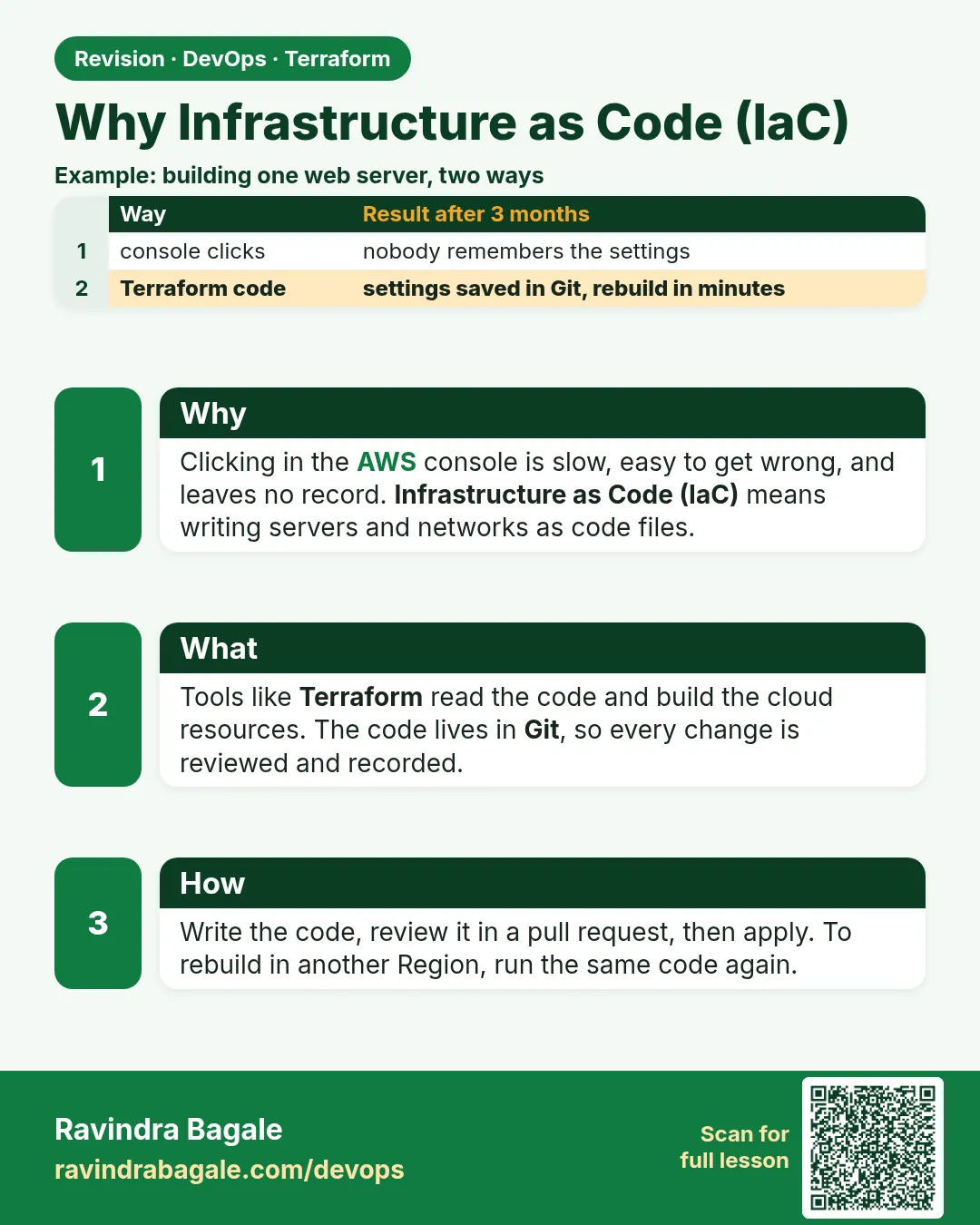
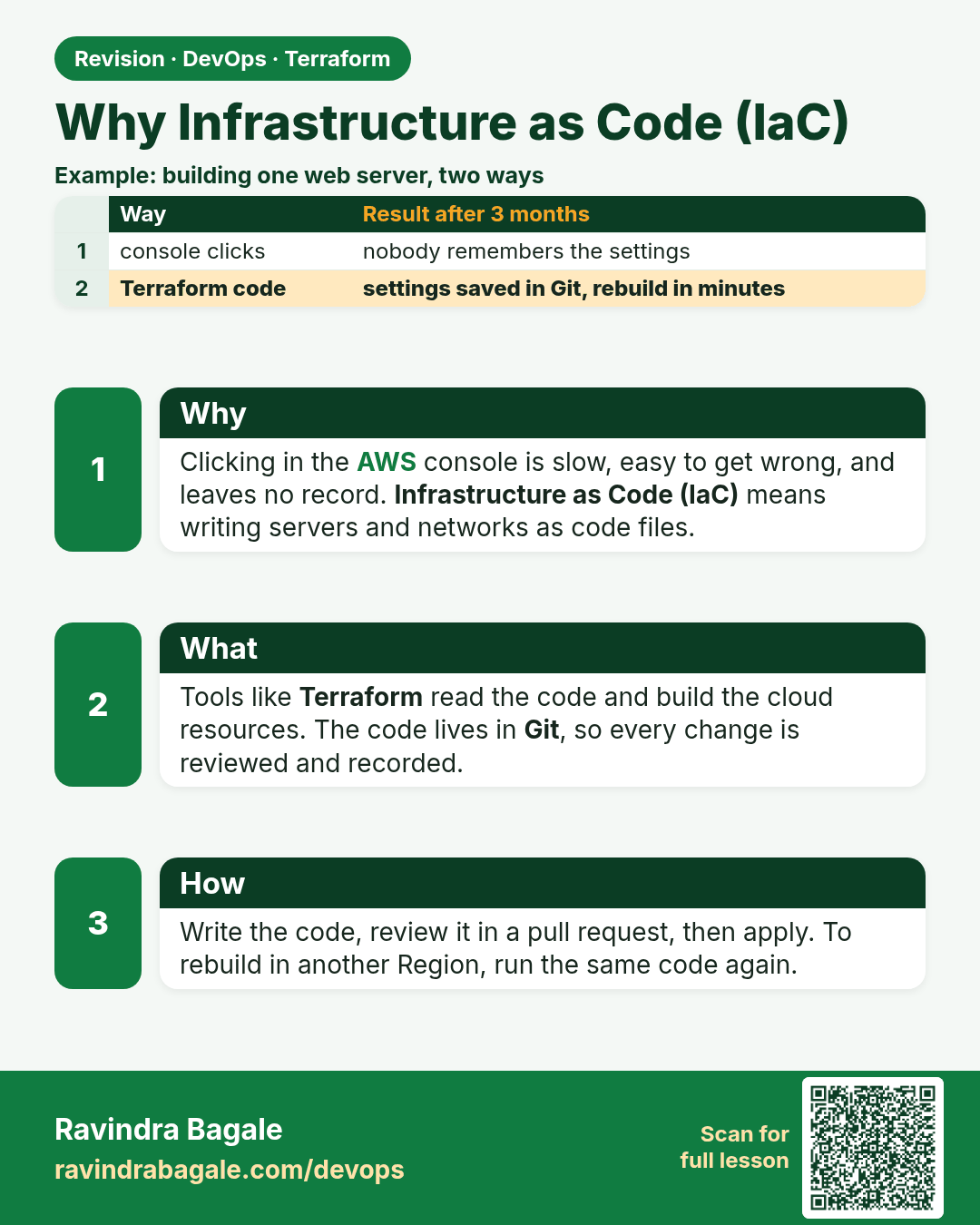
Why Infrastructure as Code (IaC). Clicking in the AWS console is slow, easy to get wrong, and leaves no record. Infrastructure as Code (IaC) means writing servers and networks as code files.
Revision card 1 of 4: Why Infrastructure as Code (IaC) · Download PNG · Open card page

Lesson: 12.1 Why IaC — console clicks versus code
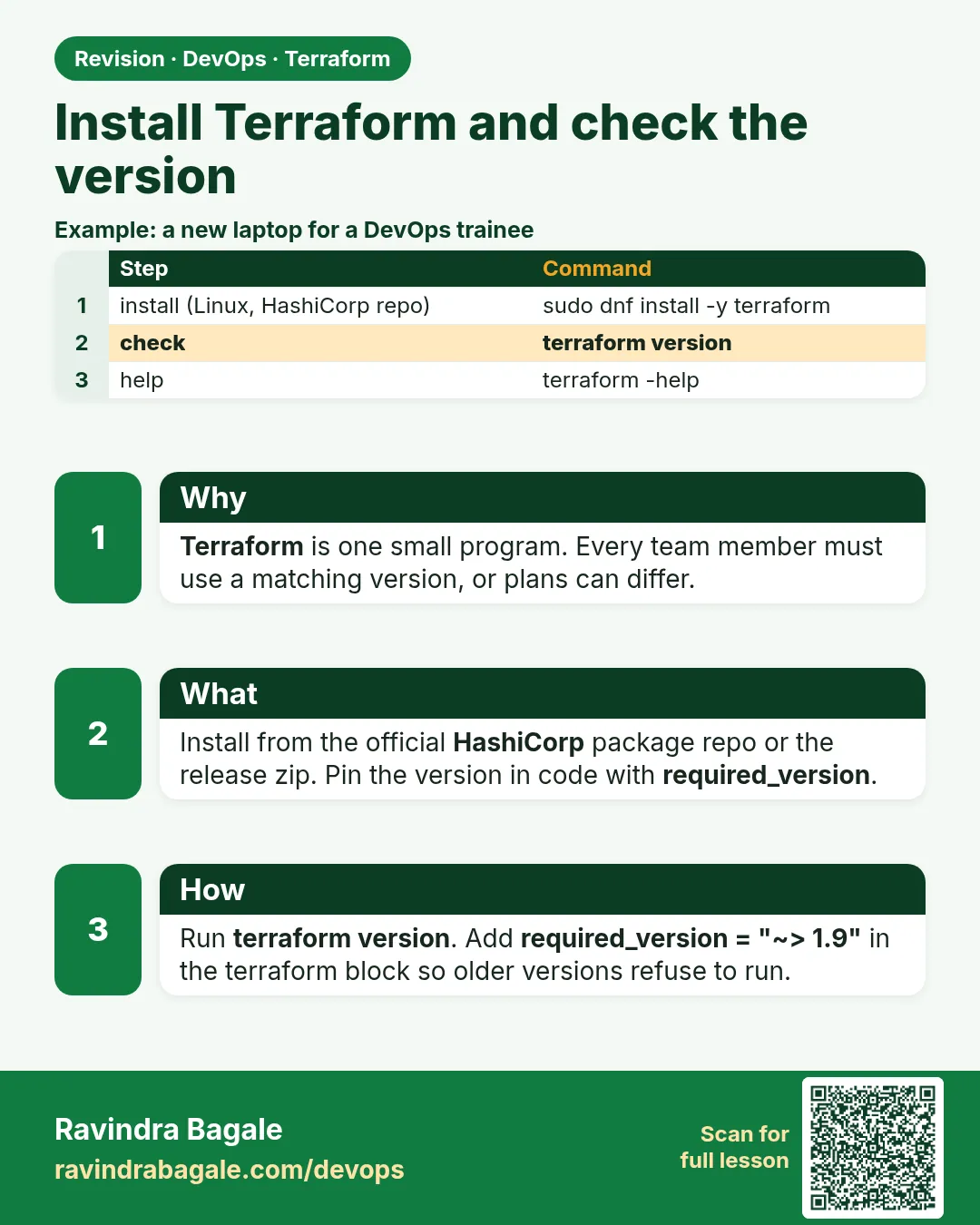
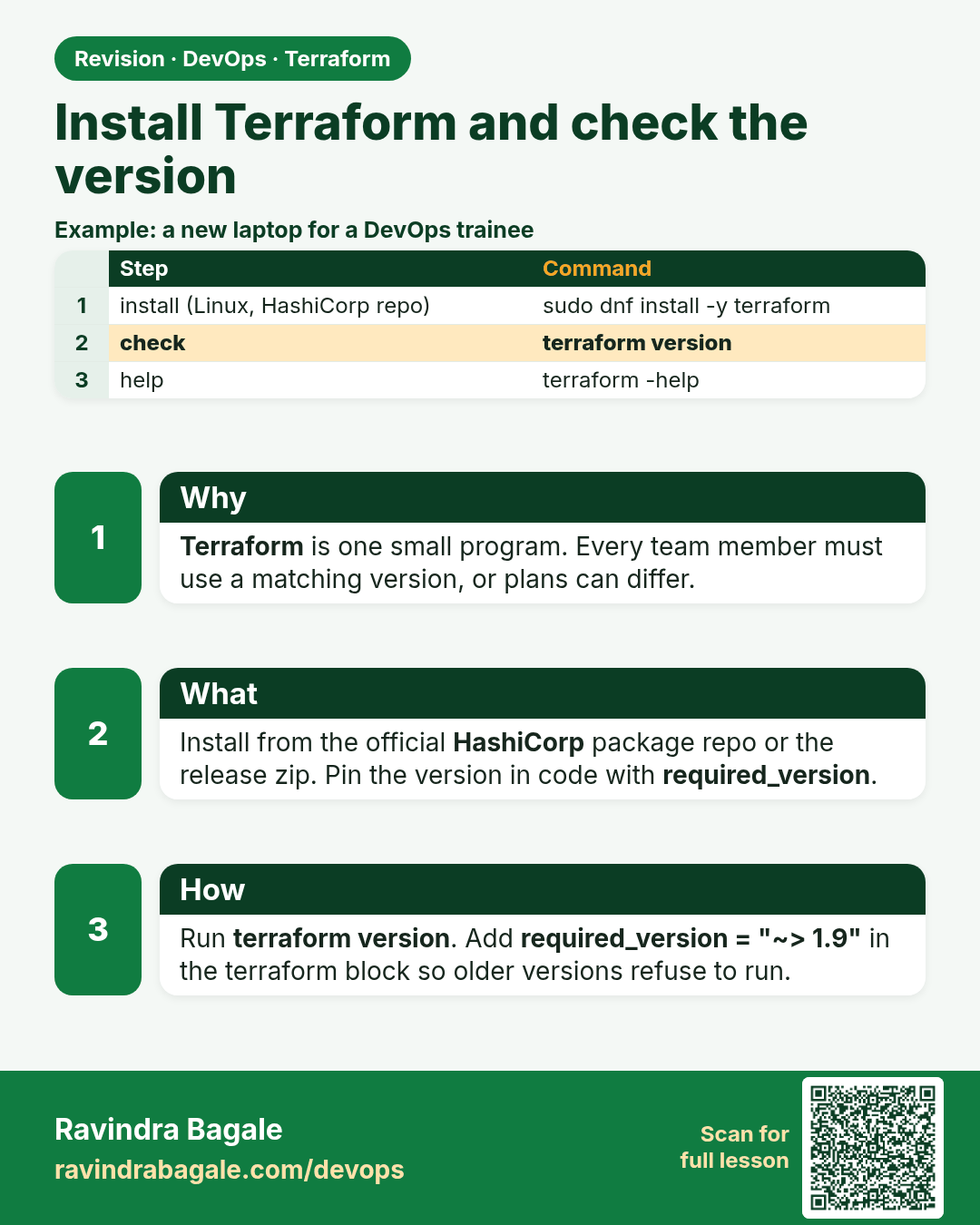
Install Terraform and check the version. Terraform is one small program. Every team member must use a matching version, or plans can differ.
Revision card 2 of 4: Install Terraform and check the version · Download PNG · Open card page

Lesson: 12.2 Install Terraform and check the version
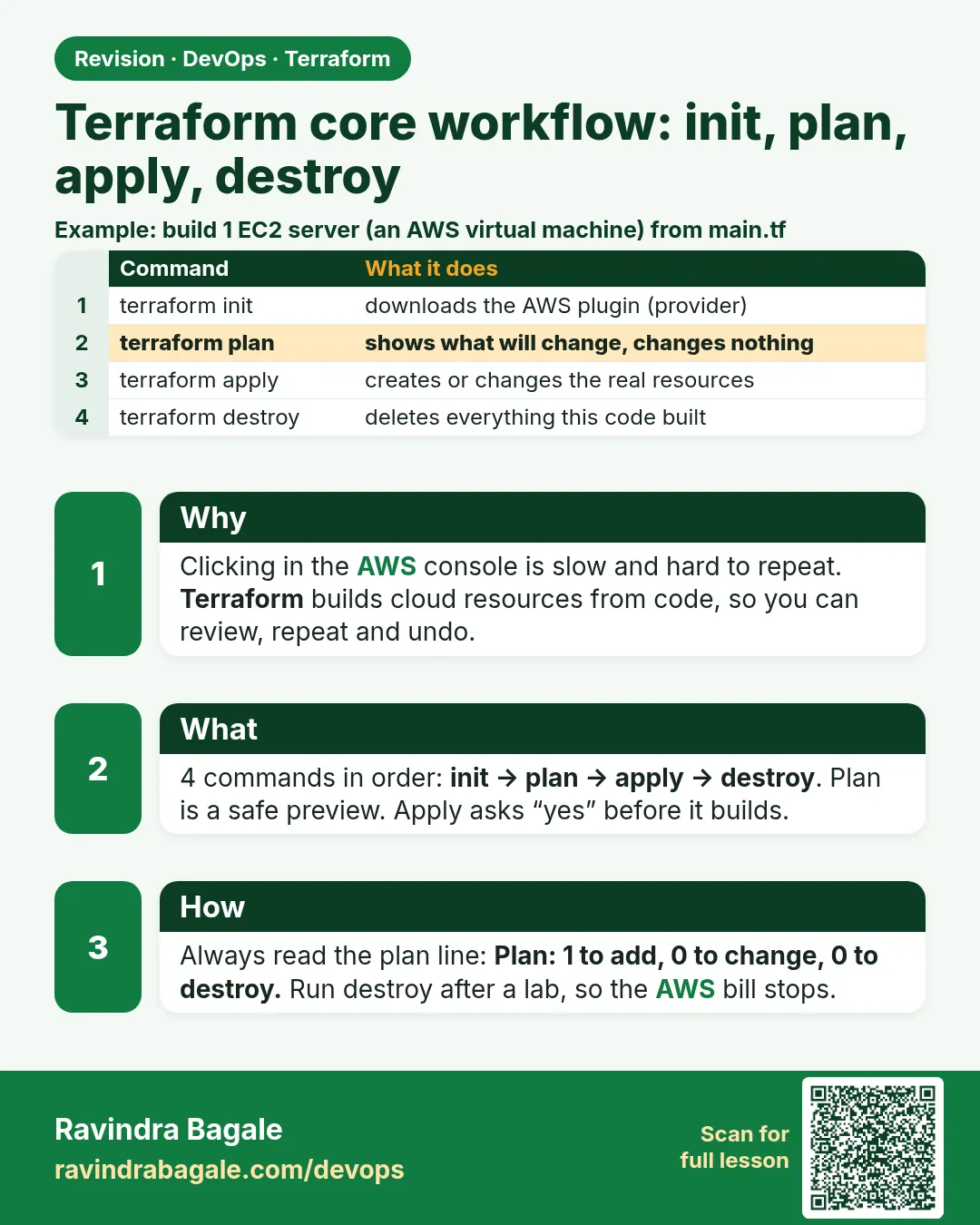
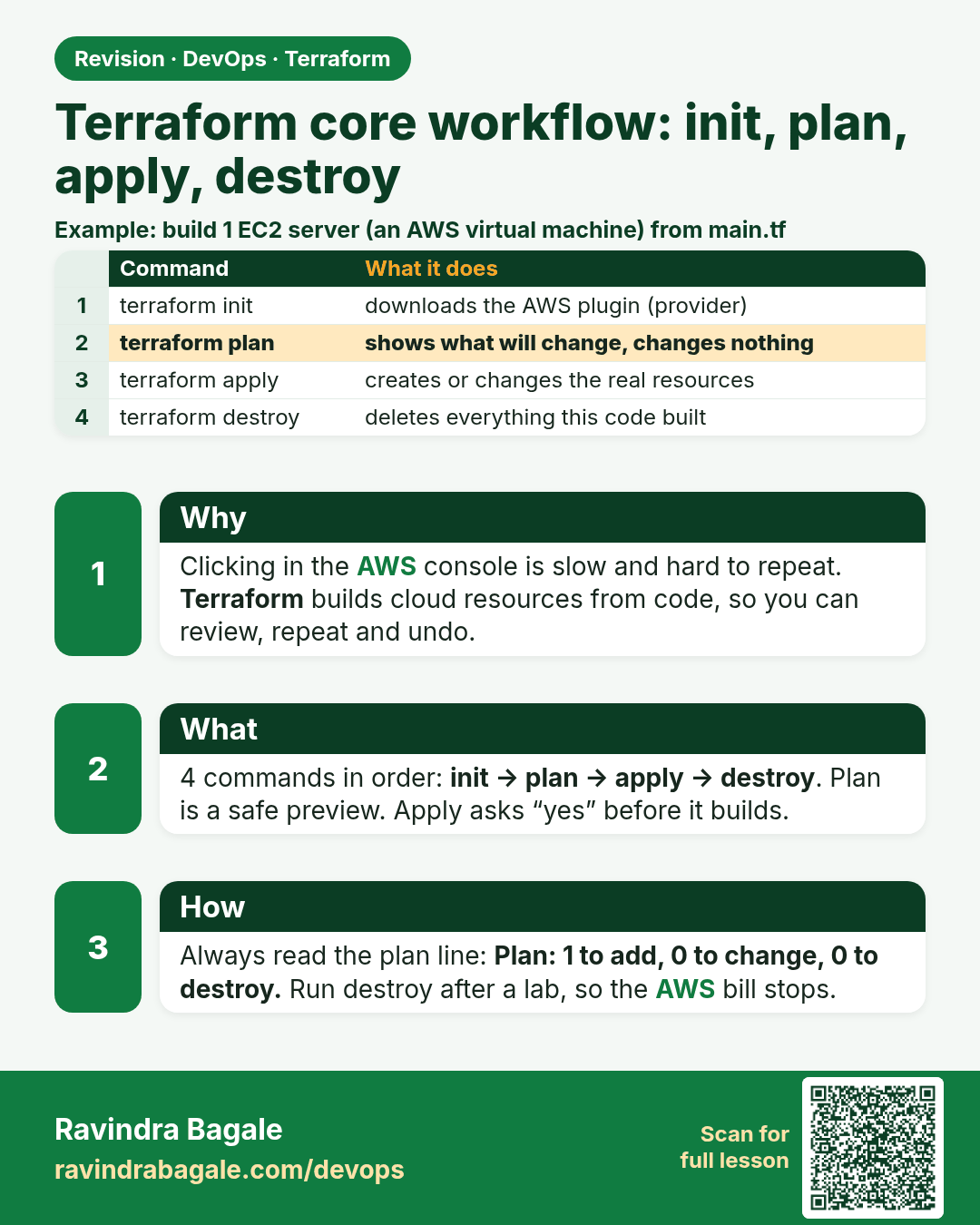
Terraform core workflow: init, plan, apply, destroy. Clicking in the AWS console is slow and hard to repeat. Terraform builds cloud resources from code, so you can review, repeat and undo.
Revision card 3 of 4: Terraform core workflow: init, plan, apply, destroy · Download PNG · Open card page

Lesson: 12.3 The core workflow — init, plan, apply, destroy
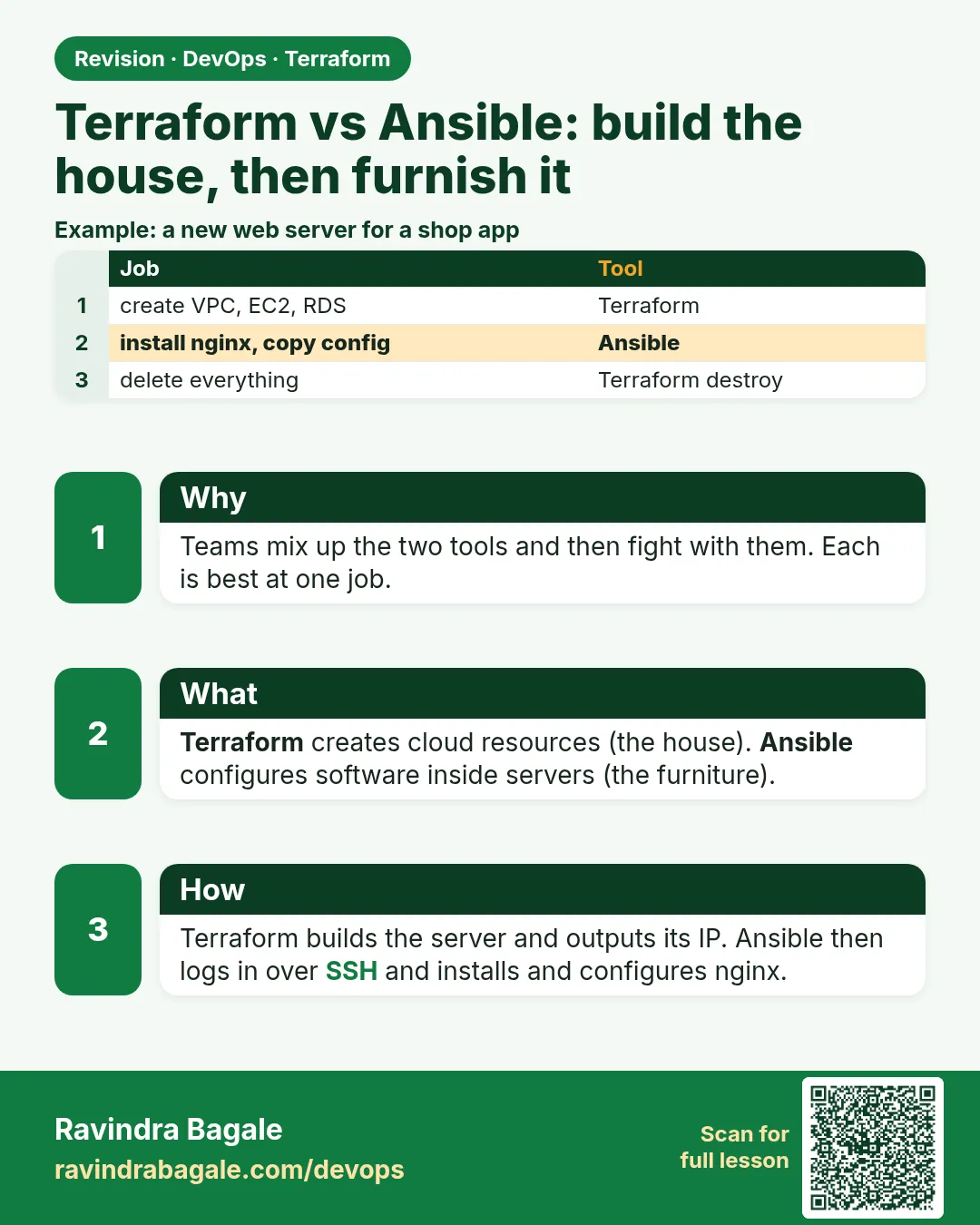
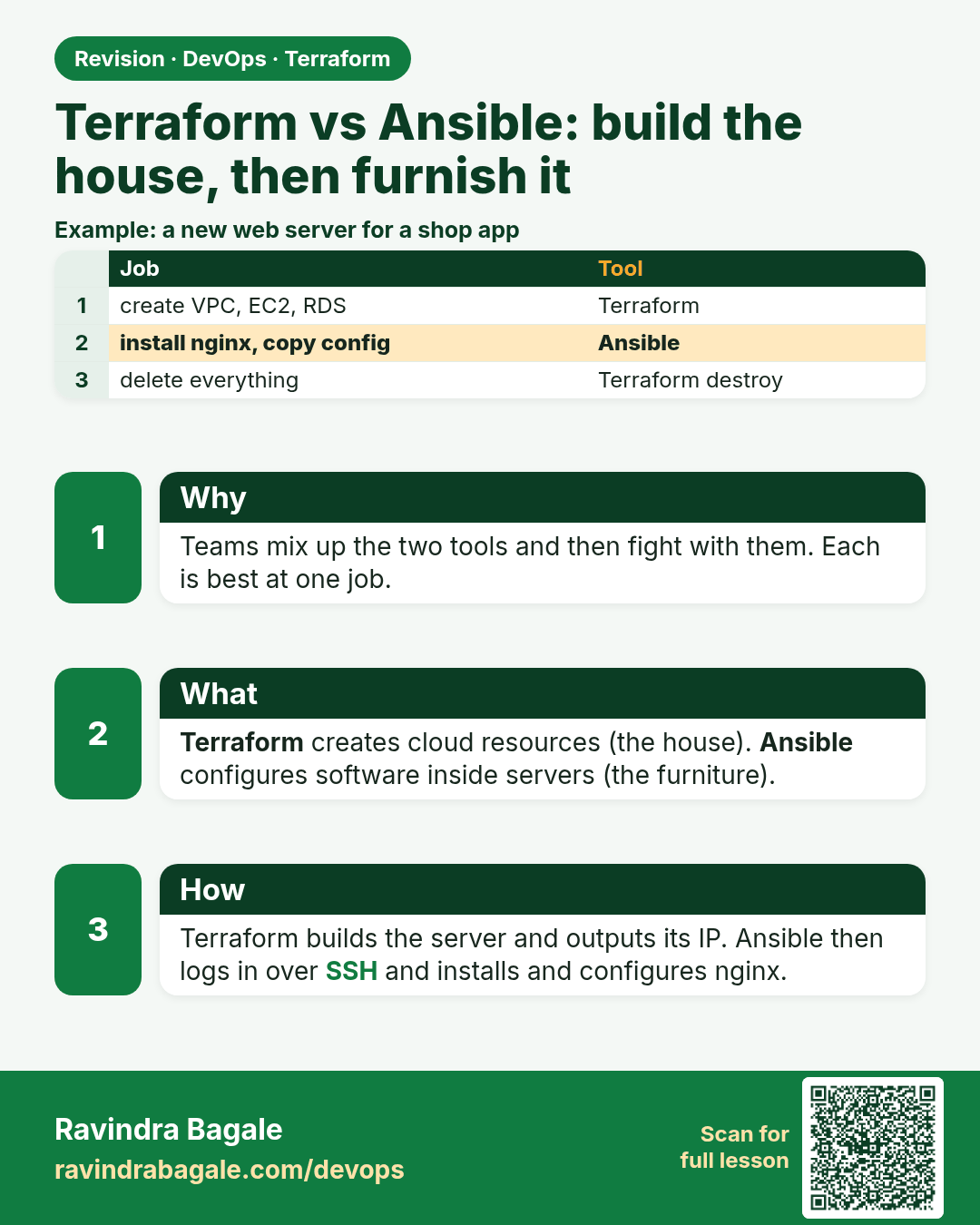
Terraform vs Ansible: build the house, then furnish it. Teams mix up the two tools and then fight with them. Each is best at one job.
Revision card 4 of 4: Terraform vs Ansible: build the house, then furnish it · Download PNG · Open card page

Lesson: 12.4 Terraform versus Ansible — build the house, then furnish it

Interview cards
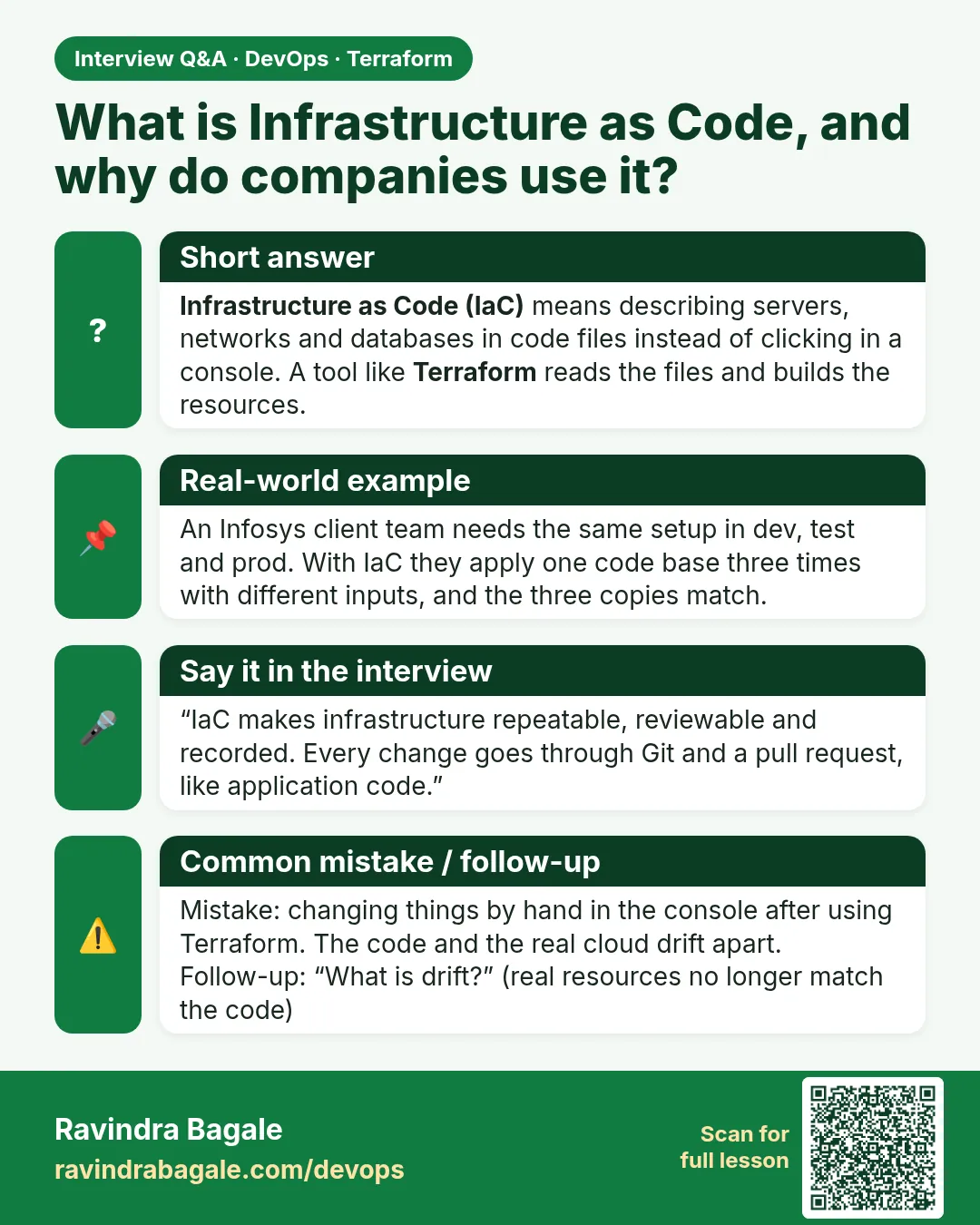
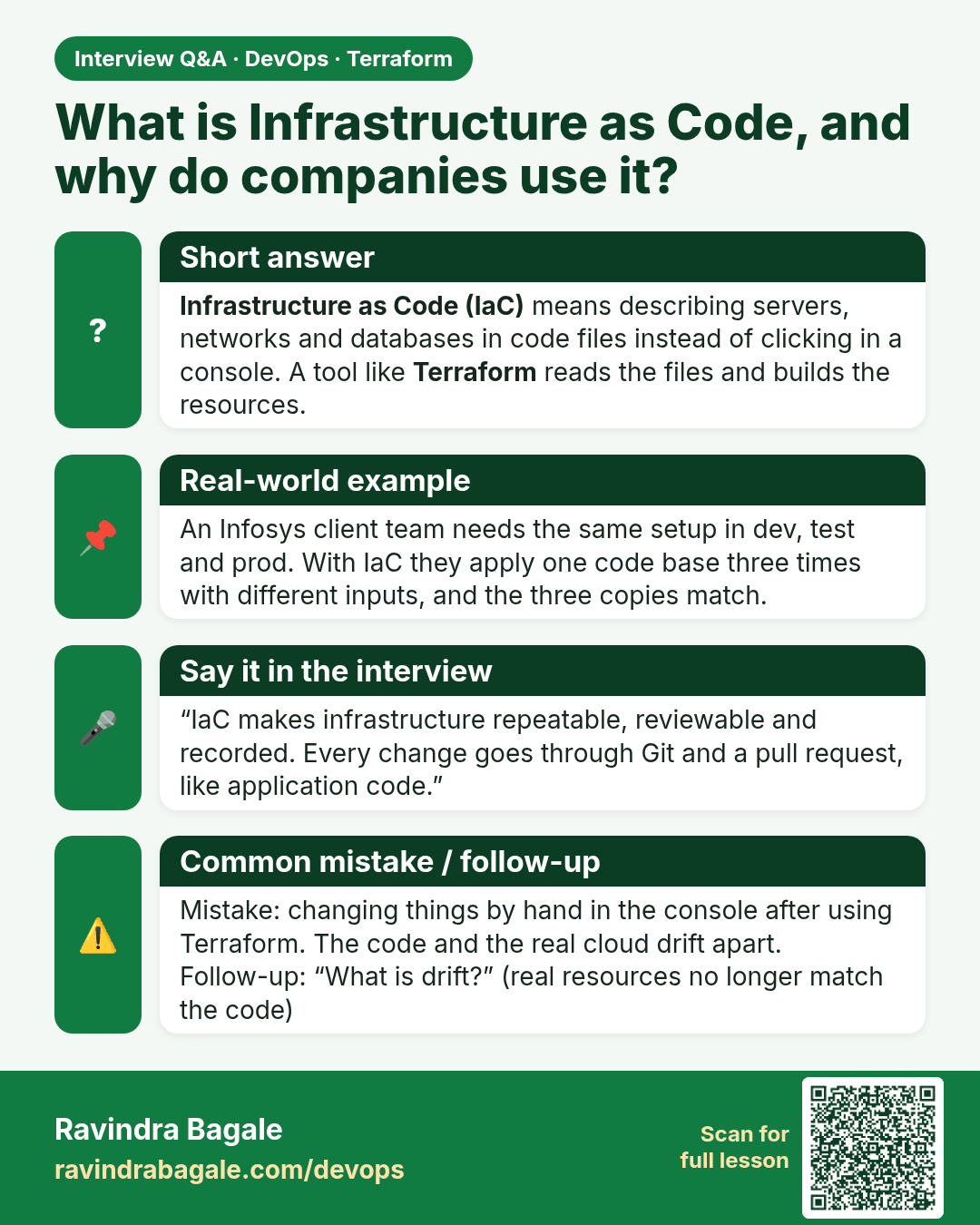
What is Infrastructure as Code, and why do companies use it? Infrastructure as Code (IaC) means describing servers, networks and databases in code files instead of clicking in a console. A tool like Terraform reads the files and builds the resources.
Interview card 1 of 4: What is Infrastructure as Code, and why do companies use it? · Download PNG · Open card page

Lesson: 12.1 Why IaC — console clicks versus code
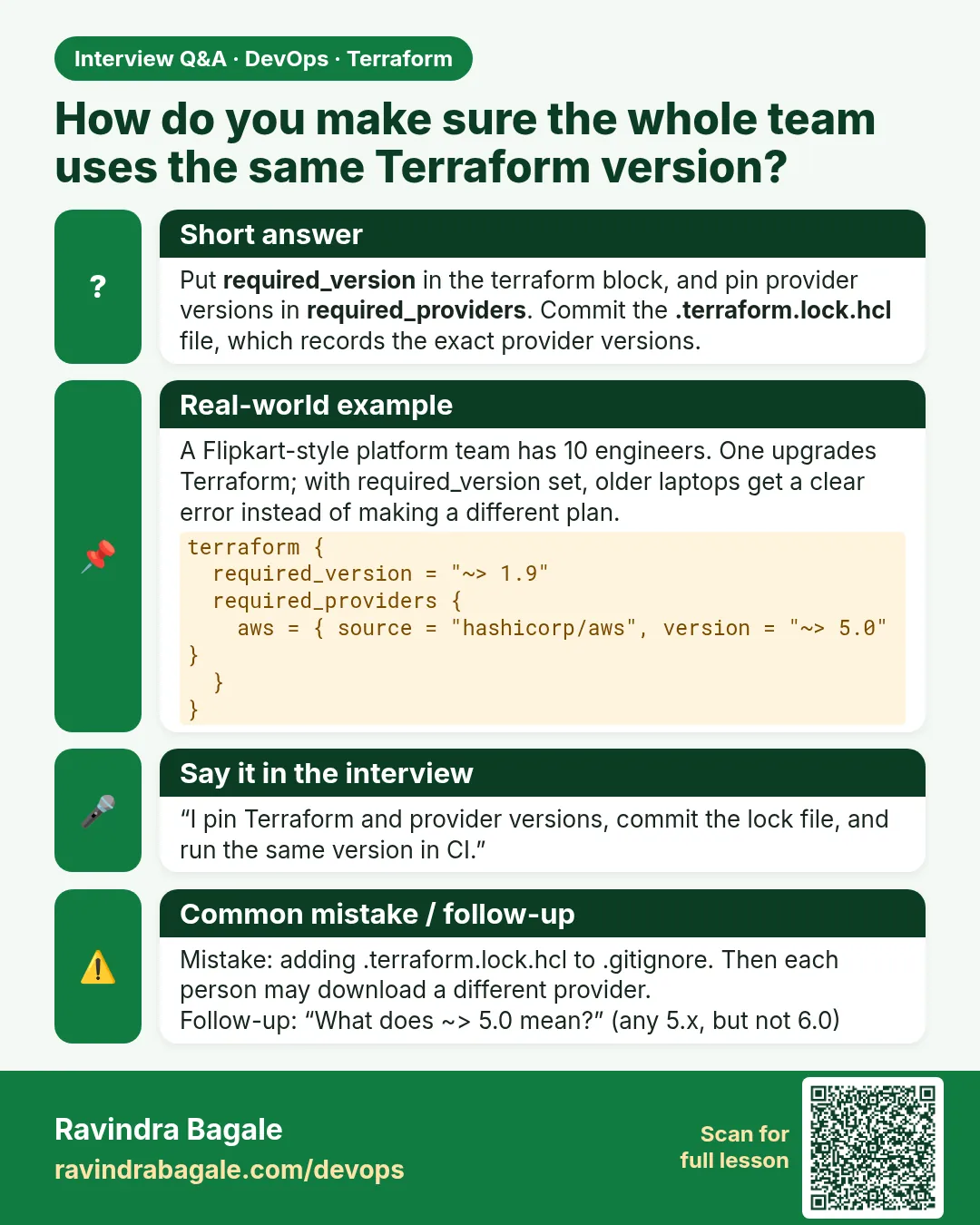
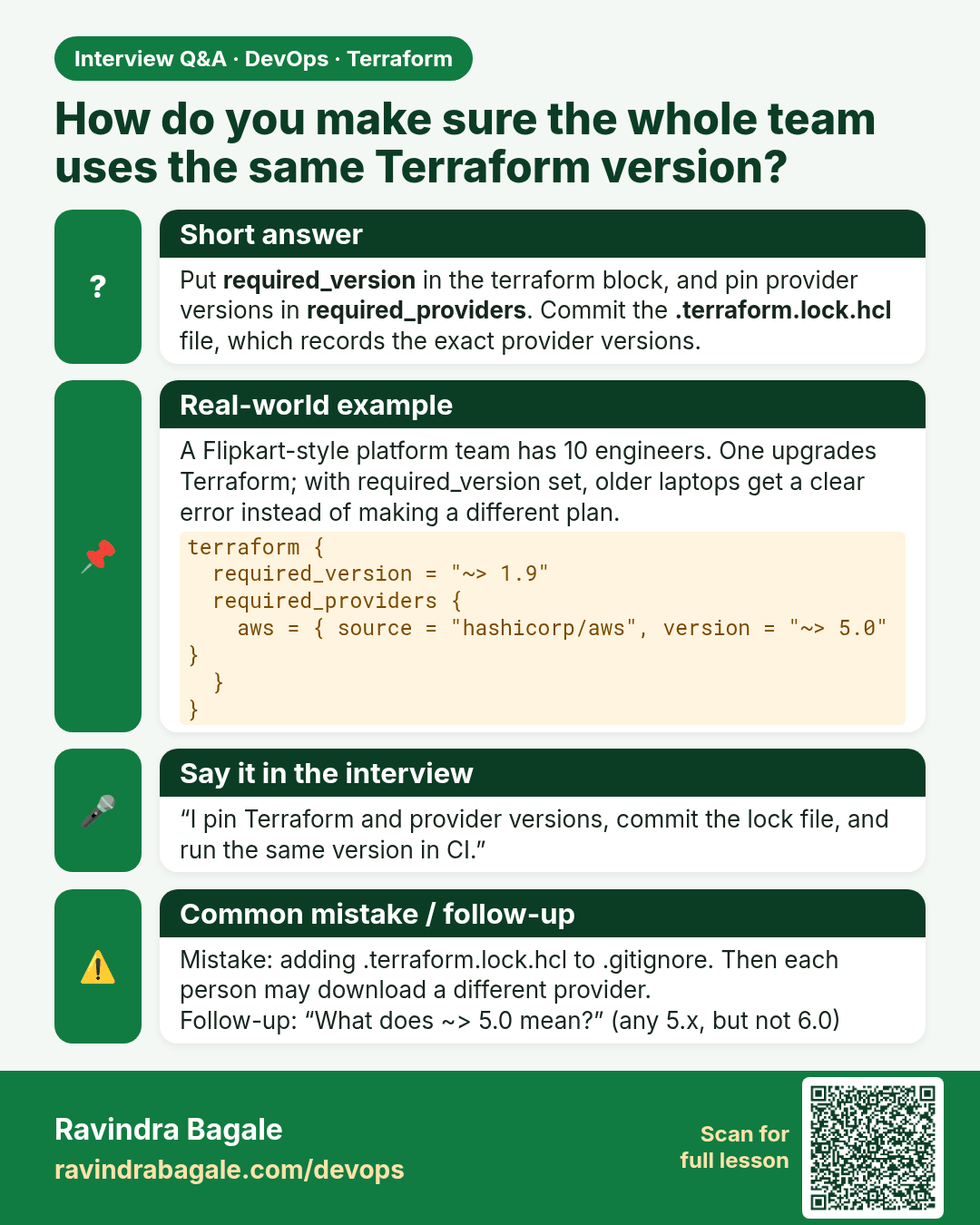
How do you make sure the whole team uses the same Terraform version? Put required_version in the terraform block, and pin provider versions in required_providers. Commit the .terraform.lock.hcl file, which records the exact provider versions.
Interview card 2 of 4: How do you make sure the whole team uses the same Terraform version? · Download PNG · Open card page

Lesson: 12.2 Install Terraform and check the version
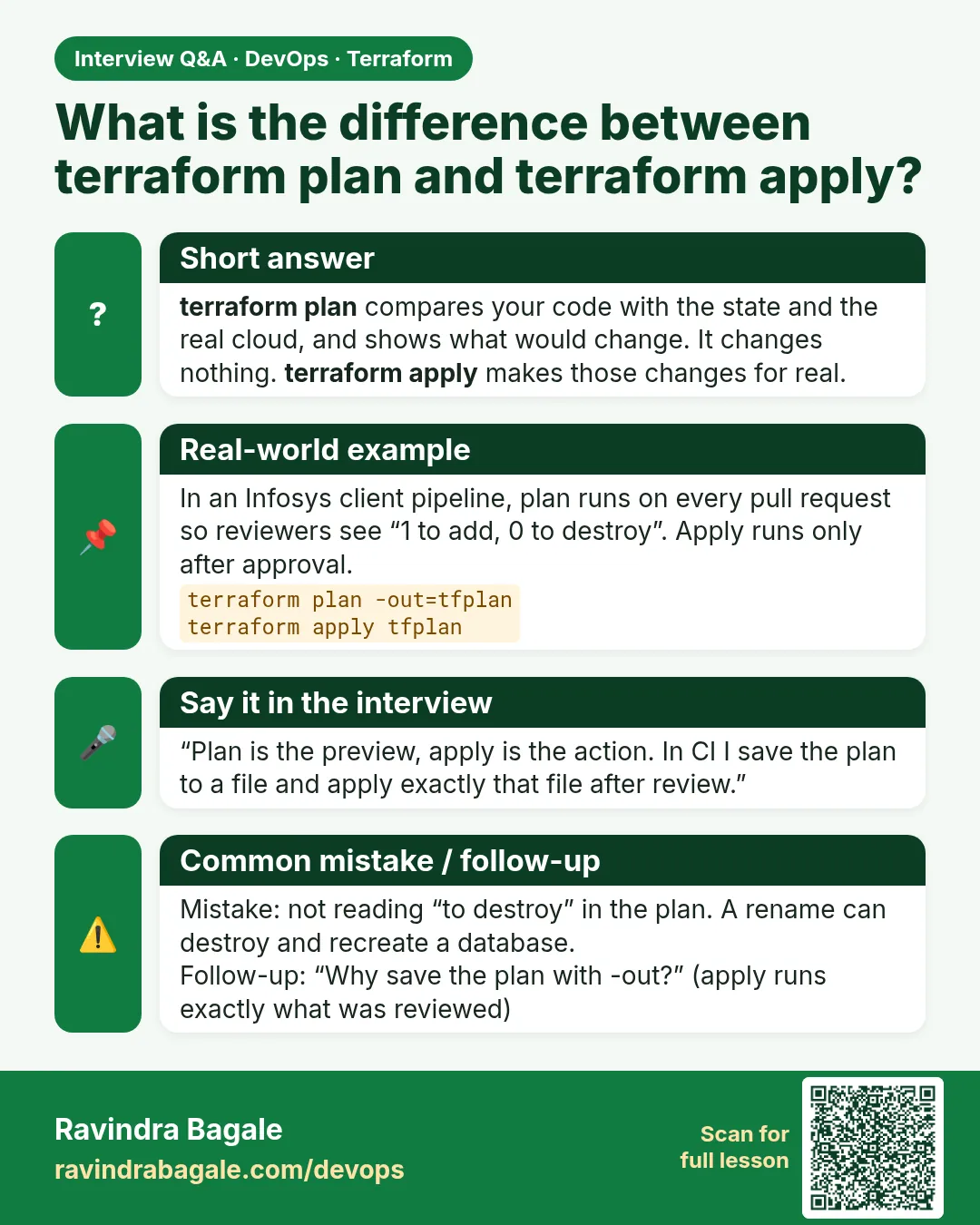
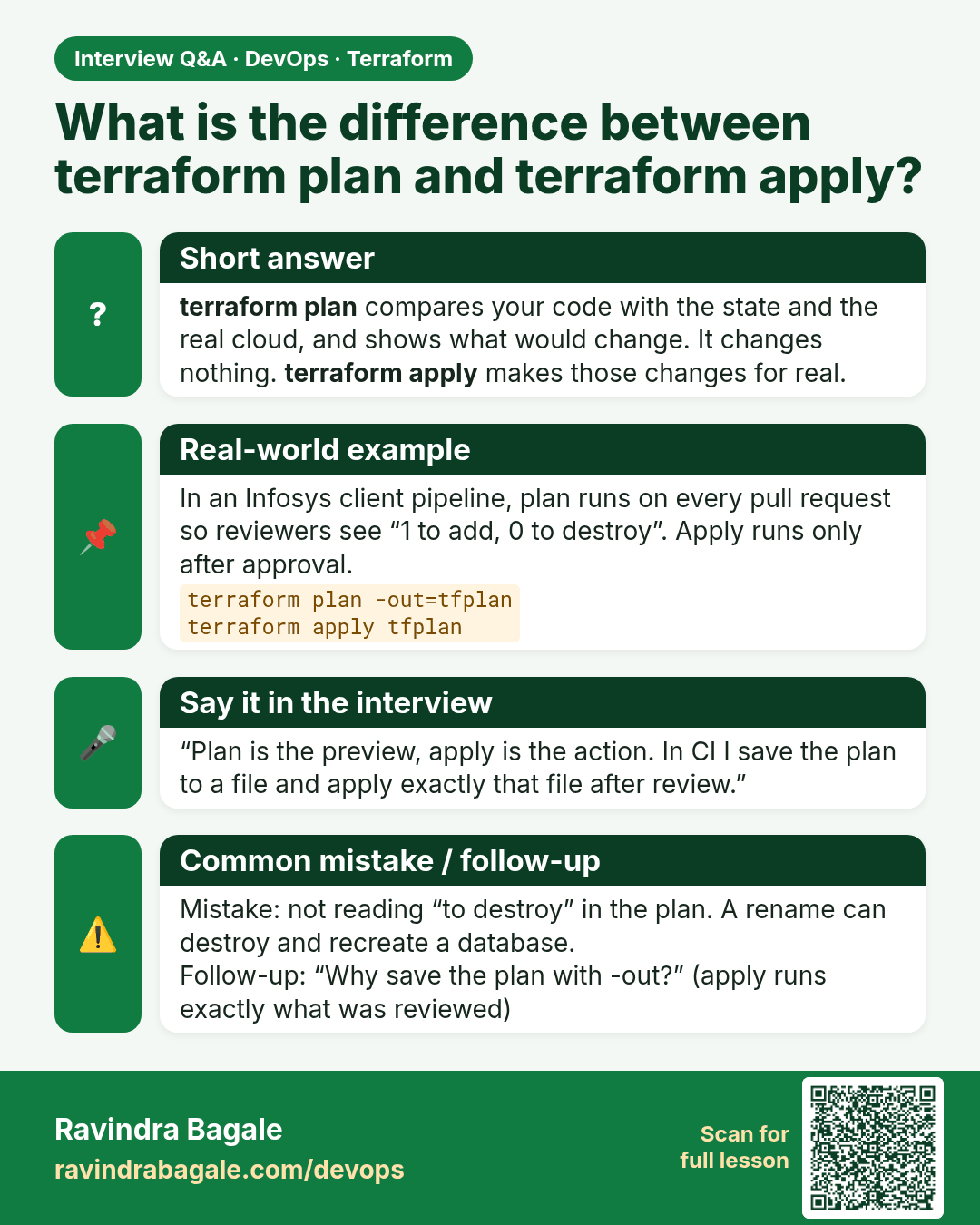
What is the difference between terraform plan and terraform apply? terraform plan compares your code with the state and the real cloud, and shows what would change. It changes nothing. terraform apply makes those changes for real.
Interview card 3 of 4: What is the difference between terraform plan and terraform apply? · Download PNG · Open card page

Lesson: 12.3 The core workflow — init, plan, apply, destroy
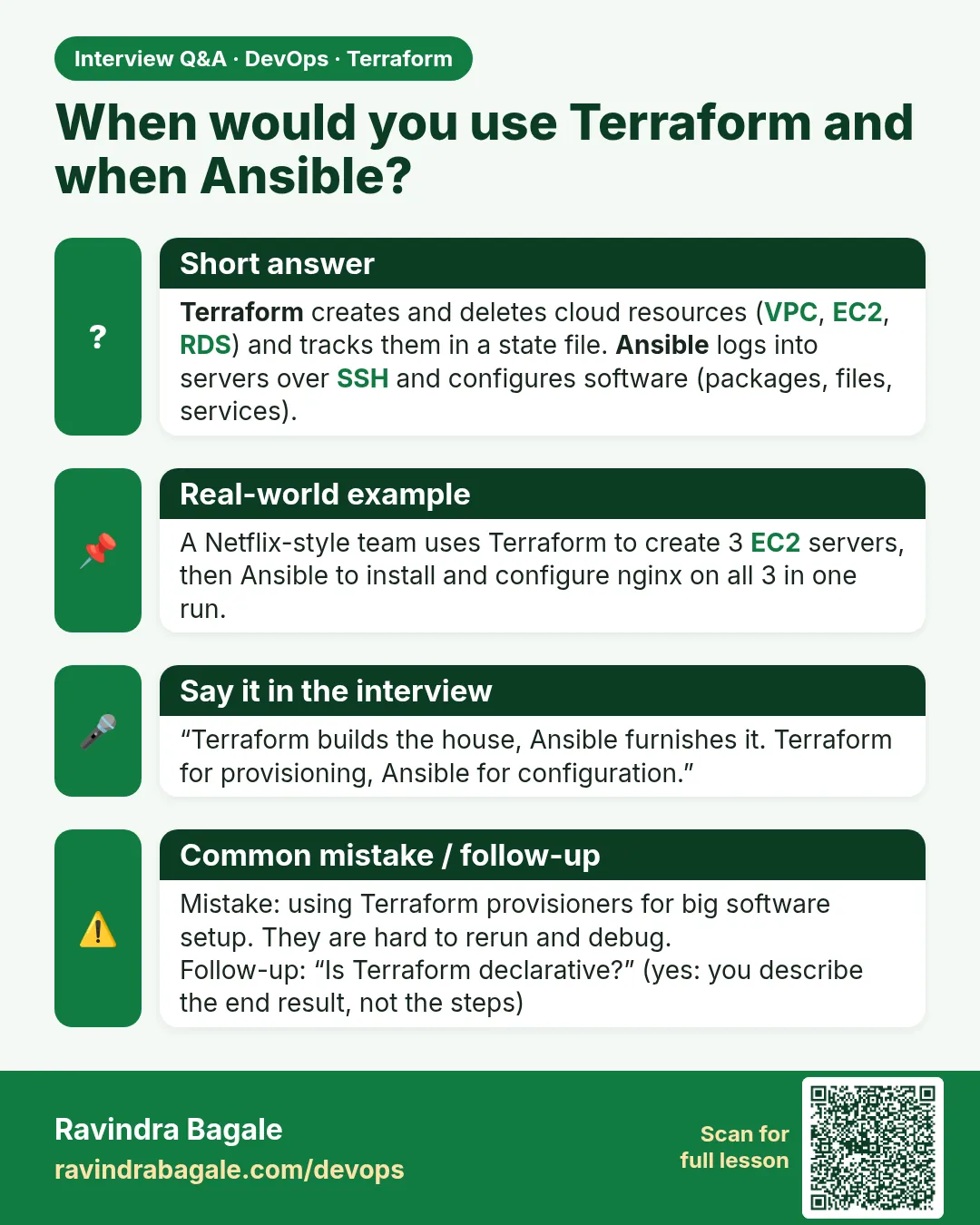
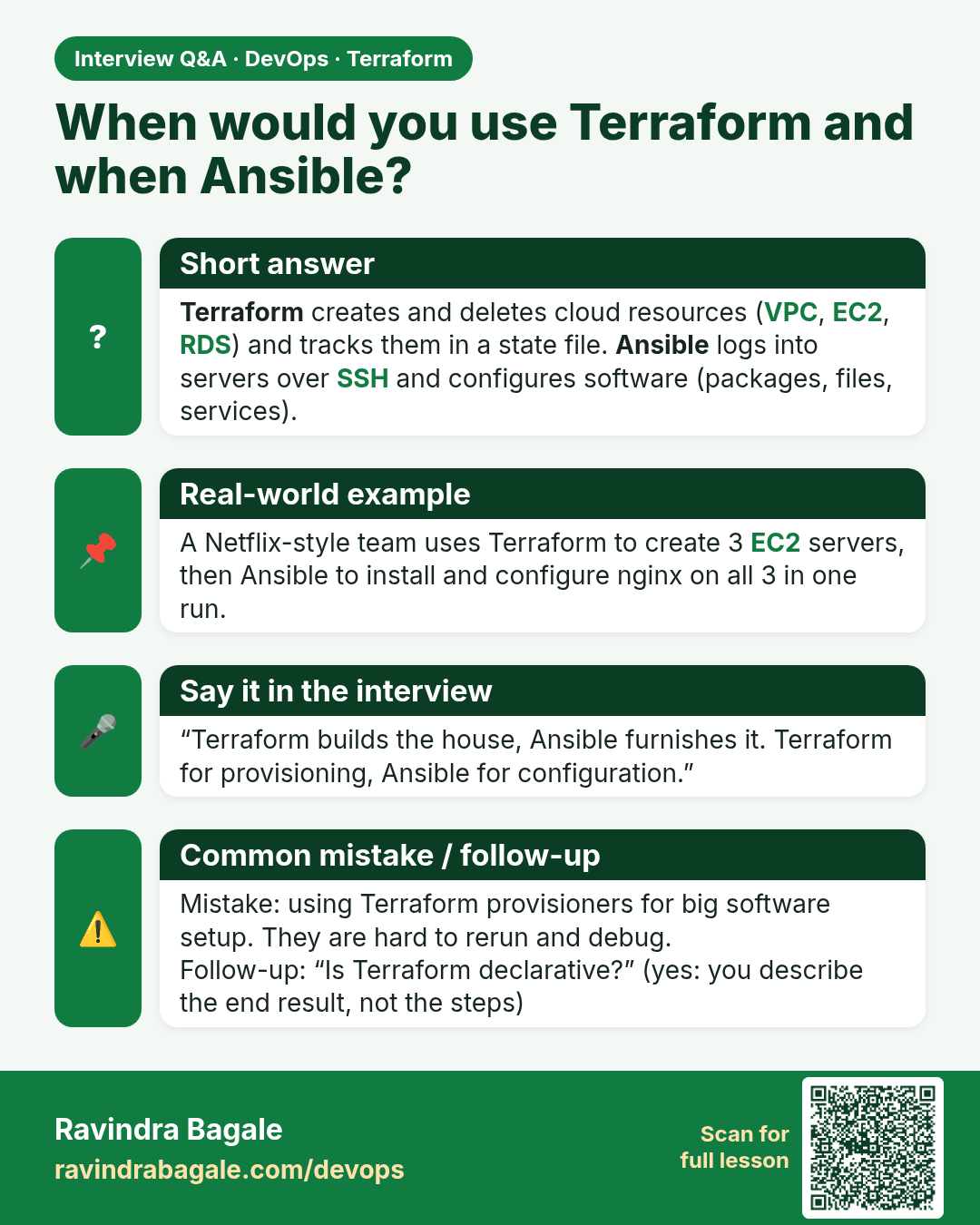
When would you use Terraform and when Ansible? Terraform creates and deletes cloud resources (VPC, EC2, RDS) and tracks them in a state file. Ansible logs into servers over SSH and configures software (packages, files, services).
Interview card 4 of 4: When would you use Terraform and when Ansible? · Download PNG · Open card page

Lesson: 12.4 Terraform versus Ansible — build the house, then furnish it

Comparison cards
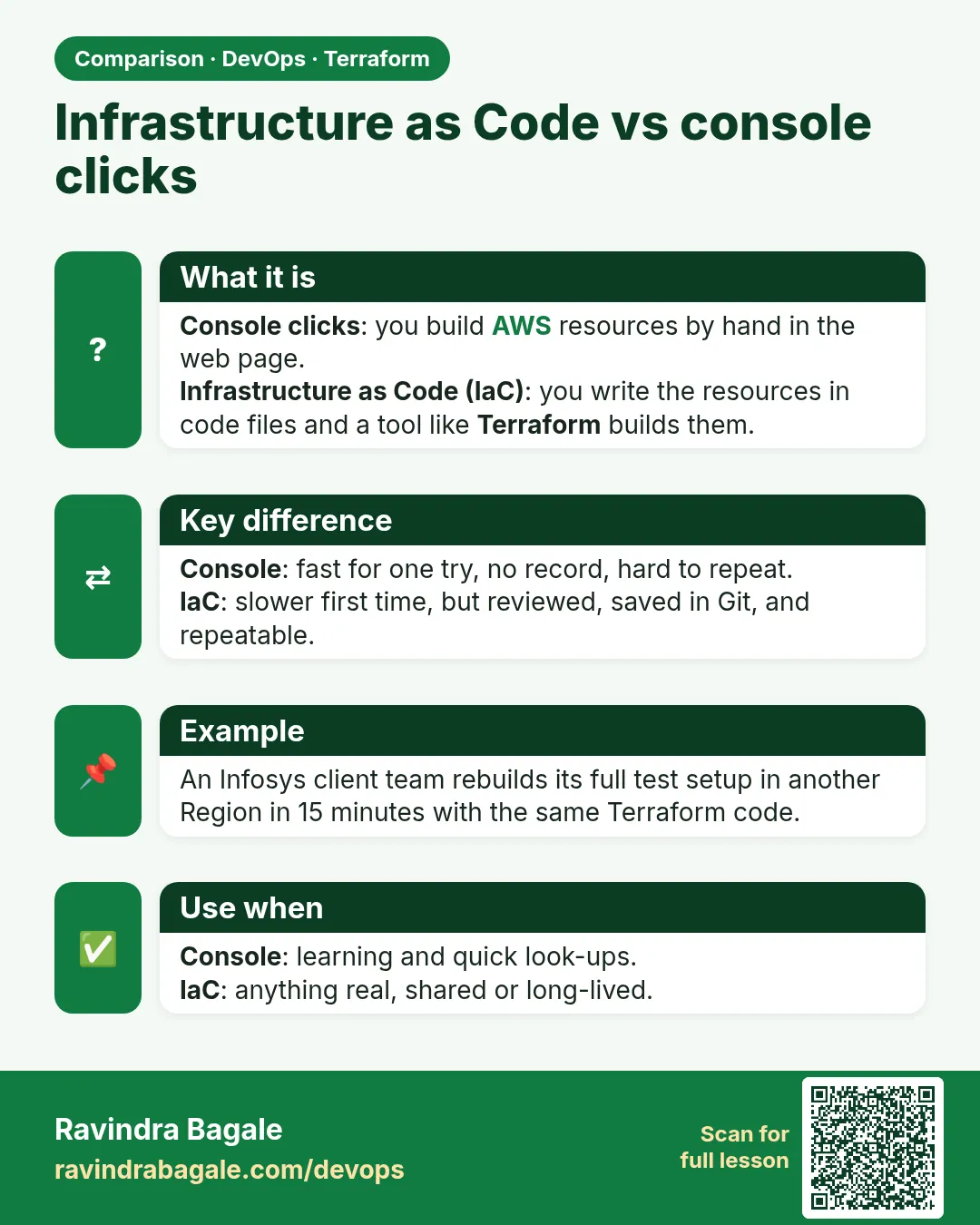
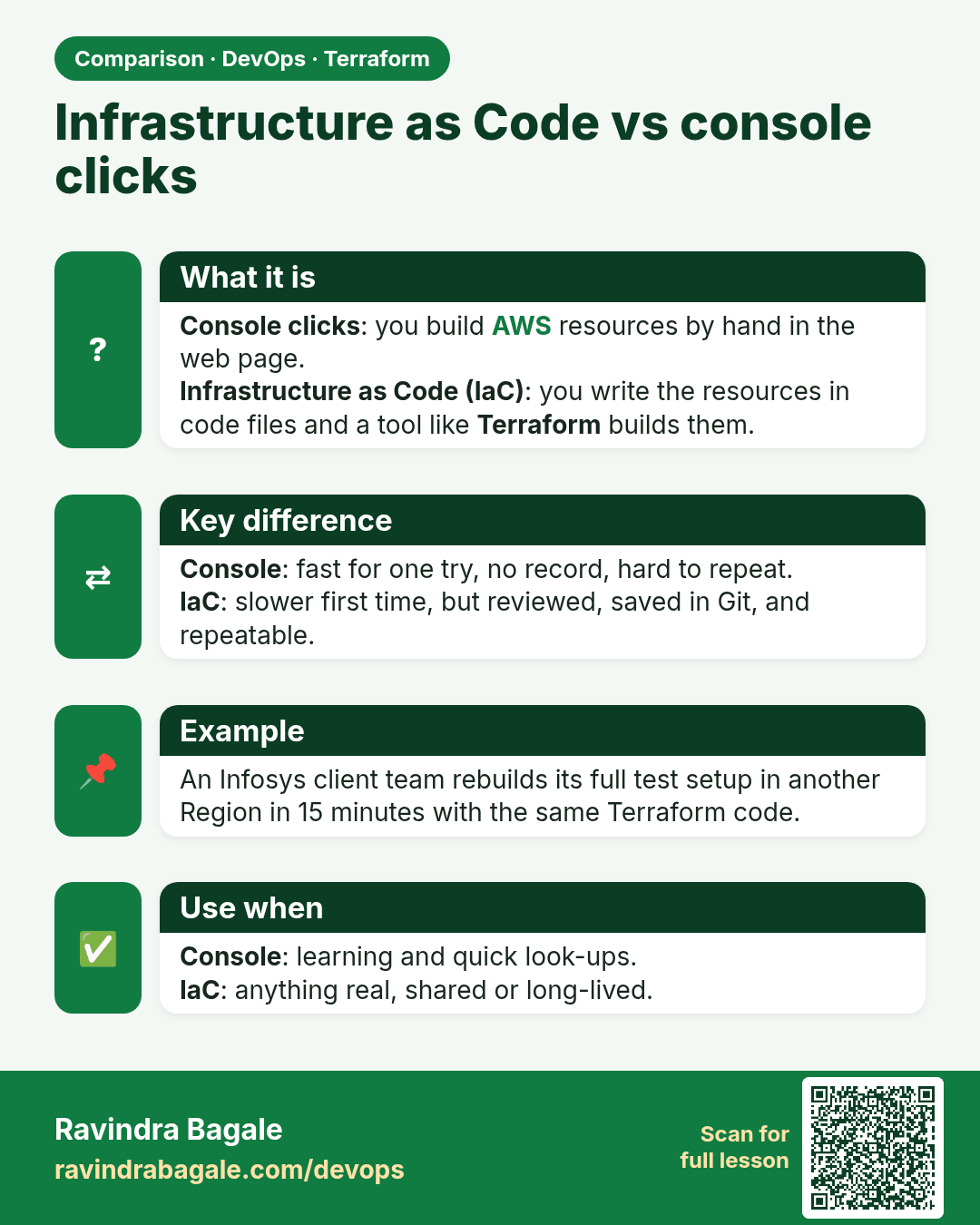
Infrastructure as Code vs console clicks. Console clicks: you build AWS resources by hand in the web page.Infrastructure as Code (IaC): you write the resources in code files and a tool like Terraform builds them.
Comparison card 1 of 3: Infrastructure as Code vs console clicks · Download PNG · Open card page

Lesson: Chapter 12: Terraform Introduction
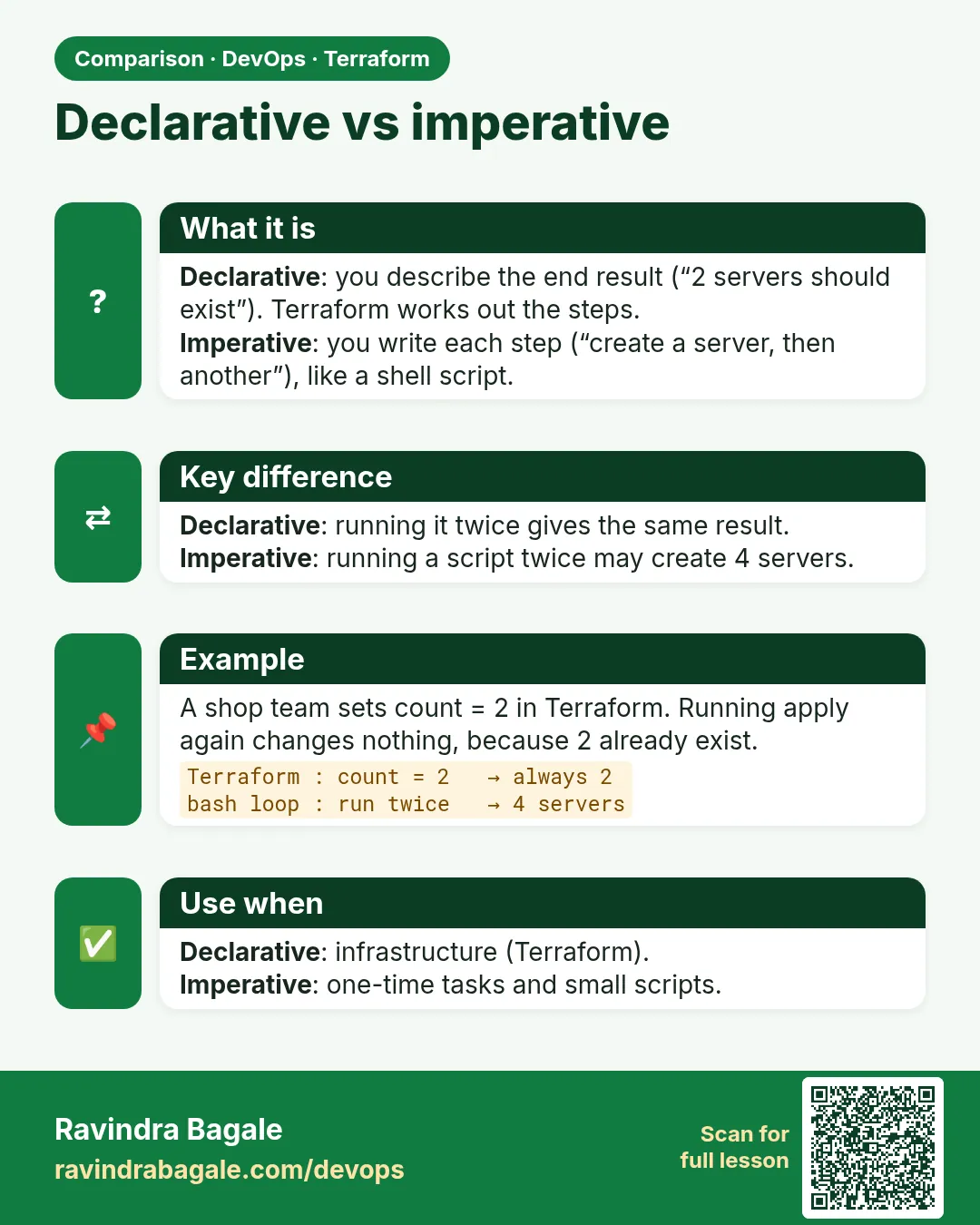
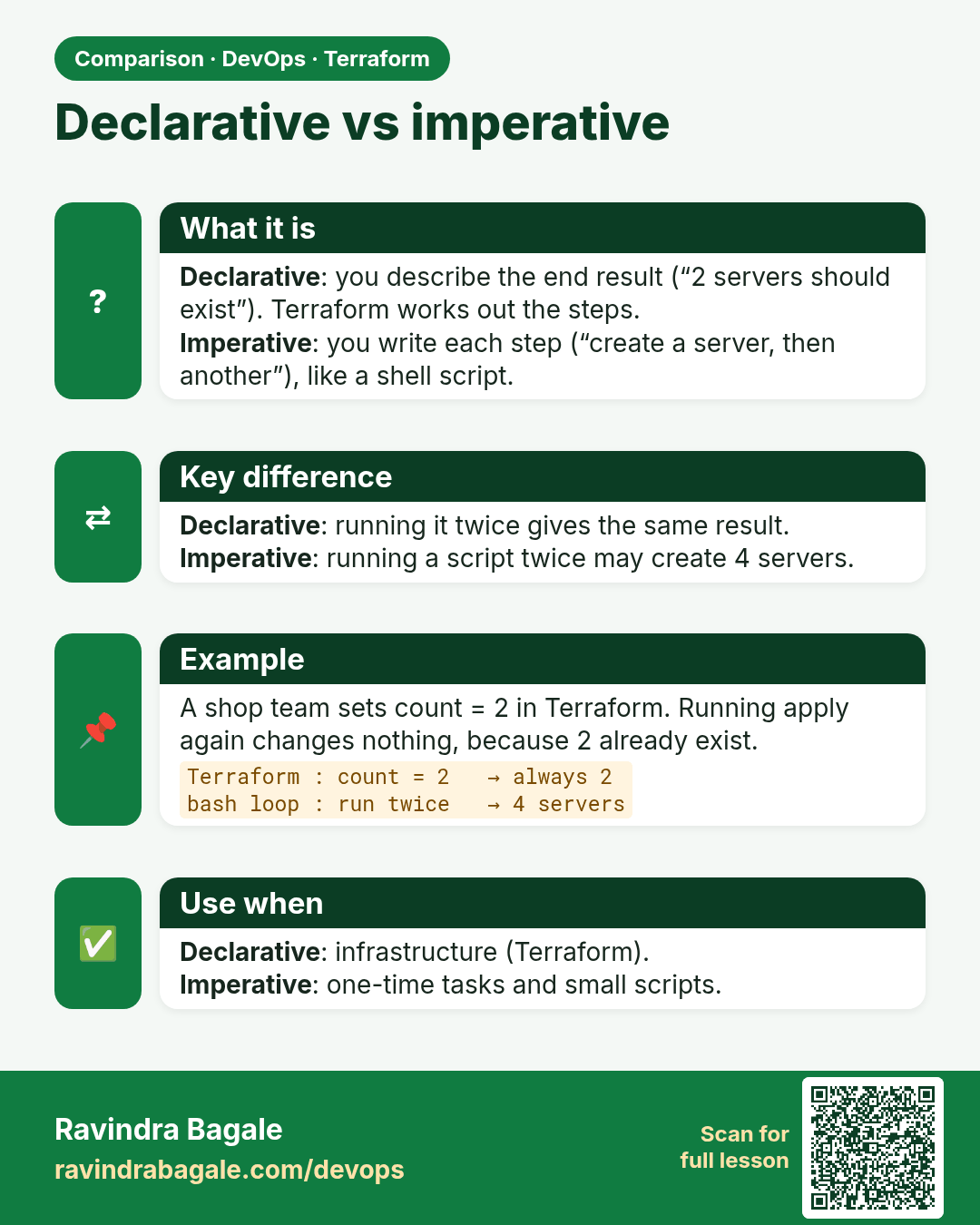
Declarative vs imperative. Declarative: you describe the end result (“2 servers should exist”). Terraform works out the steps.Imperative: you write each step (“create a server, then another”), like a shell script.
Comparison card 2 of 3: Declarative vs imperative · Download PNG · Open card page

Lesson: Chapter 12: Terraform Introduction
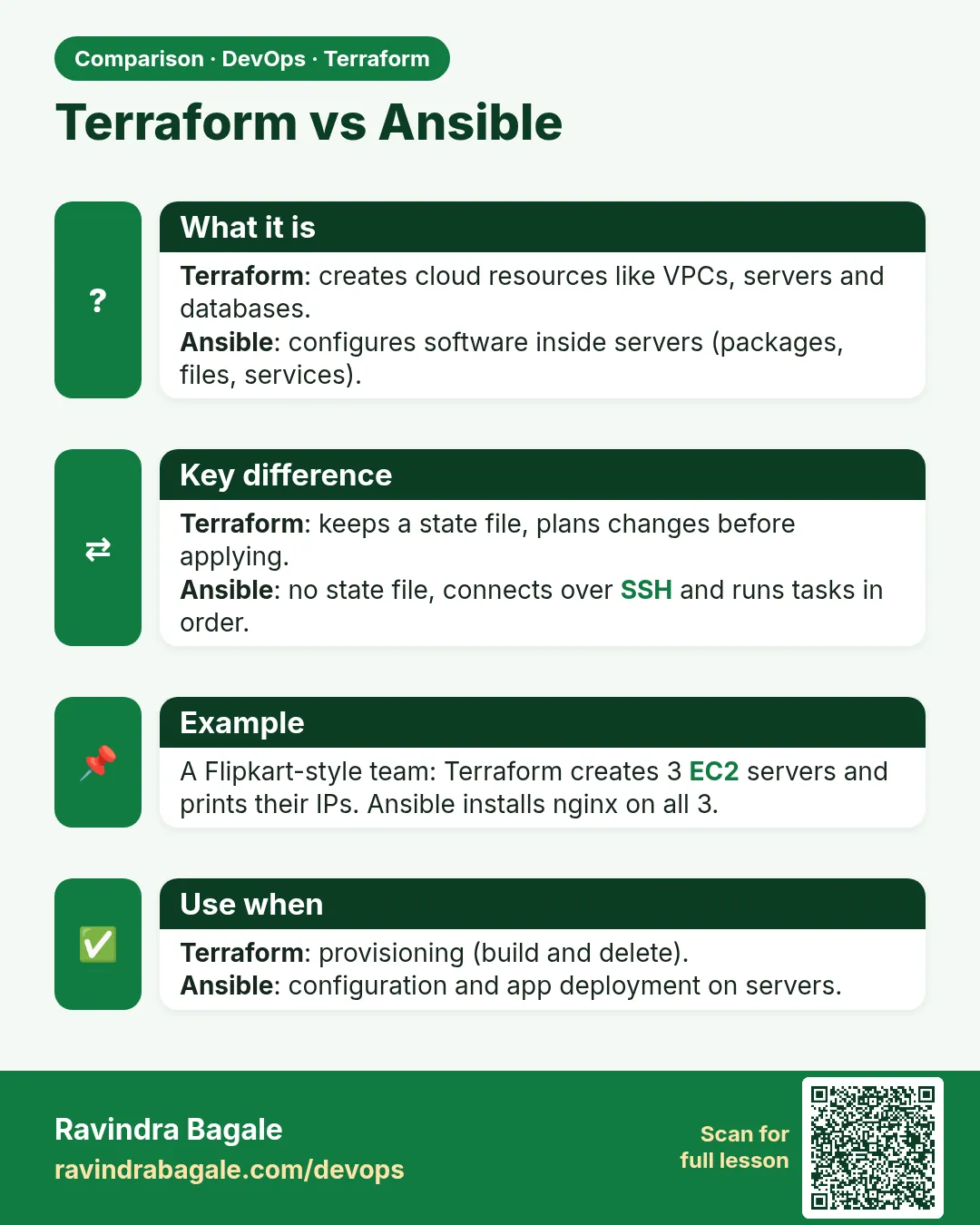
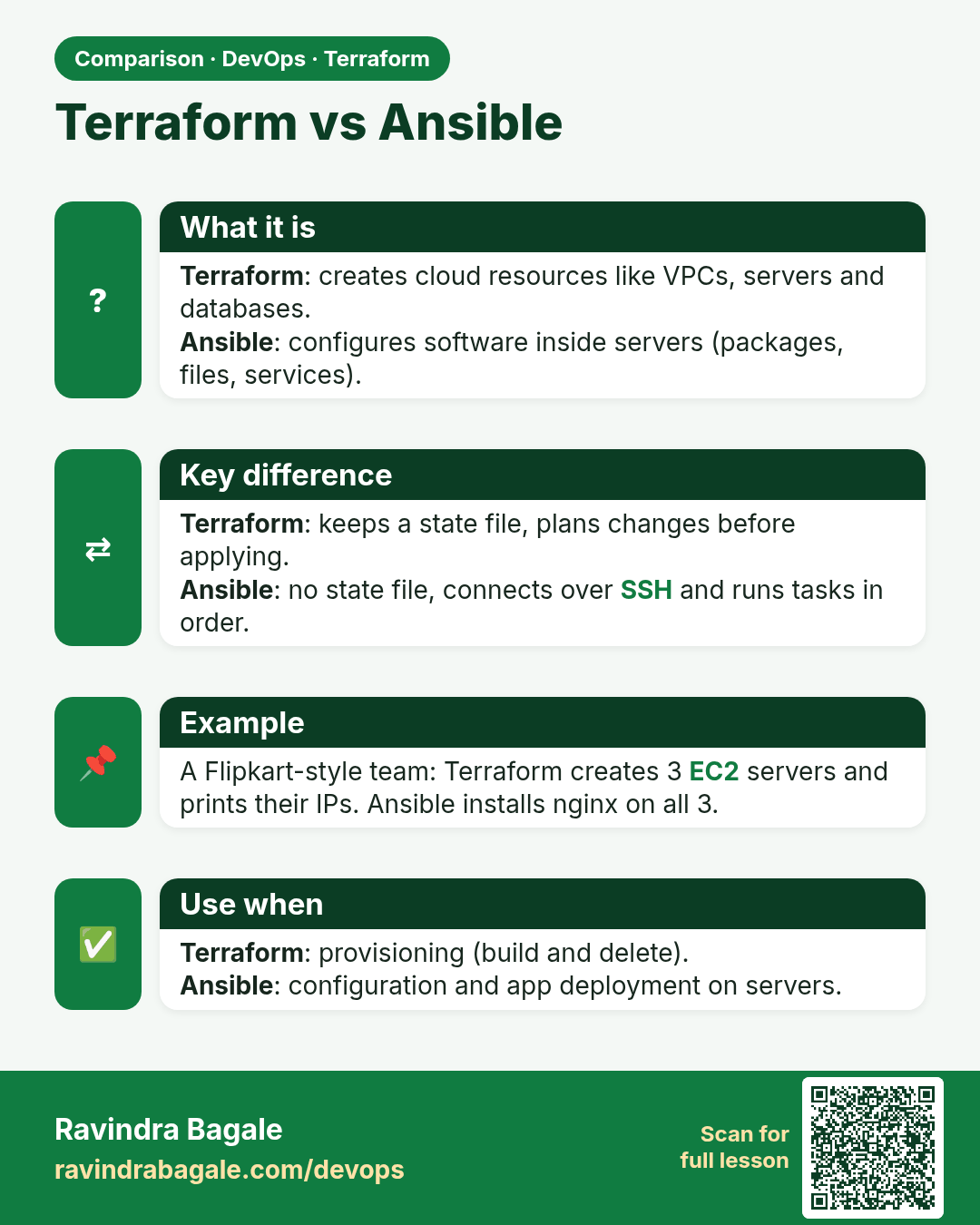
Terraform vs Ansible. Terraform: creates cloud resources like VPCs, servers and databases.Ansible: configures software inside servers (packages, files, services).
Comparison card 3 of 3: Terraform vs Ansible · Download PNG · Open card page

Lesson: Chapter 12: Terraform Introduction