Chapter 94: HashiCorp Vault and Secrets Management
94.4 Dev mode — a disposable local experiment only
Story (fictional teaching scenario). At a fictional Indore classroom, Aisha tells Luca from Rome that a convenient unlocked dev server is deliberately insecure, not a shortcut to production.
Why
An easy first run can hide the responsibilities of initialization, durable storage, TLS and root-token protection.
What
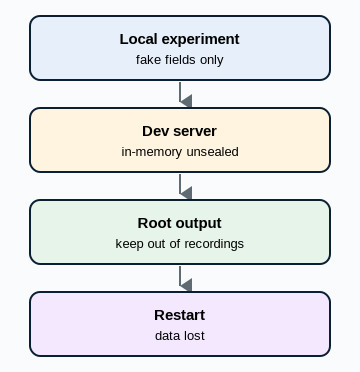
- Dev mode automatically initializes and unseals Vault, stores data in memory, and defaults to loopback without TLS.
- Root token has unrestricted access. Dev startup also prints sensitive initialization information.
- Loopback means the same computer only (127.0.0.1); it is not a production network boundary by itself.
- Restarting a dev server loses its data. It is not a backup source.
How
-
Use only an isolated disposable local session if a teacher provides Vault.
-
Never expose a dev listener on all network interfaces.
-
Do not copy startup logs into teaching screenshots.
-
For this chapter, use the Python model instead; no Vault binary is installed.
Example 1: Read the command, do not run on a shared server
- Read the command or request.
vault server -dev -dev-listen-address=127.0.0.1:18200
- Read the result.
Output (illustrative; NOT executed against Vault)
Dev server starts on loopback; initialization output intentionally omitted.
- Line by line:
serverstarts Vault.-devopts into insecure defaults. The listener flag restricts this example to loopback on a lab port. This command was NOT run. Real output includes sensitive material; this page does not reproduce it.
Ravindra Bagale's Tip
Dev mode is never a production deployment.
Dev mode कधीच production deployment नाही.
Dev mode कभी production deployment नहीं है.
Did you understand? Let us try it once more.