Chapter 94: HashiCorp Vault and Secrets Management
94.15 Troubleshooting — path, identity, policy or state?
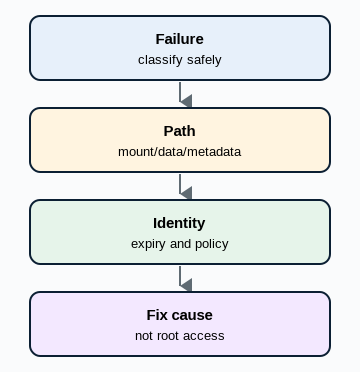
Story (fictional teaching scenario). At a fictional Jaipur firm, Grace from Leeds reads a denied response and first checks identity expiry instead of widening every policy.
Why
Classifying the failure prevents dangerous fixes made in a hurry.
What
- 403 can mean invalid/expired identity or insufficient policy; inspect safe diagnostics.
- 404 can mean a wrong mount/path or absent/deleted data; do not assume every 404 is a network failure.
- CAS mismatch means your expected version is stale.
- Sealed/unavailable is an operational state, not a reason to embed root credentials in the client.
How
-
Check the intended server/mount/version without exposing tokens.
-
Confirm the identity is valid and not expired/revoked.
-
Check capabilities on the exact API path.
-
Investigate cluster health with the responsible operator, not an app-side bypass.
Example 1: KV v2 path mismatch
- Read the command or request.
Policy grants secret/shop
Request is GET secret/data/shop
- Read the result.
Output (illustrative; NOT executed against Vault)
403 permission denied may result because the policy path does not match.
- Line by line: The CLI logical name is not the v2 API path. Fix the narrow policy after review. Do not grant secret/* just to make the error disappear.
Example 2: Stale write
- Read the command or request.
Read version1 -> another writer saves version2 -> write with CAS1
- Read the result.
Output (illustrative; NOT executed against Vault)
CAS mismatch; re-read and reconcile.
- Line by line: The failure is protection against lost updates. Blindly retrying without checking the new content defeats that protection.
Ravindra Bagale's Tip
Diagnose identity and exact path before changing permissions.
Permissions बदलण्याआधी identity आणि exact path तपासा.
Permissions बदलने से पहले identity और exact path जाँचो.
Did you understand? Let us try it once more.