Chapter 89: Amazon ECS for DevOps
89.9 ECS vs EKS comparison
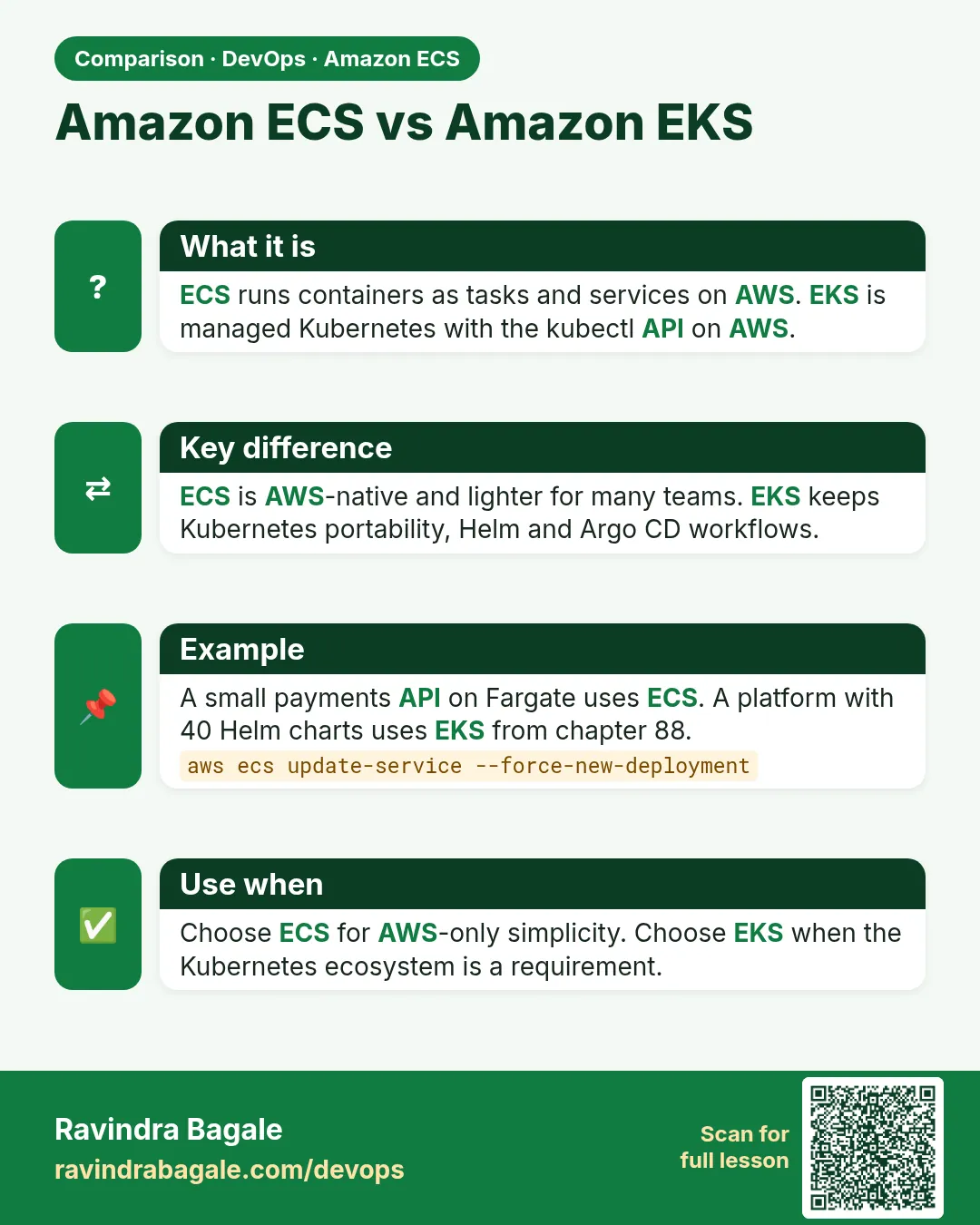
Story. In a Deloitte-style architecture review in Hyderabad, the client asked: ECS or EKS? Fatima drew one table. ECS — AWS-native tasks/services, faster for AWS-only teams, no kubectl. EKS — full Kubernetes API, Helm, Argo CD, multi-tool ecosystem, more moving parts (chapter 88). Both can use Fargate-style compute and ALBs. The choice was product need, not fashion. Keep the card below for interviews.
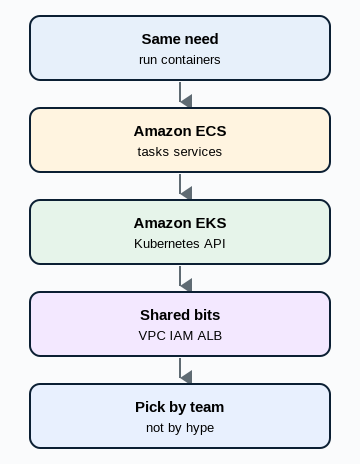
Why
Interviewers and architects will ask you to choose. A clear comparison beats buzzwords.
What
| Topic | Amazon ECS | Amazon EKS (ch 88) |
|---|---|---|
| API you learn | Tasks, services, task definitions | Pods, Deployments, Services, Ingress |
| Portability | Strong on AWS | Kubernetes API portability across clouds/vendors |
| GitOps / Helm | Possible with other tools; not native K8s | Natural fit for Helm (ch 85) and Argo CD (ch 86) |
| Control plane feel | ECS is the control plane you call via AWS APIs | Managed Kubernetes control plane (separate approximate fee) |
| IAM for apps | Task roles | IRSA (IAM Roles for Service Accounts) |
| Good default when | AWS-only, smaller platform team | You already standardised on Kubernetes |
How
- List must-haves: multi-cloud K8s? Existing Helm charts? Strict AWS-only?
- Score ops skills on your team honestly.
- Prototype one service both ways only if the decision is expensive — otherwise pick and measure.
- Revisit if you outgrow ECS scheduling features or drown in EKS toil.
Example 1: Same app, two mental models
ECS:  task definition → service desiredCount=2 → ALB target group
EKS:  Deployment replicas=2 → Service → Ingress → AWS Load Balancer Controller
What it shows: Same user outcome (two replicas behind HTTPS). Different objects and skills.
Example 2: Rough cost-shape reminder
ECS: pay for Fargate/EC2 + ALB + logs (no EKS-style per-cluster control-plane fee)
EKS: approximate control-plane hourly fee + nodes/Fargate + ALB + logs
(All approximate — verify on current AWS pricing pages.)
What it shows: Fee shapes differ. Run numbers for your size; do not memorise old blog prices.
Ravindra Bagale's Tip
Say in interviews: ECS for AWS-native simplicity; EKS when the Kubernetes ecosystem is a requirement — then name one trade-off.
Interview मध्ये: ECS = AWS-native simple; EKS = Kubernetes ecosystem हवं — नंतर एक trade-off सांगा.
Interview में: ECS = AWS-native simple; EKS = Kubernetes ecosystem चाहिए — फिर एक trade-off बताएं.
Quick quiz
Q1. Name one reason to pick ECS over EKS.
AWS-only team wants containers without learning the Kubernetes API and ecosystem.
Q2. Name one reason to pick EKS over ECS.
You need Kubernetes portability, Helm/Argo workflows, or existing K8s skills/charts.
Q3. Do both need VPC and IAM design?
Yes — neither removes networking or identity work.
Did you understand? Let us try it once more.