Chapter 89: Amazon ECS for DevOps
89.1 Why ECS — when Kubernetes is more than you need
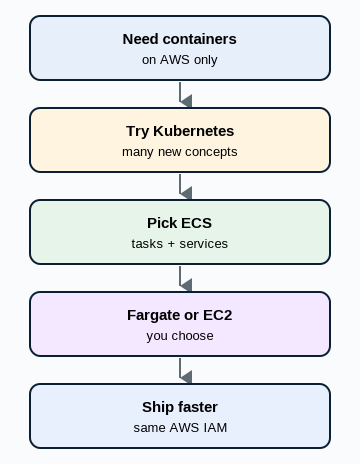
Story. At a Flipkart-style catalogue API team in Bengaluru, Rohan ran six microservices. A platform lead pushed everyone toward Kubernetes. Rohan's team spent three sprints on Ingress, Helm values, IRSA and node upgrades — and still had only two services live. Priya on a sister team used Amazon ECS on Fargate. She defined a task, attached an Application Load Balancer, and shipped. On-call pages dropped. Kubernetes was not wrong — it was more than that product needed. ECS gave them containers, scaling and AWS IAM without learning pods, Controllers and CNI first. That is why many AWS-only teams pick ECS: less cluster toil when the Kubernetes ecosystem is not a must.
Why
Not every product needs the Kubernetes API. If your team lives on AWS and wants containers with clear IAM and load balancing, ECS can be the shorter path.
What
- ECS — Elastic Container Service. AWS service that runs Docker containers as tasks.
- Task — One or more containers that start together (like a small pod idea, but ECS vocabulary).
- Service — Keeps a desired count of tasks running and can attach a load balancer.
- Cluster — Logical group where your services and tasks run (EC2 capacity or Fargate).
- EKS — Managed Kubernetes (chapter 88). Different API: kubectl, Deployments, Ingress.
How
- Ask: do we need Kubernetes portability and the K8s ecosystem, or AWS containers only?
- If AWS-only and a small ops team: start with ECS (often Fargate).
- If you already standardised on Helm, Argo CD and kubectl: EKS may fit better (chapter 88).
- Either way, put images in ECR and treat prices as approximate on the AWS pricing page.
Example 1: List clusters in a Region
aws ecs list-clusters --region ap-south-1
Output
{
    "clusterArns": [
        "arn:aws:ecs:ap-south-1:123456789012:cluster/shop-prod"
    ]
}
What it shows: At least one ECS cluster exists in ap-south-1. The account id is an example — use yours. Empty list means you have not created a cluster yet.
Example 2: Approximate cost note (not a quote)
ECS control plane: no separate "cluster fee" like EKS's managed control plane charge
You pay for: Fargate vCPU/memory hours, or EC2 instances, plus ALB, NAT, CloudWatch
(approximate — always check the current AWS pricing pages before you budget)
What it shows: ECS pricing shape differs from EKS. EKS bills a managed control plane per cluster (see chapter 88). ECS charges mainly for compute and attached AWS resources. Numbers change — verify officially.
Ravindra Bagale's Tip
Choose ECS when Kubernetes concepts would slow a small AWS-only team. Choose EKS when you need the Kubernetes API and ecosystem.
छोट्या AWS-only team ला Kubernetes slow करतं तर ECS. Kubernetes API आणि ecosystem हवं तर EKS.
छोटी AWS-only team को Kubernetes धीमा करे तो ECS. Kubernetes API और ecosystem चाहिए तो EKS.
Quick quiz
Q1. What is Amazon ECS?
Elastic Container Service — AWS runs your containers as tasks and services.
Q2. When might ECS beat EKS for a team?
When they need containers on AWS without Kubernetes control-plane and ecosystem work.
Q3. Why mark prices approximate?
AWS pricing changes; always check the current official price pages.
Did you understand? Let us try it once more.