Chapter 89: Amazon ECS for DevOps
89.2 Cluster, task definition and service
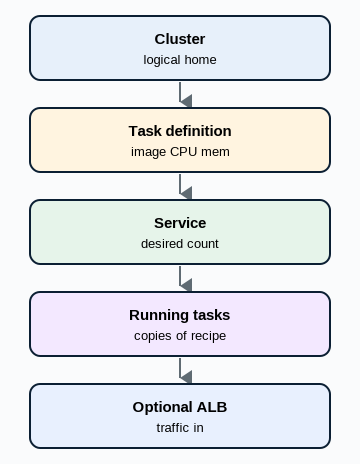
Story. Meera in Pune explained ECS to a junior with three boxes on a whiteboard. The cluster is the parking lot. The task definition is the recipe: which image, CPU, memory, ports and roles. The service is the manager that keeps N copies of that recipe running and can register them with a load balancer. Once the junior saw recipe versus running copies, aws ecs create-service stopped looking magical.
Why
If you mix up task definition and service, you will update the wrong thing and wonder why traffic still hits the old image.
What
- Cluster — Named place ECS schedules into (with Fargate capacity providers or EC2 instances).
- Task definition — Versioned JSON/YAML family: container image, CPU, memory, port mappings, logs, roles.
- Task — One running copy created from a task definition revision.
- Service — Long-running controller: desired count, deployment strategy, load balancer hooks.
- Revision — Each
register-task-definitioncreates a new revision number (shop-api:3).
How
- Create a cluster (Console, CLI or Terraform).
- Register a task definition with your container image and resources.
- Create a service that points at that task definition and a desired count.
- Update the service when you want a new revision or a new count.
Example 1: Describe a service
aws ecs describe-services --cluster shop-prod --services pay-api --region ap-south-1 \
  --query 'services[0].{status:status,desired:desiredCount,running:runningCount,td:taskDefinition}' --output table
Output
----------------------------------------------------------------
|                       DescribeServices                       |
+---------+------------+----------+----------------------------+
|  desired|  running   |  status  |  td                        |
+---------+------------+----------+----------------------------+
|  2      |  2         |  ACTIVE  |  arn:...:task-definition/pay-api:7 |
+---------+------------+----------+----------------------------+
What it shows: The service wants 2 tasks, 2 are running, and they use task definition revision 7.
Example 2: Shape of a tiny Fargate task definition (excerpt)
{
  "family": "pay-api",
  "networkMode": "awsvpc",
  "requiresCompatibilities": ["FARGATE"],
  "cpu": "256",
  "memory": "512",
  "containerDefinitions": [
    {
      "name": "pay-api",
      "image": "123456789012.dkr.ecr.ap-south-1.amazonaws.com/pay-api:1.4.0",
      "portMappings": [{ "containerPort": 8080, "protocol": "tcp" }]
    }
  ]
}
What it shows: Family name, Fargate compatibility, CPU/memory at task level, and one container image with port 8080. Account id and tag are examples.
Ravindra Bagale's Tip
Task definition = recipe. Service = keep N copies healthy. Cluster = where those copies run.
Task definition = recipe. Service = N copies healthy ठेव. Cluster = कुठे चालतात.
Task definition = recipe. Service = N copies healthy रखो. Cluster = कहाँ चलते हैं.
Quick quiz
Q1. What does a task definition hold?
Image, CPU, memory, ports, roles and log settings for containers.
Q2. What does an ECS service do?
Keeps a desired number of tasks running and can attach a load balancer.
Q3. What is a revision?
A new version number of a task definition family after you register again.
Did you understand? Let us try it once more.