Chapter 17: Interview Questions and Job Readiness
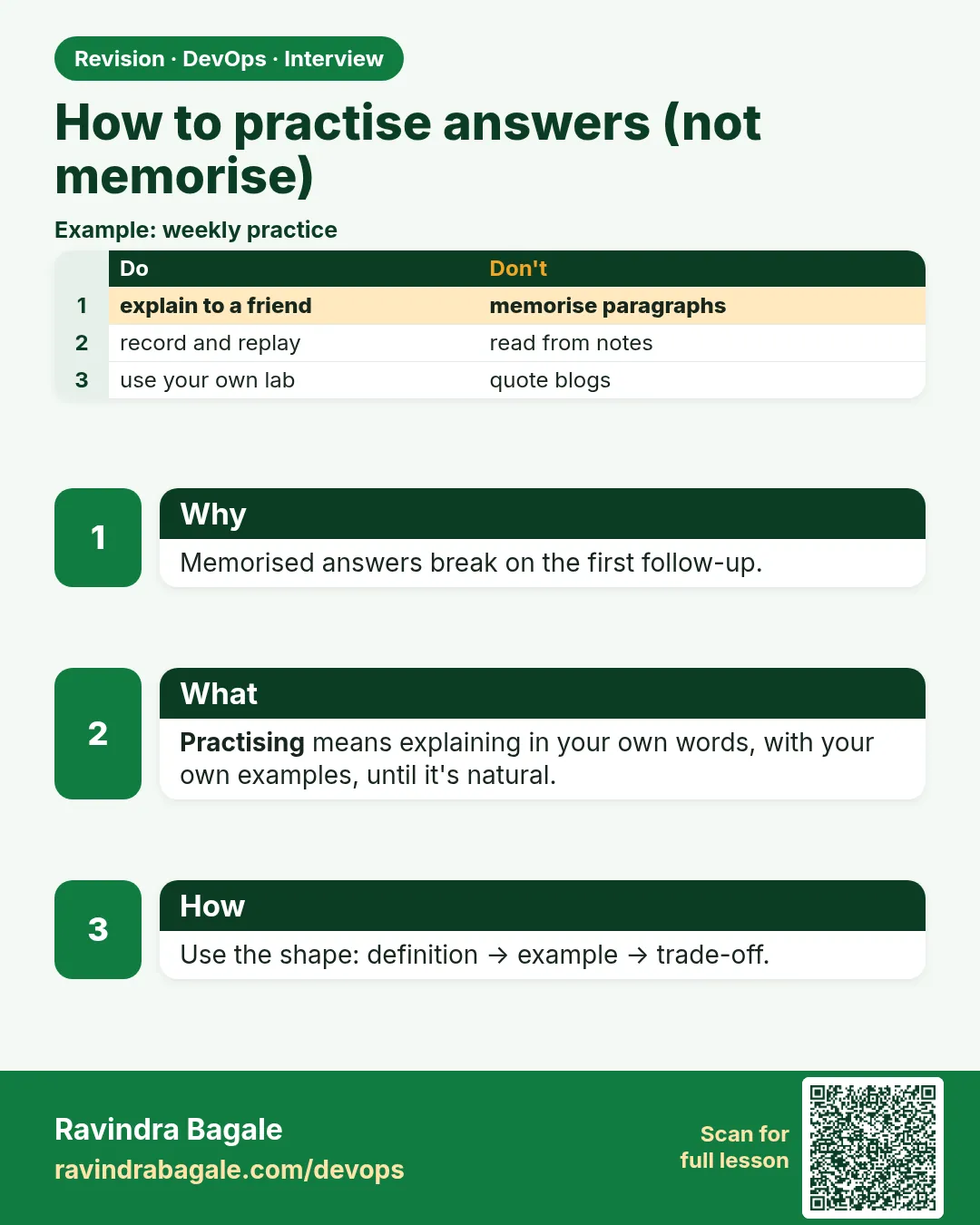
17.10 How to practise answers (not memorise)
Why: the problem
Many freshers memorise 200 answers from a list. In the room, the panel at Accenture asks the same question in a new way, "Your Docker image works on your laptop but not on the server", and the memorised answer does not fit. They freeze. Panels change the words on purpose to check understanding. The fix is to practise like a musician, not like a parrot: you run the thing, you break it, and you say what you saw in your own words, with a timer. This lesson gives you a hands-on practice system. You will build a small question bank file on your laptop, a random picker script, a timer, and a scoring sheet. You will record answers, listen back, and improve them using a fixed shape. Ten minutes a day for two weeks beats a whole night of reading.
What we will build
You will create a practice folder with a questions file, a Python script that picks random questions and times your answer, and a score log in CSV. You will practise the 4-line answer shape, Situation, Check, Fix, Prevent, and the STAR shape for behaviour questions. You will turn three weak answers into strong ones.
What: every term in plain English
- Question bank — A simple text file of questions you collect, one per line, with a topic tag.
- Random drill — Picking questions at random so you cannot rely on order.
- 4-line shape — Situation, Check, Fix, Prevent. Works for any technical scenario.
- STAR — Situation, Task, Action, Result. Used for behaviour questions like "tell me about a conflict".
- Self-review — Listening to your own recording and scoring it.
- Evidence — A real command, file, number or log line in your answer.
- Filler words — "Basically", "actually", "like". They make you sound unsure.
- Spaced practice — Repeating weak questions more often than strong ones.
How: step by step
-
Make the practice folder
mkdir -p ~/iq/drill && cd ~/iq/drillWhat it does: Everything for daily practice lives here.
Output
(no output) -
Create the question bank
printf "linux|Website is down, you have SSH. What do you type?\ngit|How do you undo a pushed commit?\ndocker|Container exits at once. Debug it.\nk8s|Pod is in CrashLoopBackOff. Steps?\ncicd|Pipeline passes locally, fails in CI. Why?\nterraform|terraform apply says state locked. What now?\nincident|502 after deploy. Walk me through it.\nbehaviour|Tell me about a time you broke something.\n" > bank.txtWhat it does: One question per line, topic first.
Output
(no output) -
Count questions per topic
cut -d"|" -f1 bank.txt | sort | uniq -cWhat it does: See where you have gaps.
Output
1 behaviour 1 cicd 1 docker 1 git 1 incident 1 k8s 1 linux 1 terraform -
Run the drill script from Example 1
python3 drill.pyWhat it does: It shows a question and starts a timer.
Output
[docker] Container exits at once. Debug it. Press Enter when you finish... -
Record your voice at the same time
arecord -d 120 -f cd answer.wavWhat it does: On Linux. On Windows or Mac use the voice recorder app.
Output
Recording WAVE 'answer.wav' : Signed 16 bit Little Endian, Rate 44100 Hz, Stereo -
Check your score log
tail -3 scores.csvWhat it does: Your progress over days.
Output
2026-10-25,docker,58,3
2026-10-25,git,41,4
2026-10-26,docker,49,4
Example 1: A drill script that picks, times and logs
Stack. Python
Goal. A drill script that picks, times and logs.
drill.py
import random, time, csv, datetime, pathlib
bank = [l.strip().split("|", 1) for l in open("bank.txt") if "|" in l]
scores = pathlib.Path("scores.csv")
weak = {}
if scores.exists():
    for d, topic, secs, score in csv.reader(open(scores)):
        weak[topic] = min(weak.get(topic, 5), int(score))
# weak topics get picked more often
weights = [6 - weak.get(t, 3) for t, q in bank]
topic, q = random.choices(bank, weights=weights)[0]
print(f"[{topic}] {q}")
start = time.time()
input("Press Enter when you finish...")
secs = int(time.time() - start)
score = input("Score yourself 1-5 (5 = clear, evidence, under 2 min): ")
with open(scores, "a", newline="") as f:
    csv.writer(f).writerow([datetime.date.today(), topic, secs, score])
print(f"{secs}s logged. Aim: 30s short version, max 120s full version.")
What each line does
bank = ...— Reads topic and question from each line.weak = ...— Remembers your lowest score per topic.weights— Lower score means higher weight, so weak topics come more often.random.choices— Picks one question using the weights.time.time()— Measures how long you talked.csv.writer— Saves date, topic, seconds and score.
Green output
[k8s] Pod is in CrashLoopBackOff. Steps?
Press Enter when you finish...
Score yourself 1-5 (5 = clear, evidence, under 2 min): 3
74s logged. Aim: 30s short version, max 120s full version.
Expected result. You have a daily habit tool that targets your weak spots.
Example 2: Turn a weak answer into a strong one with the 4-line shape
Stack. Interview practice
Goal. Turn a weak answer into a strong one with the 4-line shape.
Weak answer
Q: Container exits at once. Debug it.
A: Basically I will check the logs and see what is the issue and then
   I will fix it accordingly. Docker has many commands for this.
Strong answer
Situation: The container starts and exits in a second.
Check:     docker ps -a shows Exited (1). docker logs shows
           ModuleNotFoundError: No module named flask.
Fix:       requirements.txt was missing flask. I added it, rebuilt
           the image and it stayed Up.
Prevent:   CI now builds the image and runs a smoke test, so
           a missing package fails the pipeline, not production.
What each line does
Weak: "basically"— Filler. Delete it.Weak: "accordingly"— Empty word. Say the actual fix.Strong: Exited (1)— Real evidence from a real command.Strong: the exact error— Shows you really ran it.Strong: Prevent— Shows senior thinking.
Green output
Score before: 2 / 5 (no evidence, vague)
Score after:  5 / 5 (command, output, fix, prevention, 45 seconds)
Expected result. Use this rewrite pattern on every weak recording.
Example 3: Behaviour question with STAR, using a lab story
Stack. Terraform, Make
Goal. Behaviour question with STAR, using a lab story.
STAR answer
Q: Tell me about a time you broke something.
Situation: In my lab project I ran terraform apply on the wrong
           workspace and replaced the dev web server.
Task:      I had to restore it and make sure it never happens again.
Action:    I ran terraform workspace show, saw prod instead of dev,
           restored from the plan output, and added the workspace
           name to my shell prompt and a check in the Makefile.
Result:    Down for 12 minutes. Since then zero wrong-workspace runs.
           I now always read the plan before apply.
The Makefile check you mention
apply:
    @test "$$(terraform workspace show)" = "$(ENV)" || (echo "wrong workspace"; exit 1)
    terraform plan -out=tf.plan
    terraform apply tf.plan
What each line does
Own the mistake— Panels trust people who admit and fix errors.Numbers— 12 minutes and zero repeats make it real.Action has commands— terraform workspace show is evidence.Makefile check— Prevention that you can show on screen.Lab story is fine— Freshers can use project stories. Say it was a lab.
Green output
make apply ENV=dev
wrong workspace
make: *** [Makefile:2: apply] Error 1
Expected result. A behaviour answer that is still technical and honest.
Verify: did it work?
-
See your average score per topic
python3 -c "import csv,collections as c;d=c.defaultdict(list);[d[t].append(int(s)) for _,t,_,s in csv.reader(open('scores.csv'))];print({k:round(sum(v)/len(v),1) for k,v in d.items()})"What it does: Shows which topics need work.
Output
{'docker': 3.5, 'git': 4.0} -
Count practice days
cut -d, -f1 scores.csv | sort -u | wc -lWhat it does: Aim for 14 days in a row.
Output
2
When it is red 1
FileNotFoundError: bank.txt
Cause. You ran the script from another folder.
Fix, step by step
- cd ~/iq/drill
- Run python3 drill.py again.
When it is red 2
ValueError: invalid literal for int()
Cause. You typed text instead of a number for the score.
Fix, step by step
- Type only 1 to 5.
- Fix the bad line in scores.csv with a text editor.
When it is red 3
Your answers are always over 3 minutes
Cause. You explain everything at once.
Fix, step by step
- Give the 30 second version first.
- Stop and ask: "Shall I go deeper on any part?"
Cleanup
-
Keep the folder
ls ~/iq/drillWhat it does: Do not delete it. You use it daily.
Output
bank.txt drill.py scores.csv
Ravindra Bagale's Tip
Do not only memorise — practise. Put a 10-minute timer every day and speak. In 2 weeks you will see the difference.
पाठ करू नका, करून बघा. रोज १० मिनिट timer लावून बोला — २ आठवड्यांत फरक दिसतो.
रटो मत, करके देखो. रोज़ १० मिनट timer लगाकर बोलो — २ हफ़्ते में फर्क दिखेगा.
Practice tasks
Medium Remove filler words
Why: Filler makes you sound unsure.
What to do: Listen to one recording and count "basically" and "actually".
- Write the count.
- Re-record without them.
Check: The count drops to zero or one.
Hard Answer in Hindi or Marathi first, then English
Why: Some learners think faster in their home language.
What to do: Explain one scenario in your language, then in simple English.
- Keep the same 4 lines.
- Compare the two recordings.
Check: The English version has all four lines.
Easy Say Answer practice in two lines
Why: Interviewers cut you off after 30 seconds. The short version must come first.
What to do: Write a two line answer about Answer practice for a fresher interview.
- Line 1: the problem it solves.
- Line 2: the one command or file you used.
- Say it aloud with a timer.
Check: You finish inside 30 seconds and you name one real command.
Easy Run the commands, not just read them
Why: An interviewer can tell if you only read. Typing the command once gives you the real output to talk about.
What to do: Run every command in the How part of this lesson on your own lab machine.
- Start a small Ubuntu VM, WSL or EC2 t3.micro.
- Run each step and save the output in notes.txt.
- Mark any output that looks different from the lesson.
Check: notes.txt has the real output of every step.
Medium Break it on purpose
Why: You must know the red error by face. In a live round there is no time to read slowly.
What to do: Cause one error from the "When it is red" part of this lesson and fix it.
- Follow the error section.
- Copy the exact message into your notes.
- Write the fix in one line.
Check: You fixed it using only your notes.
Medium Answer in the 4-line shape
Why: A clear shape makes any answer sound senior: Situation, Check, Fix, Prevent.
What to do: Pick one interview question from this lesson and answer in four lines.
- Situation: what broke.
- Check: the command you ran and what it showed.
- Fix: the change you made.
- Prevent: the alert, test or doc you added.
Check: Each of the four lines has a real noun, like a command, a file or a number.
Medium Mock round with a friend
Why: Speaking is a different skill from knowing. Practice it.
What to do: Let a friend ask you three questions from this lesson.
- Friend picks random questions.
- You answer, friend times you.
- Swap and repeat.
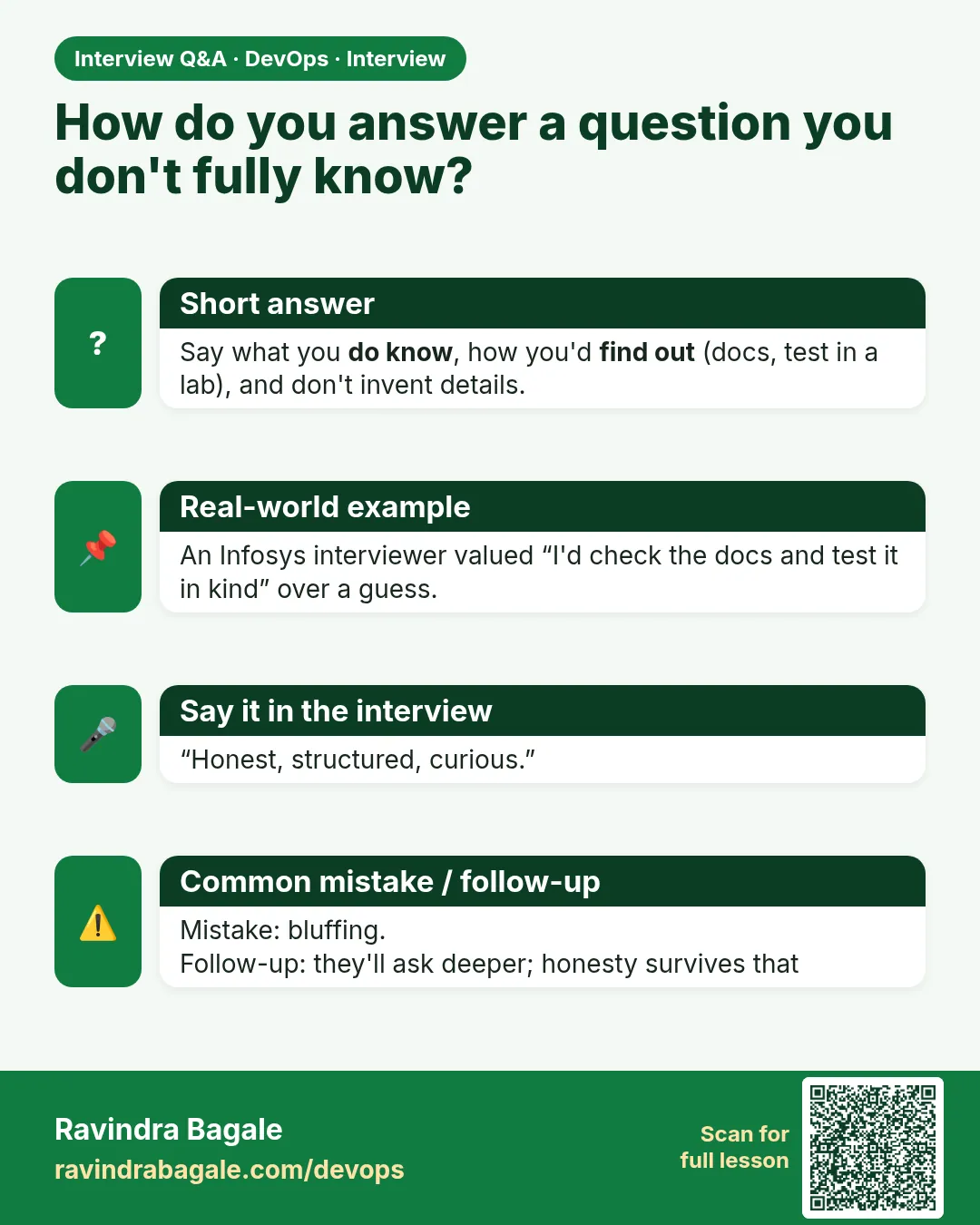
Check: You answer all three without saying "I am not sure" twice.
Hard Whiteboard it top to bottom
Why: Many panels say "draw it". A neat top-to-bottom drawing shows you see the whole flow.
What to do: Draw the main flow of this lesson as boxes from top to bottom.
- Start at the user or the trigger.
- Add each hop: server, container, pipeline, tool.
- Write the command you use to check each box beside it.
Check: Every box has one check command next to it.
Hard Write a mini runbook
Why: Good engineers leave notes for the next person. Interviewers love to hear that you do this.
What to do: Write a one page runbook for the main scenario in this lesson.
- Title, symptoms, first 3 checks, fix, how to confirm, how to undo.
Check: A teammate can follow it alone at 2 a.m.
Homework: try at home
Try at home
At home, add 20 questions to bank.txt from chapters 13 and 14 and from lessons 17.2 to 17.9. Practise 10 minutes a day for 14 days and plot your average score with a spreadsheet.
Recap
- Practise like a musician: run, break, explain, repeat.
- Use the 4-line shape for scenarios and STAR for behaviour.
- Every answer needs evidence: a command, output or number.
- Give a 30 second version first.
- Drill weak topics more often.
FAQ
How many questions should I prepare?
About 40 well-understood questions beat 300 memorised ones.
Can I use lab stories?
Yes. Say clearly it was a lab or personal project.
What if my English is weak?
Short sentences are fine. Clear beats fancy.
Should I practise with a friend?
Yes, once a week. They will ask in new words.
Is it ok to pause before answering?
Yes. Say "Let me think for a moment".
Interview questions
-
Tell me about yourself.
Two lines background, two lines DevOps skills with one project and its numbers, one line what you want next.
-
Why DevOps?
I like making releases fast and safe. In my project I cut deploy time from 20 to 4 minutes, and I enjoyed that most.
-
What is your weakness?
A real one plus action: "I used to skip docs, now I write a runbook for every lab."
-
Tell me about a failure.
Use STAR with numbers and the prevention you added.
-
How do you learn a new tool?
Read the quick start, build a tiny lab, break it, write notes, then use it in a project.
-
Why should we hire you?
I have hands-on labs in CI/CD, Docker, Kubernetes and Terraform, I explain clearly, and I write runbooks.
Quick quiz
Q1. What are the four parts of the scenario shape?
Situation, Check, Fix, Prevent.
Q2. What does STAR stand for?
Situation, Task, Action, Result.
Q3. What makes an answer believable?
Real evidence: commands, outputs and numbers.
Q4. How long is the short version?
About 30 seconds.
Q5. Why random order?
So you understand, not memorise the order.
Did you understand? Let us try it once more.
 Revision card
 Interview card