Chapter 17: Interview Questions and Job Readiness
17.1 DevOps culture and process
Why: the problem
Think of a Zomato interview room. The panel does not ask "What is DevOps?" and wait for a definition. They say: "Our team ships once a month and every release breaks something. You join on Monday. What do you do in your first two weeks?" This is a scenario question. They want to see how you think, which commands you run and which numbers you look at. A fresher who says "DevOps is culture plus automation" sounds like a textbook. A fresher who says "First I count how many deploys we did last month with git log, then I time one release from merge to live, then I automate the slowest step" sounds like an engineer. This lesson turns the culture questions into hands-on answers. You will measure real numbers from a Git repo, draw the release flow on a whiteboard, and practise the answer shape that panels at Infosys, TCS, Swiggy and Flipkart expect.
What we will build
You will make a small practice repo with a fake release history. You will measure the four DORA numbers from it with Git commands: how often we deploy, how long a change takes to go live, how often a deploy fails, and how fast we recover. Then you will use those numbers in three whiteboard answers: "explain DevOps to a manager", "CI vs CD vs release", and "our releases are slow, fix it".
What: every term in plain English
- Scenario question — A question that gives a situation and asks what you would do. There is no single right definition. They judge your steps.
- Whiteboard answer — An answer you draw as boxes and arrows while you talk. It shows the whole flow.
- DORA metrics — Four numbers from Google research that show how good a team is at shipping: deploy frequency, lead time, change failure rate and time to restore.
- Deploy frequency — How many times per day or week we put new code live.
- Lead time for changes — Time from a commit being merged to that commit running in production.
- Change failure rate — Out of all deploys, the percent that caused a problem and needed a fix or rollback.
- MTTR — Mean time to restore. Average minutes from "it broke" to "it works again".
- Release tag — A Git tag like v1.4.0 that marks the exact commit we shipped.
How: step by step
-
Make a practice repo
mkdir -p ~/iq/dora && cd ~/iq/dora && git init -q && git config user.email ravi@lab.local && git config user.name RaviWhat it does: A private repo to play with. Nothing leaves your laptop.
Output
(no output) -
Create five fake releases
for v in 1 2 3 4 5; do echo "release $v" >> CHANGELOG; git add CHANGELOG; git commit -qm "feat: change $v"; git tag v1.$v.0; doneWhat it does: Each loop makes one commit and one release tag.
Output
(no output) -
List the releases with dates
git tag -l "v*" --format="%(refname:short) %(creatordate:short)"What it does: This is your deploy history. Count lines to get deploy frequency.
Output
v1.1.0 2026-10-25 v1.2.0 2026-10-25 v1.3.0 2026-10-25 v1.4.0 2026-10-25 v1.5.0 2026-10-25 -
Count deploys
git tag -l "v*" | wc -lWhat it does: Five tags means five deploys in this period.
Output
5 -
Mark one release as a hotfix
git commit -q --allow-empty -m "fix: hotfix for v1.3.0 login bug" && git tag v1.3.1What it does: A hotfix tag tells us one deploy failed.
Output
(no output) -
Count hotfixes
git log --oneline | grep -c "hotfix"What it does: One failed deploy out of five is a 20 percent change failure rate.
Output
1
Example 1: Measure lead time for one change with Git only
Stack. Git, Bash
Goal. Measure lead time for one change with Git only.
lead_time.sh
#!/usr/bin/env bash
# Usage: bash lead_time.sh v1.4.0
set -euo pipefail
TAG="$1"
TAG_TIME=$(git log -1 --format=%ct "$TAG")
FIRST=$(git log --format=%ct "$TAG"~1.."$TAG" | tail -1)
MIN=$(( (TAG_TIME - FIRST) / 60 ))
echo "tag=$TAG lead_time_minutes=$MIN"
Run it
bash lead_time.sh v1.4.0
for t in $(git tag -l "v*"); do bash lead_time.sh "$t"; done
What each line does
set -euo pipefail— Stop on any error or empty variable. Safe script habit.git log -1 --format=%ct TAG— Prints the commit time of the tag as seconds since 1970.TAG~1..TAG— All commits that went into this release only.tail -1— The oldest commit of the release, when work started.$(( ... / 60 ))— Bash maths. Turns seconds into minutes.
Green output
tag=v1.4.0 lead_time_minutes=0
tag=v1.1.0 lead_time_minutes=0
tag=v1.2.0 lead_time_minutes=0
tag=v1.3.0 lead_time_minutes=0
tag=v1.3.1 lead_time_minutes=0
Expected result. In a real repo you will see numbers like 2880 minutes (2 days). In the interview you say: our lead time was 2 days, I cut it to 3 hours by automating tests.
Example 2: Whiteboard answer: "Explain CI, CD and release to a manager"
Stack. Whiteboard
Goal. Whiteboard answer: "Explain CI, CD and release to a manager".
Draw this, top to bottom
[Developer pushes code]
        |
[CI: build + unit tests]      runs on every push, 5 min
        |
[Artifact: image app:3f9c2a1] stored in a registry
        |
[CD: deploy to staging]       automatic
        |
[Smoke tests on staging]
        |
[Deploy to production]        Continuous Delivery = a human clicks
        |                     Continuous Deployment = no click
[Release: users see feature]  feature flag turned on
Say this while you draw
1. CI means every push is built and tested. Broken code is caught in minutes.
2. The output is one artifact, tagged with the commit SHA.
3. CD moves that same artifact to staging and then production.
4. Deploy means the code is on the servers.
5. Release means users can see it. A feature flag can keep it hidden.
6. At Flipkart scale, deploy and release are split so Big Billion Days
   features go live at midnight without a new deploy.
What each line does
CI box— Build and test on every push. The goal is fast feedback.Artifact box— Build once, deploy the same thing everywhere.Delivery vs Deployment— Delivery has a manual approval. Deployment is fully automatic.Release box— Users see it. Can be later than deploy.Real company line— Shows you know why the split matters in real life.
Green output
Panel: "Good. So is deploy and release the same?"
You:   "No. Deploy is a technical step. Release is a business step.
        We can deploy on Tuesday and release with a flag on Friday."
Panel: (nods, moves to next topic)
Expected result. You answer in under two minutes, with a drawing and one real company example.
Example 3: Scenario: "Our releases are monthly and painful
Stack. GitLab CI, Docker, Python
Goal. Scenario: "Our releases are monthly and painful. You join Monday. What do you do?"
Your first two weeks plan
Day 1-2  Measure. Use git tag and the ticket tool:
         deploys last 90 days = 3, lead time = 21 days,
         change failure rate = 2 of 3 = 66 percent, MTTR = 6 hours.
Day 3    Shadow one release. Time each step with a stopwatch.
         Manual test 2 days, manual server copy 3 hours, DB script 1 hour.
Day 4-6  Fix the slowest step first: add a CI job that runs tests on every push.
Day 7-9  Make one build artifact (Docker image tagged with SHA).
Day 10   Write a one page rollback runbook. Practise rollback in staging.
Week 3+  Deploy smaller changes more often. Track the 4 numbers weekly.
The CI job you add first (.gitlab-ci.yml)
stages: [test, build]
unit_tests:
  stage: test
  image: python:3.12-slim
  script:
    - pip install -r requirements.txt
    - pytest -q
build_image:
  stage: build
  image: docker:27
  services: [docker:27-dind]
  script:
    - docker build -t registry.example.com/shop/app:$CI_COMMIT_SHORT_SHA .
    - docker push registry.example.com/shop/app:$CI_COMMIT_SHORT_SHA
What each line does
Measure first— You never fix before you know the numbers. Panels love this.Shadow one release— You see the real pain, not the one people describe.Fix the slowest step first— Biggest win for the least work.stages: [test, build]— Tests run before the image is built. Fail fast.$CI_COMMIT_SHORT_SHA— Each image is tied to one commit, so rollback is easy.Track weekly— Shows the change worked. Managers trust numbers.
Green output
unit_tests   passed  1m 12s
build_image  passed  2m 40s
Pipeline #418 passed for commit 3f9c2a1
Expected result. You give a calm, step by step plan with numbers. That is a senior-sounding fresher answer.
Verify: did it work?
-
Check your repo has tags
git tag | wc -lWhat it does: Should be 6 after the hotfix tag.
Output
6 -
Check the change failure rate maths
echo "scale=0; 1*100/5" | bcWhat it does: 1 hotfix out of 5 deploys.
Output
20
When it is red 1
fatal: ambiguous argument 'v1.4.0~1..v1.4.0': unknown revision
Cause. The tag does not exist, or the first commit has no parent.
Fix, step by step
- List tags: git tag
- Use a tag that is not the very first commit.
- Run the script again.
When it is red 2
Panel: "That is a textbook answer. Give me a real example."
Cause. You only gave a definition with no command, number or story.
Fix, step by step
- Restart with one real number: "In my lab the lead time was 2 days".
- Name the command you used to measure it.
- End with what you changed and the new number.
When it is red 3
bc: command not found
Cause. The bc calculator is not installed.
Fix, step by step
- sudo apt-get install -y bc
- Or use bash maths: echo $(( 1*100/5 ))
Cleanup
-
Remove the practice repo
cd ~ && rm -rf ~/iq/doraWhat it does: Deletes only the lab folder.
Output
(no output)
Ravindra Bagale's Tip
In an interview skip the definition — give a number. Lead time was 2 days, I made it 3 hours — that one line sticks with the panel.
Interview मध्ये definition नको, number सांगा. Lead time २ दिवस होता, ३ तास केला — ही एक line panel ला लक्षात राहते.
Interview में definition नहीं, number बताओ. Lead time २ दिन था, ३ घंटे किया — ये एक line panel को याद रहती है.
Practice tasks
Medium Compute MTTR from fake incidents
Why: Panels ask "how do you measure recovery?" A tiny calculation makes it real.
What to do: Write three incident start and end times in a file and compute average minutes.
- Make incidents.txt with lines like 10:00 10:45.
- Convert to minutes by hand or with a small Python script.
- Say: our MTTR was 35 minutes.
Check: You have one MTTR number you can explain.
Hard Turn monthly into weekly
Why: This is the classic DevOps transformation story.
What to do: Write a 6 step plan to move a team from monthly to weekly releases.
- Use the Example 3 plan as a base.
- Add one risk and how you handle it.
Check: Plan fits on one page and has numbers.
Easy Say DevOps culture and process in two lines
Why: Interviewers cut you off after 30 seconds. The short version must come first.
What to do: Write a two line answer about DevOps culture and process for a fresher interview.
- Line 1: the problem it solves.
- Line 2: the one command or file you used.
- Say it aloud with a timer.
Check: You finish inside 30 seconds and you name one real command.
Easy Run the commands, not just read them
Why: An interviewer can tell if you only read. Typing the command once gives you the real output to talk about.
What to do: Run every command in the How part of this lesson on your own lab machine.
- Start a small Ubuntu VM, WSL or EC2 t3.micro.
- Run each step and save the output in notes.txt.
- Mark any output that looks different from the lesson.
Check: notes.txt has the real output of every step.
Medium Break it on purpose
Why: You must know the red error by face. In a live round there is no time to read slowly.
What to do: Cause one error from the "When it is red" part of this lesson and fix it.
- Follow the error section.
- Copy the exact message into your notes.
- Write the fix in one line.
Check: You fixed it using only your notes.
Medium Answer in the 4-line shape
Why: A clear shape makes any answer sound senior: Situation, Check, Fix, Prevent.
What to do: Pick one interview question from this lesson and answer in four lines.
- Situation: what broke.
- Check: the command you ran and what it showed.
- Fix: the change you made.
- Prevent: the alert, test or doc you added.
Check: Each of the four lines has a real noun, like a command, a file or a number.
Medium Mock round with a friend
Why: Speaking is a different skill from knowing. Practice it.
What to do: Let a friend ask you three questions from this lesson.
- Friend picks random questions.
- You answer, friend times you.
- Swap and repeat.
Check: You answer all three without saying "I am not sure" twice.
Hard Whiteboard it top to bottom
Why: Many panels say "draw it". A neat top-to-bottom drawing shows you see the whole flow.
What to do: Draw the main flow of this lesson as boxes from top to bottom.
- Start at the user or the trigger.
- Add each hop: server, container, pipeline, tool.
- Write the command you use to check each box beside it.
Check: Every box has one check command next to it.
Hard Write a mini runbook
Why: Good engineers leave notes for the next person. Interviewers love to hear that you do this.
What to do: Write a one page runbook for the main scenario in this lesson.
- Title, symptoms, first 3 checks, fix, how to confirm, how to undo.
Check: A teammate can follow it alone at 2 a.m.
Homework: try at home
Try at home
At home, open any real repo you have. Count the release tags from the last 90 days and write the four DORA numbers in one table. Say them aloud in a 60 second answer.
Recap
- Scenario questions judge your steps, not your definitions.
- Measure first: deploy frequency, lead time, failure rate, MTTR.
- Draw CI, artifact, CD and release top to bottom.
- Deploy and release are different steps.
- Fix the slowest step first and track the numbers weekly.
FAQ
Do freshers really get culture questions?
Yes. Almost every round starts with "what is DevOps" or "how would you improve releases". Give a story, not a definition.
I have no job experience. What story do I tell?
Use your lab. "In my lab project I measured lead time and cut it from 20 minutes to 5 with caching" is a real story.
Should I say CALMS?
Only if you can give one example for each letter. Otherwise use DORA numbers, which are easier to show.
How long should my answer be?
Start with a 30 second answer. Go deeper only if they ask.
What if I do not know the company tools?
Say the idea and one tool you know: "We would add a CI test job, in GitLab or Jenkins".
Interview questions
-
What is DevOps?
A way of working where dev and ops share ownership, ship small changes often, and use automation and monitoring. Example: we moved from monthly to weekly deploys with a CI pipeline.
-
How do you measure if DevOps is working?
DORA metrics. I measure deploy frequency and lead time from Git tags, and failure rate and MTTR from incident tickets.
-
Our releases break often. What do you do?
Measure failure rate, add automated tests in CI, make one artifact per commit, add a tested rollback, and ship smaller changes.
-
Explain CI to a non-technical manager.
Every time someone saves code, a robot builds it and runs the tests. If it breaks, we know in 5 minutes, not 5 weeks.
-
What is a feature flag?
A switch in config that turns a feature on or off without a new deploy.
-
What is blameless postmortem?
A meeting after an incident that asks what in the process failed, not who failed, and writes action items.
Quick quiz
Q1. What are the four DORA metrics?
Deploy frequency, lead time for changes, change failure rate and time to restore.
Q2. Is deploy the same as release?
No. Deploy puts code on servers. Release lets users see it.
Q3. What is the first thing to do in a slow release team?
Measure the current numbers before changing anything.
Q4. Continuous Delivery vs Continuous Deployment?
Delivery needs a manual approval before production. Deployment does not.
Q5. Why tag the image with the commit SHA?
So we know exactly which code runs and can roll back to any version.
Did you understand? Let us try it once more.
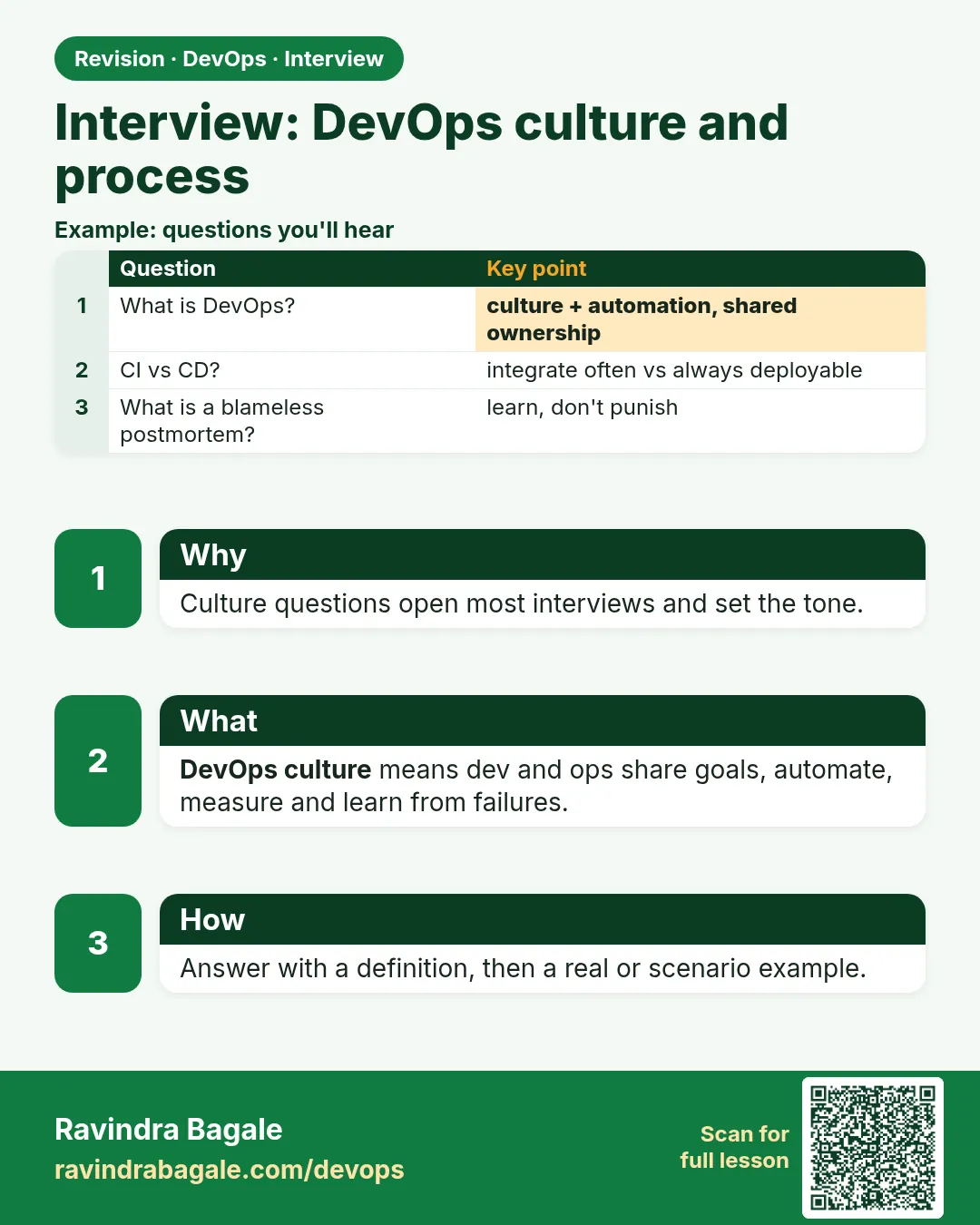 Revision card
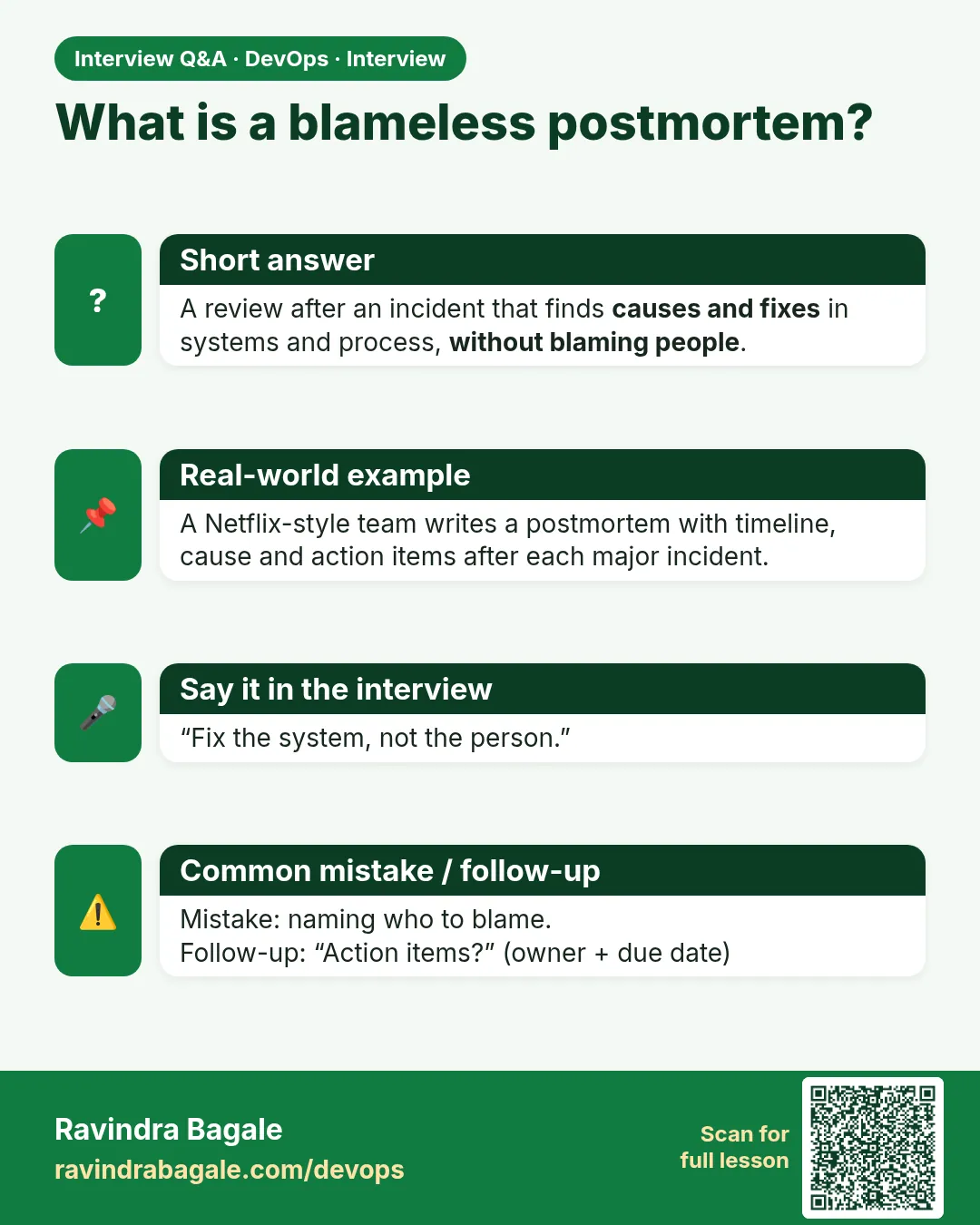 Interview card