Chapter 88: Amazon EKS for DevOps
88.1 Why EKS — the managed control plane story
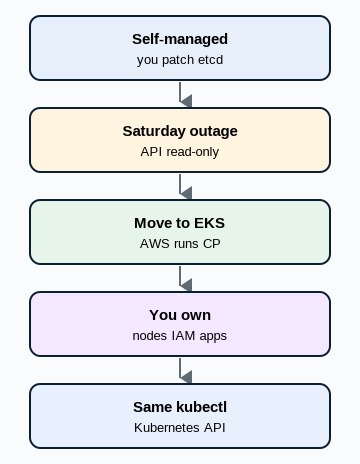
Story. At a Swiggy-style delivery platform in Bengaluru, Ananya ran three self-managed Kubernetes control-plane VMs. One etcd disk filled on a Saturday. API server went read-only. Couriers could not fetch new orders for 18 minutes. The on-call bill and refunds were about ₹1.8 lakh that weekend. The next quarter the platform team moved production to Amazon EKS. AWS runs the control plane (API server, etcd, scheduler, controller-manager). Ananya still owns node capacity, networking, IAM and apps — but she no longer patches etcd at 2 a.m. That is why teams pick EKS: less control-plane toil, same Kubernetes API.
Why
Running etcd and the API server yourself is a full-time job. EKS keeps the Kubernetes API you already know, and AWS operates the control plane for you.
What
- EKS — Elastic Kubernetes Service. Managed Kubernetes control plane on AWS.
- Control plane — API server, etcd, scheduler, controller-manager.
- Data plane — Worker nodes or Fargate where your pods run.
- Region and VPC — Your cluster lives in an AWS Region inside your VPC subnets.
- kubectl — Same client. You point kubeconfig at the EKS API endpoint.
How
- Create an EKS cluster in a Region (for example
ap-south-1). - Attach compute: managed node groups and/or Fargate profiles.
- Update kubeconfig and run normal
kubectlcommands. - Own add-ons, IAM, networking and application health yourself.
Example 1: Describe the cluster after create
aws eks describe-cluster --name shop-prod --region ap-south-1 --query 'cluster.{status:status,version:version,endpoint:endpoint}' --output table
Output
----------------------------------------------------------
|                    DescribeCluster                     |
+----------+---------------------------------------------+
|  endpoint|  https://A1B2C3D4.yl4.ap-south-1.eks.amazonaws.com|
|  status  |  ACTIVE                                     |
|  version |  1.29                                       |
+----------+---------------------------------------------+
What it shows: The control plane is ACTIVE on a Kubernetes version. You talk to that endpoint with kubectl. Version numbers change over time — always check what AWS supports today.
Example 2: Approximate control-plane cost note
EKS control plane (approximate — check current AWS pricing):
about USD 0.10 per hour per cluster
≈ USD 73 per month ≈ ₹6,000 per month at rough FX
plus EC2 or Fargate for worker capacity
What it shows: The managed API is not free. Worker nodes are usually the bigger bill. Treat every number here as approximate and verify on the official AWS price list before you budget.
Ravindra Bagale's Tip
EKS removes etcd babysitting. It does not remove VPC design, IAM, node capacity planning or app readiness probes.
EKS etcd babysitting काढते. VPC design, IAM, node capacity आणि readiness probes काढत नाही.
EKS etcd babysitting हटाता है. VPC design, IAM, node capacity और readiness probes नहीं हटाता.
Quick quiz
Q1. What does AWS manage on EKS?
The Kubernetes control plane (API server, etcd, scheduler, controllers).
Q2. What do you still own?
Nodes or Fargate capacity, VPC, IAM, add-ons and applications.
Q3. Why mention prices as approximate?
AWS pricing changes; always check the current official price page.
Did you understand? Let us try it once more.