Spotify Architecture Explained: How Spotify Runs on Google Cloud
Short answer: Spotify runs on Google Cloud Platform (GCP). It moved there from its own data centres starting in 2015. Today thousands of small microservices, many on Kubernetes, power the app. Online data lives in Cloud Bigtable (petabytes), events flow through Cloud Pub/Sub, and exabytes of data sit in a Google Cloud Storage data lake (2026). Spotify also created Backstage, the developer portal now hosted by the CNCF.
Suppose you play your Discover Weekly playlist
It is Monday morning in Chennai. You open Spotify and play Discover Weekly. In simple terms:
- The app calls Spotify's backend on Google Cloud.
- Small services handle your login, your playlists, search and recommendations.
- Your personalised data, such as listening history, is read from Bigtable.
- The audio is streamed to your phone. How Spotify delivers audio files (which CDN) is not publicly shared.
- Each play sends an event into Spotify's event delivery system on Cloud Pub/Sub.
- These events land in the data lake and are used to build next week's playlist and your year-end Wrapped.
What architecture style does Spotify use?
Spotify is known for many small autonomous teams, each owning its own services.
- Microservices at large scale: before the move, Spotify ran about 2,000 services and 20,000 daily data pipelines (2019); by 2023 it had tens of thousands of services and hundreds of thousands of cloud resources.
- Declarative infrastructure (2023): teams describe the cloud resources they want in code, and Kubernetes-style controllers create and fix them.
- Fleet management (2023): automated changes are rolled out across thousands of components, so teams do not upgrade everything by hand.
- Indexed data lake (2026): petabytes live in Bigtable for online use, but exabytes sit in the GCS data lake. Spotify built Random Access Parquet so services and AI agents can look up one user's data straight from lake files.
- Backstage: a developer portal that lists every service and its owner; Spotify open-sourced it and it is now a CNCF project. Spotify also offers it as a hosted product (Spotify Portal).
Spotify architecture diagram (public parts)
This diagram shows only what Spotify or its partners have shared publicly. Press Play to follow a request step by step.
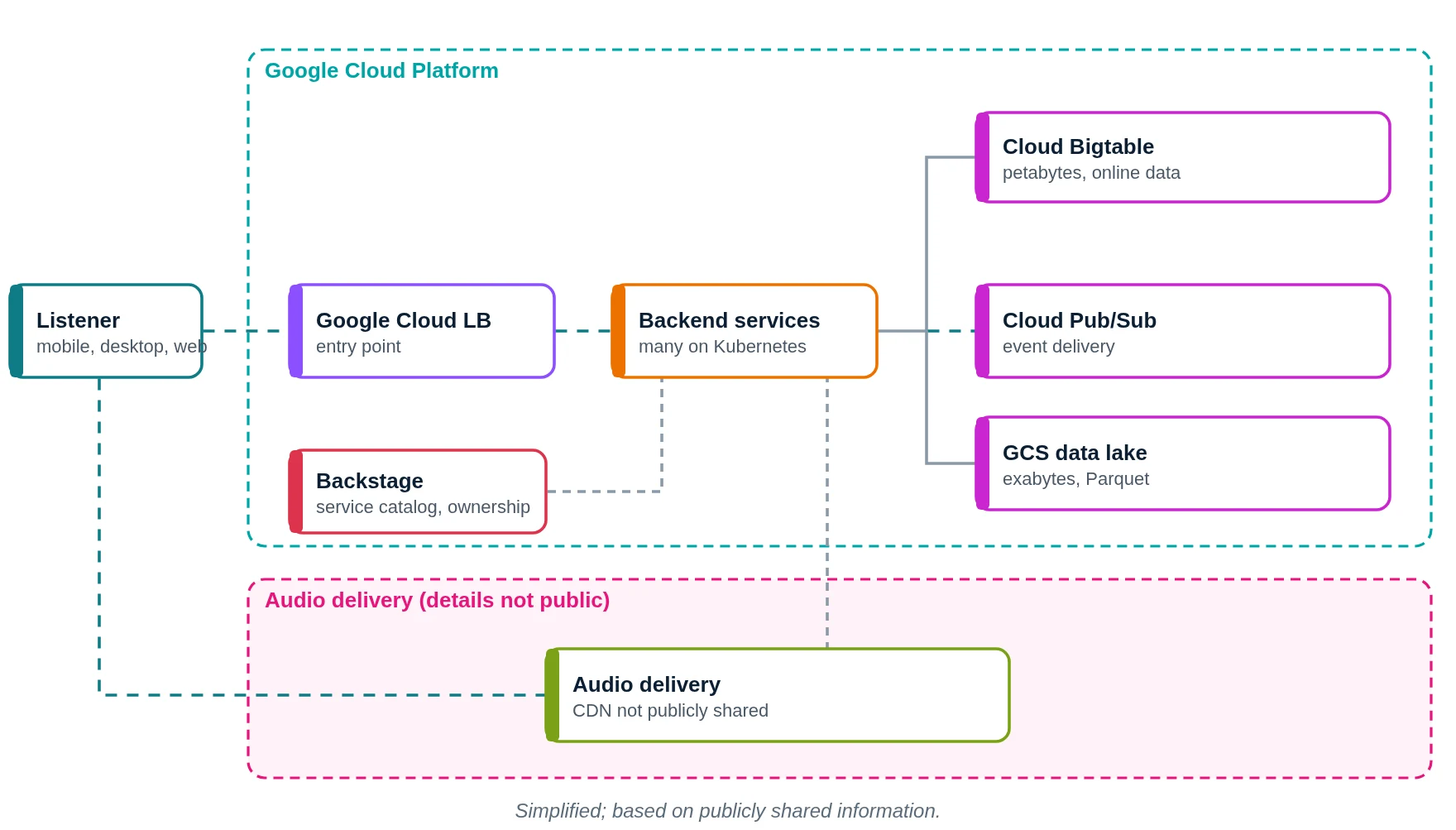
- You open Spotify.
- The request enters Google Cloud.
- Backend services build your home screen.
- Personal data is read from Bigtable.
- Your play becomes an event on Pub/Sub.
- Events land in the data lake for playlists and Wrapped.
- Backstage tracks which team owns each service.
- Audio streams to your app (CDN details not public).
- Music plays on your phone.
What does Spotify use? Main technologies
| Layer | What Spotify uses (public) | What it does in simple words |
|---|---|---|
| Cloud | Google Cloud Platform | Hosts Spotify since the 2015 to 2018 migration |
| Containers | Kubernetes | Runs services |
| Online database | Cloud Bigtable | Petabytes of online data |
| Events | Cloud Pub/Sub | Event delivery |
| Data lake | Google Cloud Storage, Parquet | Exabytes of data |
| Point lookups | Random Access Parquet (2026) | Fast reads from lake files |
| Developer portal | Backstage | Service catalog |
| Infra as code | Declarative infrastructure (2023) | Manages cloud resources |
Which cloud provider does Spotify use?
Spotify uses Google Cloud Platform. In 2019 Spotify chose to go all-in with a single cloud provider instead of multi-cloud or hybrid, and picked GCP.
How it started: own data centres and the move to Google Cloud (2015 to 2019)
- Spotify launched in 2008 on its own servers, in four regions of co-located data centres.
- By 2015 this meant about 2,000 services, 20,000 daily pipeline runs and over 100 petabytes of data.
- In early 2015 Spotify began planning its cloud move and chose Google Cloud.
- The old way was self-run Cassandra, Kafka, Elasticsearch, PostgreSQL and Memcached; in the cloud these became Bigtable, Pub/Sub and managed services.
- Event delivery was rebuilt on Cloud Pub/Sub, running in the cloud for 2.5 years by late 2019.
How does Spotify store data?
- Cloud Bigtable: petabytes of data for online features (2026).
- Google Cloud Storage: an exabyte-scale data lake in Parquet files.
- BigQuery and Trino are used for analytics over the lake.
- Audio file storage and CDN details are not publicly shared.
How does Spotify monitor its systems?
- Backstage gives each service a page with its owner, docs and health.
- The exact metrics and alerting stack used today is not publicly shared.
If we built an app like Spotify on AWS (illustrative)
Please read this first
This section is a learning design by Ravindra Bagale. It is not Spotify's real setup. Spotify runs on Google Cloud, not AWS. We use AWS here because it is what you learn in the AWS course.
Suppose you want to build "SurSangam", a music streaming app for Indian classical music. Here is a simple AWS layout.
1. Network: VPC, subnets, route tables, gateways
- Create one VPC with CIDR
10.0.0.0/16in the Mumbai region (ap-south-1). - Use two Availability Zones (A and B), so one AZ failing does not stop the app.
- In each AZ make three subnets: public (load balancer, NAT gateway), private app (your code) and private data (databases, cache).
- Attach one internet gateway (IGW) to the VPC. Public route table:
0.0.0.0/0 → IGW. This route is what makes a subnet public. - Private app route table:
0.0.0.0/0 → NAT gateway, so servers can download updates but nobody can connect in from the internet. - Private data route table: only the local VPC route. Use VPC endpoints to reach S3, DynamoDB and SQS without going over the internet.
2. Compute: where the code runs
- ALB in public subnets.
- Music services on EKS in private subnets.
- Play events go to Kinesis, then to S3 for analytics.
3. Storage and databases
- S3 + CloudFront for audio files (with DRM where needed).
- Aurora for the catalog.
- DynamoDB for play history and playlists.
- ElastiCache for hot data; Athena to query the S3 data lake.
4. Monitoring
- CloudWatch dashboards and alarms.
- X-Ray traces.
- A service catalog like Backstage to track owners.
Request flow diagram
Press Play. The numbered list below the diagram lights up with each step.
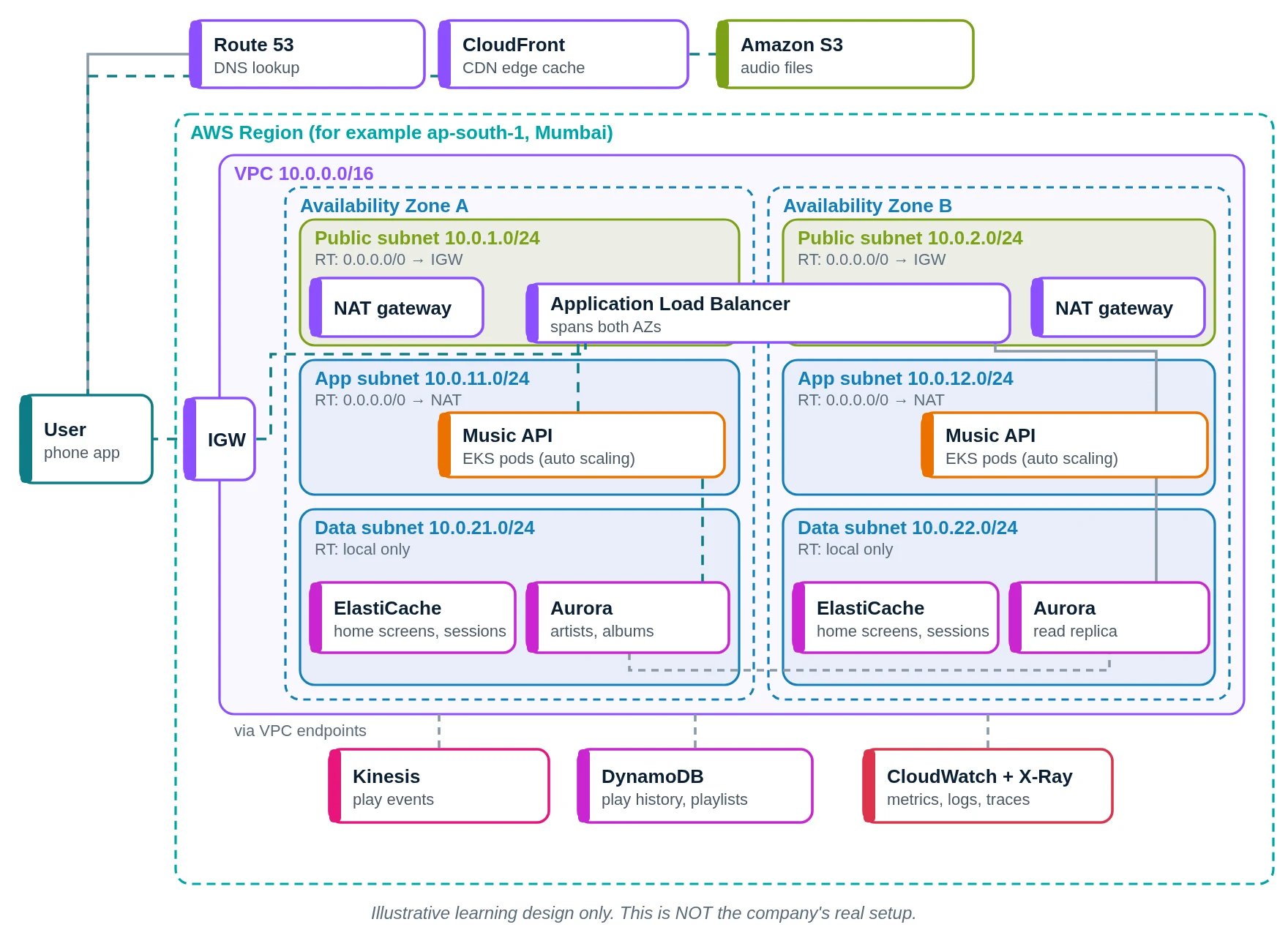
- You open SurSangam. Route 53 answers.
- Audio streams from CloudFront.
- On a miss CloudFront reads S3.
- API calls enter through the internet gateway.
- The ALB forwards to a pod.
- The music API builds your home screen.
- Hot data from ElastiCache.
- Catalog from Aurora; history from DynamoDB.
- Your play is sent as an event to Kinesis.
- CloudWatch watches it all.
- The raga plays.
Spotify versus our AWS design
| Part | Spotify (public info) | Our AWS design |
|---|---|---|
| Cloud | Google Cloud | AWS |
| Containers | Kubernetes | EKS |
| Online data | Bigtable | DynamoDB |
| Events | Cloud Pub/Sub | Kinesis |
| Data lake | GCS + Parquet | S3 + Athena |
| Audio delivery | Not publicly shared | CloudFront |
Quick quiz: check what you learned
Which cloud does Spotify use?
- Google Cloud Platform
- AWS
- Microsoft Azure
- Oracle Cloud
Show answer
A. Spotify moved to Google Cloud starting in 2015.
What does Spotify use for event delivery?
- Amazon SQS
- Cloud Pub/Sub
- RabbitMQ
- FTP files
Show answer
B. Spotify rebuilt event delivery on Cloud Pub/Sub.
What is Backstage?
- A music player
- A billing tool
- A developer portal
- A CDN
Show answer
C. Backstage is Spotify's open-source developer portal, now a CNCF project.
Where do exabytes of Spotify data sit?
- Phone memory
- Bigtable only
- Printed reports
- A GCS data lake
Show answer
D. As of 2026, exabytes sit in the GCS data lake.
Learn it properly
Build the AWS parts yourself with these free guides and lessons:
- How to create a custom VPC with subnets, internet gateway and route tables
- Public vs private subnet in AWS · 3-tier architecture project on AWS
- How to launch an EC2 instance · Install the CloudWatch agent on EC2
- AWS course: What is a VPC? Default VPC vs custom VPC
- Related architectures: Snapchat Architecture Explained: Multicloud on AWS and Google Cloud · Flipkart Architecture Explained: Data Centres, Google Cloud, Aerospike · PhonePe Architecture Explained: UPI at Scale, HBase, Kafka, Druid · Paytm Architecture Explained: AWS, Microservices, Paxos Databases
- All famous app architectures explained