Flipkart Architecture Explained: How Flipkart Handles Big Billion Days
Short answer: Flipkart runs its shopping services as many microservices in its own data centres (2023), and it moved its big data analytics platform to Google Cloud. All app traffic now enters through Nexus, a central API gateway built on Apache APISIX (2025). Fast data for search, pricing and recommendations lives in Aerospike on Kubernetes, handling about 90 million queries per second across three data centres during sales (2025).
Suppose you buy a phone in the Big Billion Days sale
The sale starts at midnight. You and millions of others open Flipkart and search for a new phone. In simple terms:
- Your app's request reaches Nexus, Flipkart's central API gateway, which checks login, sessions, bots and rate limits.
- Nexus routes it to the right microservice: search, product page, pricing, offers or cart.
- Search results, prices and offers are read from Aerospike clusters in under a millisecond.
- When sellers change prices or rules, the change is saved in MySQL and copied to Aerospike through Debezium and Kafka (change data capture).
- Clicks and ad views stream through Apache Flink, which handles about 1 million ad events per second (2026).
- Order and event data later lands in Flipkart's data platform on Google Cloud for reports.
What architecture style does Flipkart use?
Flipkart today is built on a set of shared platforms used by hundreds of services.
- One API gateway (2025): before Nexus, each team ran its own gateway features. Nexus, built on open-source APISIX with an etcd-based control plane, targets 99.99% availability and under 10 ms of extra p99 latency, and runs across several data centres.
- Aerospike as a platform (2025): a team of fewer than ten engineers runs Aerospike for 50+ use cases using the Aerospike Kubernetes Operator.
- Event-driven updates (2026): the rate card engine uses a transactional outbox: write to MySQL, emit an event, and update Aerospike through Debezium and Kafka.
- Stream processing (2026): the ads team uses Flink with RocksDB state for exactly-right ad budget counting at 1 million events per second.
Flipkart architecture diagram (public parts)
This diagram shows only what Flipkart or its partners have shared publicly. Press Play to follow a request step by step.
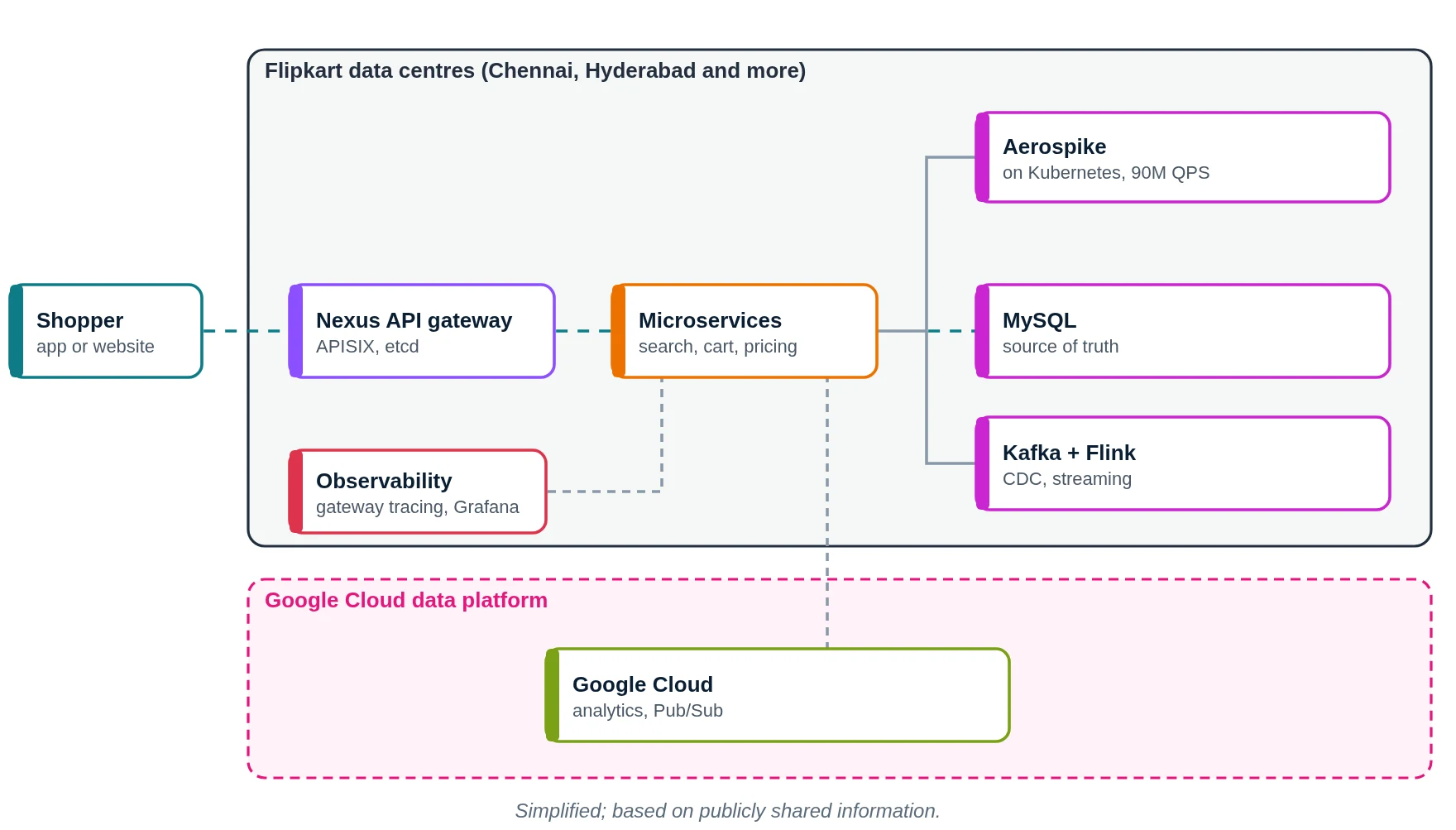
- You open Flipkart in the sale.
- Nexus checks your session and rate limits.
- Microservices build search results and the product page.
- Prices and offers come from Aerospike.
- Seller changes are stored in MySQL.
- Kafka carries changes; Flink counts ad events.
- Requests are traced and monitored.
- Event data flows to the Google Cloud data platform.
- Your order is placed.
What does Flipkart use? Main technologies
| Layer | What Flipkart uses (public) | What it does in simple words |
|---|---|---|
| API gateway | Nexus on Apache APISIX (2025) | Auth, rate limits, routing |
| Fast data | Aerospike on Kubernetes | Search, pricing, recommendations |
| Database | MySQL | Source of truth for configs |
| Change data capture | Debezium + Kafka | Copies changes to Aerospike |
| Streaming | Apache Flink with RocksDB | Real-time ad counting |
| Data platform | Google Cloud: Dataproc, Pub/Sub | Analytics (10 PB/day batch) |
| Hosting | Own data centres | Shopping services |
Which cloud provider does Flipkart use?
Flipkart uses a mix:
- Its shopping services run in Flipkart's own data centres; its Aerospike setup spans three data centres.
- In 2023 Flipkart moved its data analytics platform (FDP) and content catalog object store to Google Cloud, moving from on-premises Kafka to Pub/Sub (130+ billion messages a day) and Hive to Dataproc.
How it started: MySQL and self-managed clusters
- Before the central platforms, Flipkart teams ran their own gateways and their own Aerospike clusters on virtual machines.
- Flipkart's data platform ran on self-managed Hadoop, Hive and Kafka in Chennai and Hyderabad until the 2023 move to Google Cloud.
- Earlier, Flipkart ran MySQL with high availability and studied replication lag.
How does Flipkart store data?
- Aerospike: fast key-value data, 170+ clusters (2025).
- MySQL: source of truth for configuration like rate cards.
- Google Cloud: about 10 PB batch and 2 PB near-real-time data processed daily.
- Product image storage and CDN details are not publicly shared.
How does Flipkart monitor its systems?
- Nexus adds central tracing and observability for every API request (2025).
- Aerospike clusters send metrics through Prometheus sidecars to Grafana (2025).
- The full company-wide monitoring stack is not publicly shared.
If we built an app like Flipkart on AWS (illustrative)
Please read this first
This section is a learning design by Ravindra Bagale. It is not Flipkart's real setup. Flipkart uses its own data centres plus Google Cloud. We use AWS here because it is what you learn in the AWS course.
Suppose you want to build "BazaarBharat", a shopping site for local sellers. Here is a simple AWS layout.
1. Network: VPC, subnets, route tables, gateways
- Create one VPC with CIDR
10.0.0.0/16in the Mumbai region (ap-south-1). - Use two Availability Zones (A and B), so one AZ failing does not stop the app.
- In each AZ make three subnets: public (load balancer, NAT gateway), private app (your code) and private data (databases, cache).
- Attach one internet gateway (IGW) to the VPC. Public route table:
0.0.0.0/0 → IGW. This route is what makes a subnet public. - Private app route table:
0.0.0.0/0 → NAT gateway, so servers can download updates but nobody can connect in from the internet. - Private data route table: only the local VPC route. Use VPC endpoints to reach S3, DynamoDB and SQS without going over the internet.
2. Compute: where the code runs
- ALB or API Gateway at the front.
- Shop services on EKS in private subnets.
- Order events through SQS (or MSK for Kafka).
3. Storage and databases
- S3 + CloudFront for product images.
- Aurora for orders.
- DynamoDB for cart and stock counts.
- ElastiCache for prices and offers, like Flipkart's Aerospike use.
4. Monitoring
- CloudWatch alarms on latency and errors.
- X-Ray traces.
- Load-test before sales.
Request flow diagram
Press Play. The numbered list below the diagram lights up with each step.
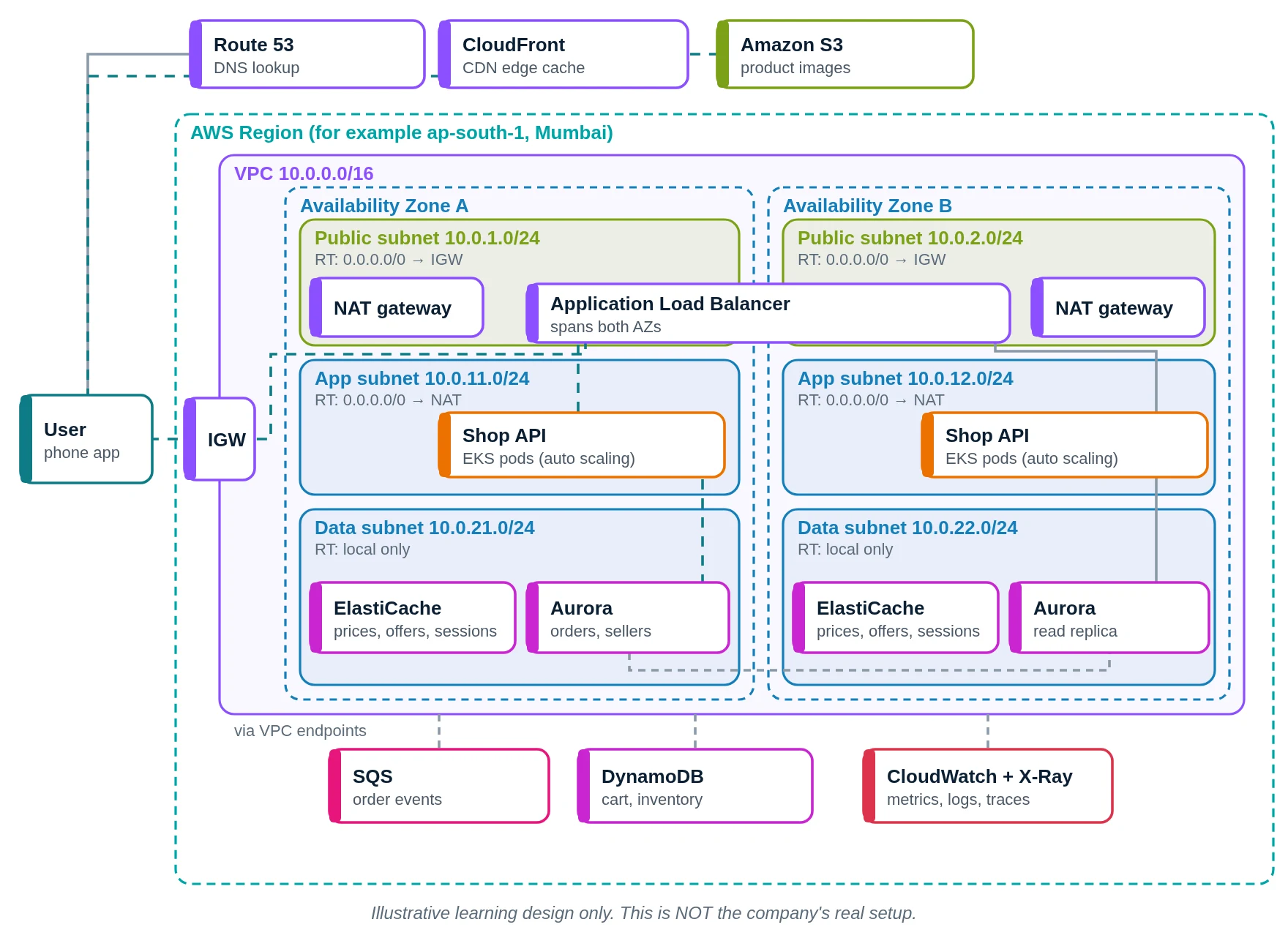
- You open BazaarBharat. Route 53 answers.
- Images load from CloudFront.
- CloudFront reads S3.
- API calls enter through the internet gateway.
- The ALB forwards to a pod.
- The shop API builds the page.
- Prices from ElastiCache.
- Orders in Aurora; cart in DynamoDB.
- An order event goes to SQS.
- CloudWatch watches.
- Your order is placed.
Flipkart versus our AWS design
| Part | Flipkart (public info) | Our AWS design |
|---|---|---|
| Hosting | Own data centres + Google Cloud | AWS |
| Gateway | Nexus (APISIX) | ALB / API Gateway |
| Fast data | Aerospike | ElastiCache, DynamoDB |
| Database | MySQL | Aurora |
| Streaming | Kafka, Flink | SQS / MSK |
| Monitoring | Prometheus, Grafana | CloudWatch, X-Ray |
Quick quiz: check what you learned
What is Nexus at Flipkart?
- A central API gateway
- A delivery van app
- A payment card
- A database
Show answer
A. Nexus is Flipkart's central API gateway built on APISIX.
Which database serves Flipkart's fast search and pricing data?
- Oracle
- Aerospike
- SQLite
- Neo4j
Show answer
B. Flipkart runs Aerospike at about 90 million queries per second.
Where did Flipkart move its data analytics platform?
- Microsoft Azure
- AWS
- Google Cloud
- IBM Cloud
Show answer
C. Flipkart moved FDP to Google Cloud in 2023.
What does Flink do for Flipkart Ads?
- Stores photos
- Sends emails
- Builds the app
- Counts ad events in real time
Show answer
D. Flink processes about 1 million ad events per second.
Learn it properly
Build the AWS parts yourself with these free guides and lessons:
- How to create a custom VPC with subnets, internet gateway and route tables
- Public vs private subnet in AWS · 3-tier architecture project on AWS
- How to launch an EC2 instance · Install the CloudWatch agent on EC2
- AWS course: What is a VPC? Default VPC vs custom VPC
- Related architectures: PhonePe Architecture Explained: UPI at Scale, HBase, Kafka, Druid · Paytm Architecture Explained: AWS, Microservices, Paxos Databases · JioHotstar Architecture Explained: AWS EKS, Envoy, Multi-CDN Live · Zomato Architecture Explained: AWS, Microservices, DynamoDB, Kafka
- All famous app architectures explained