JioHotstar Architecture Explained: How Hotstar Streams Cricket to Millions
Short answer: JioHotstar (formerly Disney+ Hotstar) runs its backend as microservices on AWS, on several Amazon EKS clusters that are grouped into one logical "data centre" (2025). An internal API gateway built on Envoy replaced more than 200 separate load balancers. Live video goes out through multiple CDNs; a QoS Routing Manager picks the best CDN for each group of users (2026). A big live match needs 60 to 80 Tbps of streaming bandwidth.
Suppose you watch an IPL final on JioHotstar
It is the IPL final. You open JioHotstar in Indore, along with tens of millions of others. In simple terms:
- Your app calls JioHotstar's backend on AWS. An Envoy-based gateway routes the call to the right microservice in an EKS cluster.
- Services check your subscription and fetch the match details.
- The QoS Routing Manager picks the best CDN for your cohort (internet provider, state, city and user type).
- Your player downloads video segments from that CDN.
- During breaks, the ad decision engine picks ads, inserted on the server or guided by the server.
- A watchdog system keeps testing every live stream variant on real devices during the match.
What architecture style does JioHotstar use?
Hotstar is known for handling "tsunami" traffic when a big cricket moment happens.
- Datacenter abstraction (2025): several EKS clusters in a region act as one unit; each team gets one logical namespace per data centre.
- Central Envoy gateway (2025): one fleet of gateways handles routing, authentication, rate limiting and load shedding for all services.
- Multi-CDN, cohort routing (2026): users are grouped by ASN, country, state, city and user type, and traffic weights shift in real time.
- Scale: In 2025 Hotstar redesigned the platform for 50+ million concurrent users.
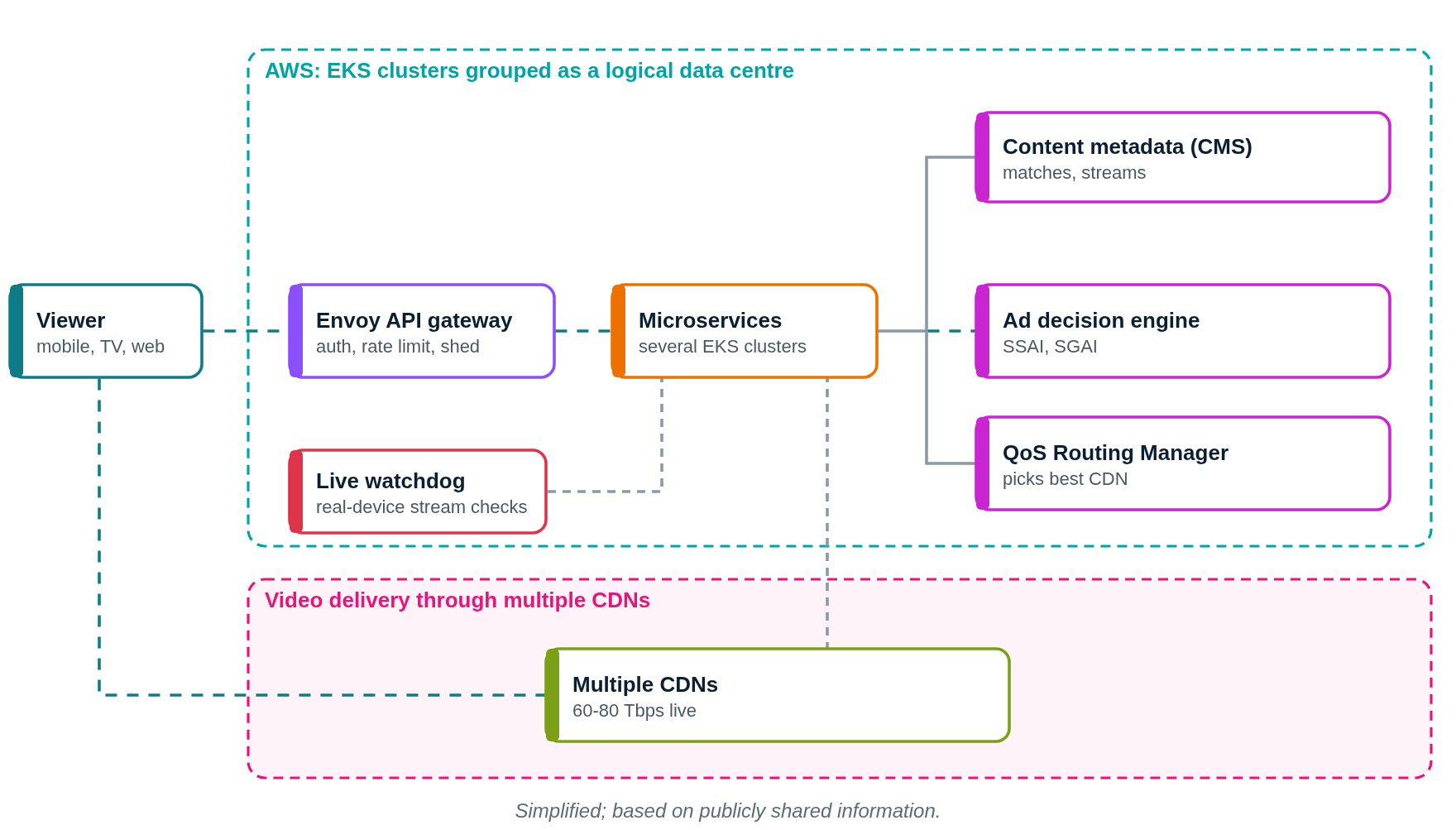
JioHotstar architecture diagram (public parts)
This diagram shows only what JioHotstar or its partners have shared publicly. Press Play to follow a request step by step.
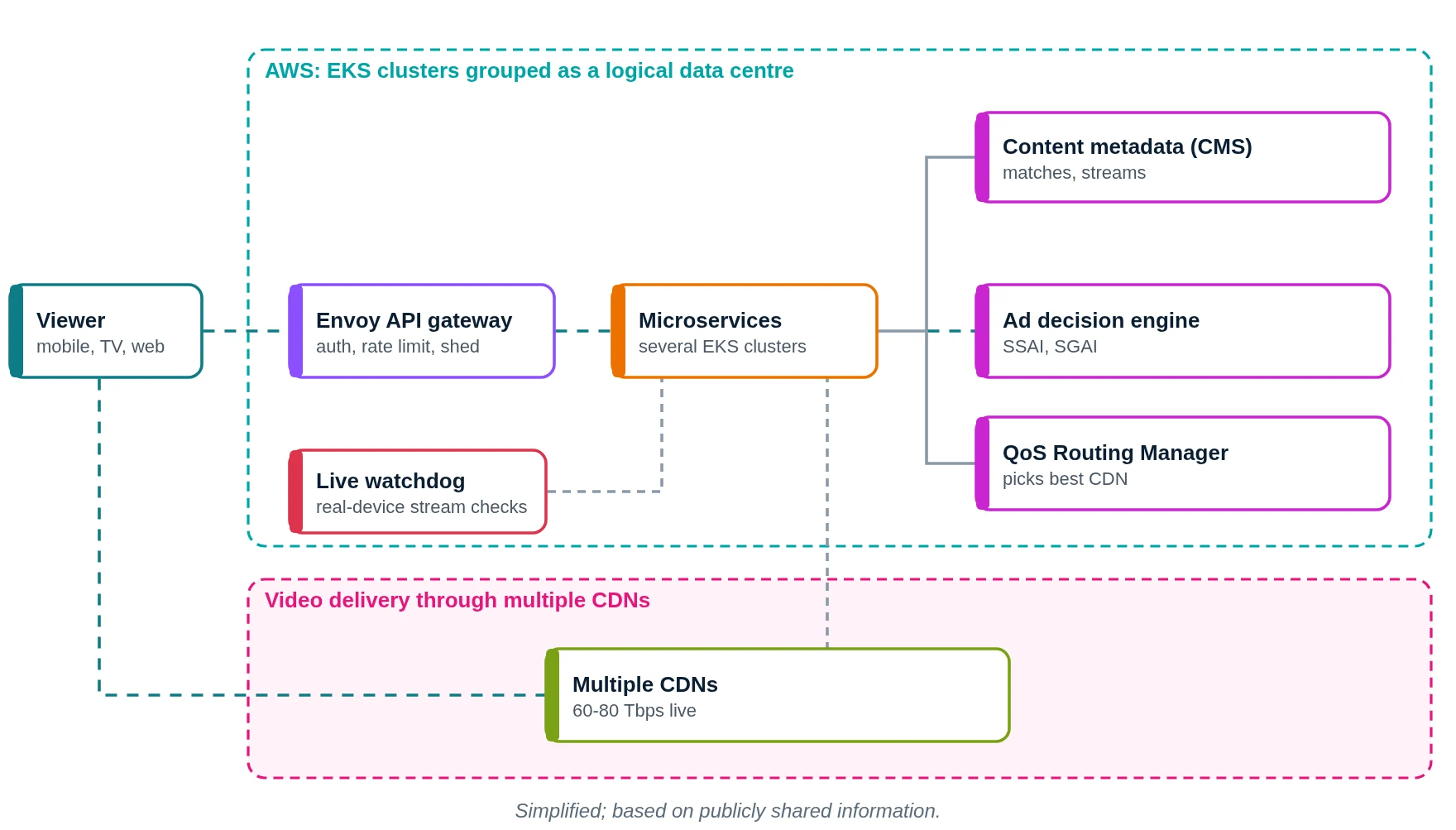
- You open the IPL final.
- The Envoy gateway routes your call.
- Microservices on EKS check your plan.
- Match and stream details come from the CMS.
- The ad engine picks ads for breaks.
- The QoS Routing Manager chooses a CDN for your cohort.
- The watchdog keeps checking every stream.
- Video segments stream from the chosen CDN.
- You watch the winning six.
What does JioHotstar use? Main technologies
| Layer | What JioHotstar uses (public) | What it does in simple words |
|---|---|---|
| Cloud | AWS | Hosts the backend |
| Containers | Amazon EKS, several clusters per region | Runs microservices |
| Gateway | Envoy-based internal API gateway | Routing, auth, rate limiting, load shedding |
| Video delivery | Multiple CDNs | Streams to viewers |
| CDN routing | QoS Routing Manager (2026) | Best CDN per cohort |
| Ads | Ad decision engine (SSAI, CSAI, SGAI) | Selects and inserts ads |
| Stream checks | Live video validation orchestrator | Tests streams on real devices |
Which cloud provider does JioHotstar use?
JioHotstar's backend runs on AWS. In 2025 it chose managed EKS for the latest Kubernetes features, fast cluster provisioning and AWS reliability. Video reaches viewers through multiple CDN providers; which CDNs are used is not publicly shared.
How does JioHotstar pick a CDN for each viewer?
In 2026 JioHotstar reworked traffic orchestration, because one CDN choice per state is not enough. India's networks differ street by street: a 5G user in South Delhi and a local broadband user in rural Rajasthan see very different networks.
- Cohorts: users are grouped by a mix of ASN (internet provider), country, state, city and user type.
- Live scores: the QoS Routing Manager pulls real-time video quality metrics for each cohort and CDN.
- Dynamic weights: it shifts traffic weights so each cohort goes to the CDN performing best for it, avoiding local congestion before it spreads.
Ads during live matches
In 2026 ads are inserted in three ways: SSAI (stitched into the stream on the server, often per cohort), CSAI (the player inserts ads at cue markers) and SGAI (the server guides the player, allowing one-to-one personalisation even in live events). An ad decision engine picks 2 to 3 ads out of thousands for each 30-second break.
How it started: KOPS clusters and Kubernetes (2019 to 2023)
- Hotstar moved to Kubernetes early to handle IPL traffic, using self-managed KOPS clusters on AWS.
- By the 2023 World Cup the old setup hit limits: NodePort and IP address exhaustion, an older Kubernetes version, and 200+ load balancers to pre-warm (2024).
- That led to the datacenter abstraction on EKS (2025).
- Earlier, Hotstar prepared capacity ahead of big matches, because normal auto scaling was too slow for sudden spikes.
How does JioHotstar store data?
- Content metadata lives in the CMS, which the watchdog treats as the source of truth (2026).
- Video is delivered in many variants (languages, camera angles, devices, Dolby Vision, HDR10, 4K).
- Databases and video storage products are not publicly shared.
How does JioHotstar monitor its systems?
- The QoS Routing Manager watches video quality metrics per cohort in real time.
- The live video validation "watchdog" automatically checks every stream variant on real devices during events; at peak JioHotstar ran close to 55 concurrent live streams (2026).
- The metrics and alerting tools are not publicly shared.
If we built an app like JioHotstar on AWS (illustrative)
Please read this first
This section is a learning design by Ravindra Bagale. It is not JioHotstar's real setup. JioHotstar does run its backend on AWS, but with its own design. We use AWS here because it is what you learn in the AWS course.
Suppose you want to build "GullyLive", a live streaming app for local cricket tournaments. Here is a simple AWS layout.
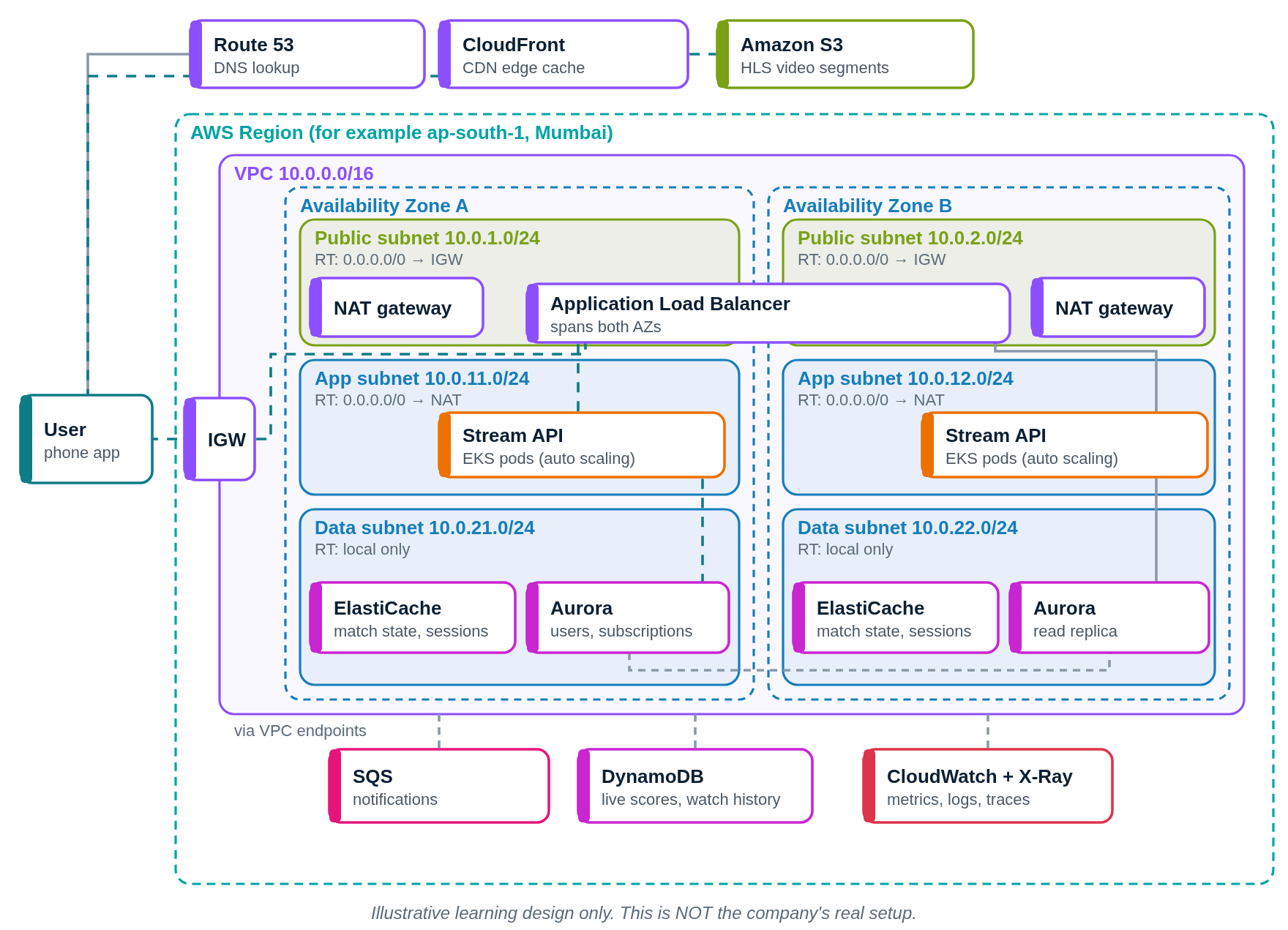
1. Network: VPC, subnets, route tables, gateways
- Create one VPC with CIDR
10.0.0.0/16in the Mumbai region (ap-south-1). - Use two Availability Zones (A and B), so one AZ failing does not stop the app.
- In each AZ make three subnets: public (load balancer, NAT gateway), private app (your code) and private data (databases, cache).
- Attach one internet gateway (IGW) to the VPC. Public route table:
0.0.0.0/0 → IGW. This route is what makes a subnet public. - Private app route table:
0.0.0.0/0 → NAT gateway, so servers can download updates but nobody can connect in from the internet. - Private data route table: only the local VPC route. Use VPC endpoints to reach S3, DynamoDB and SQS without going over the internet.
2. Compute: where the code runs
- ALB in public subnets.
- Services on EKS; pre-scale before big matches.
- Live video through MediaLive + MediaPackage.
3. Storage and databases
- S3 for recordings; CloudFront for live and on-demand segments.
- Aurora for subscriptions.
- DynamoDB for scores; ElastiCache for match state.
4. Monitoring
- CloudWatch dashboards for concurrency and errors.
- Synthetic checks on stream URLs.
Request flow diagram
Press Play. The numbered list below the diagram lights up with each step.
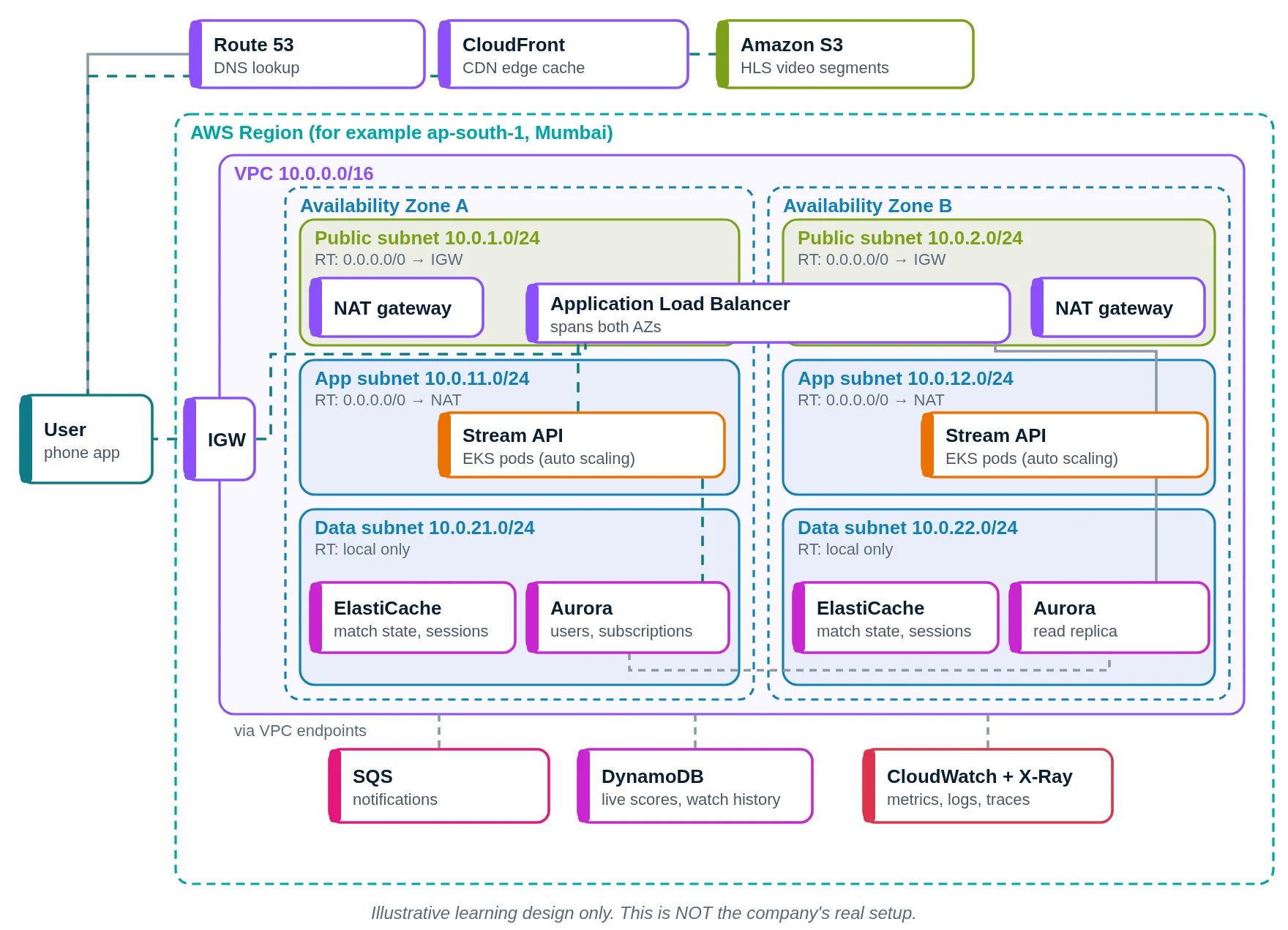
- You open GullyLive. Route 53 answers.
- Video segments via CloudFront.
- Recordings from S3.
- API calls through the internet gateway.
- The ALB forwards to a pod.
- The stream API checks your plan.
- Match state from ElastiCache.
- Plans in Aurora; scores in DynamoDB.
- Wicket alerts go to SQS.
- CloudWatch watches.
- You watch the match.
JioHotstar versus our AWS design
| Part | JioHotstar (public info) | Our AWS design |
|---|---|---|
| Cloud | AWS | AWS |
| Containers | Several EKS clusters as one DC | One EKS cluster |
| Gateway | Envoy internal gateway | ALB |
| Video delivery | Multiple CDNs with QoS routing | CloudFront |
| Monitoring | QoS metrics, watchdog | CloudWatch |
Quick quiz: check what you learned
Which Kubernetes service does JioHotstar use?
- Amazon EKS
- Google GKE
- Azure AKS
- None
Show answer
A. Since 2025 it runs several EKS clusters.
What replaced 200+ load balancers at Hotstar?
- A CDN
- An Envoy-based API gateway
- A database
- A mobile app
Show answer
B. One fleet of Envoy gateways replaced them.
What does the QoS Routing Manager choose?
- Which ad to show
- The match score
- The best CDN per user cohort
- Video codec
Show answer
C. It maps each cohort to the best CDN.
About how much bandwidth does a big live event need?
- 1 Gbps
- 100 Mbps
- 10 Gbps
- 60 to 80 Tbps
Show answer
D. Big events need 60 to 80 Tbps.
Learn it properly
Build the AWS parts yourself with these free guides and lessons:
- How to create a custom VPC with subnets, internet gateway and route tables
- Public vs private subnet in AWS · 3-tier architecture project on AWS
- How to launch an EC2 instance · Install the CloudWatch agent on EC2
- AWS course: What is a VPC? Default VPC vs custom VPC
- Related architectures: Zomato Architecture Explained: AWS, Microservices, DynamoDB, Kafka · Swiggy Architecture Explained: AWS, Kafka, DynamoDB and CloudFront · Zerodha Architecture Explained: Self-Hosted Go, PostgreSQL, AWS · Uber Architecture Explained: 4,000 Services, Kubernetes, Docstore
- All famous app architectures explained