Instagram Architecture Explained: How Instagram Works Behind the Scenes
Short answer: Instagram is a large Python Django application running in Meta's own data centres. Its main databases are PostgreSQL (users, media information, friendships) and Cassandra (feeds and activity), with Memcache in front for speed and an async queue for slow jobs. Instagram started on AWS (EC2, S3, CloudFront) and moved to Facebook's data centres in 2013–2014. Below you will see the real public picture, then a clearly labelled design for building something similar on AWS.
What does Instagram's architecture look like today (2023 to 2026)?
Today Instagram shares much of Meta's common infrastructure:
- Threads (2023) was built on the Instagram stack and Meta's shared systems, such as the ZippyDB key-value store and the Async serverless job platform. That is how it launched in about five months.
- Shared video backend (2023): video uploads, processing and delivery run on horizontal backend layers shared by Meta's apps (Video @Scale 2023).
- Python performance: Instagram's Django server runs on Meta's Cinder/CinderX runtime, and in 2023 Meta upstreamed Immortal Objects to Python to save memory in its pre-forked web servers.
- Recommendations: Explore and Reels use large machine learning systems; in 2025 Instagram scaled to about 1,000 recommendation models.
- Live video (October 2026): Instagram Live ingest now uses Media over QUIC at Meta scale.
The core idea from the early days still holds: a big Python Django web tier, caches, and replicated databases across Meta data centres. Those older details are in the "How it started" part below.
Suppose you open Instagram and tap a reel
Let us start with something you do every day. You open Instagram on your phone in Pune and tap a reel. In less than a second, the video starts, and you see the likes, comments and the creator's name. What happened behind the screen?
- Your phone sends a request to Instagram's servers over the internet.
- The request reaches the nearest entry point of Meta's network and a load balancer.
- The load balancer sends it to one of thousands of web servers running Instagram's Python code.
- The web server first checks a fast in-memory cache (Memcache) for data like the like count.
- If the data is not in cache, it asks the databases: PostgreSQL for the post and user details, Cassandra for feed and activity data.
- The video file itself comes from Meta's storage and delivery network, close to you.
- Small "later" jobs, like telling the creator you liked the reel, go into a queue and run in the background.
Keep this example in mind. Every part of this article is one of these seven steps.
What architecture style does Instagram use?
Instagram is famous for running one of the biggest Django deployments in the world. In 2019 the server was a Python/Django monolith with several million lines of code and thousands of endpoints, deployed continuously about every 7 minutes, around 100 times a day. Django is a Python web framework. Instead of splitting everything into hundreds of tiny services from day one, Instagram kept a large Python application at the centre and added separate systems around it when needed.
In simple words, the style is:
- Stateless web tier: any web server can handle any request, because no user data is kept on the server itself. This makes it easy to add more servers.
- Cache in front of databases: Memcache answers the most common reads so the databases are not overloaded.
- Two kinds of databases: a relational database (PostgreSQL) for data that needs strong structure, and a wide-column NoSQL database (Cassandra) for huge, fast-growing data like feeds.
- Async (background) processing: the web server puts slow jobs on a queue, and separate "async workers" pick them up.
- Multiple data centres: In 2015 Instagram grew from one to three data centres so that a single failure does not take the app down.
Instagram's engineers have also worked on Python performance. Meta open-sourced Cinder, the performance-focused version of CPython that Instagram uses in production.
How it started: Instagram on AWS (2010 to 2014)
Yes. This is the most interesting part for AWS learners. In 2011, with only a few engineers and 14 million users, the whole app ran on Amazon EC2:
- Ubuntu Linux servers on EC2.
- Route 53 for DNS, and an Elastic Load Balancer (with SSL ended at the ELB) in front of three Nginx servers.
- Django on Gunicorn as the app server.
- PostgreSQL, split into thousands of logical shards placed on a few physical servers, with replicas in a different Availability Zone and EBS snapshots for backups. Each photo got a 64-bit, time-sortable ID generated inside PostgreSQL ("Sharding & IDs at Instagram", 2012).
- Redis for the main feed, activity feed and sessions; Memcached for caching.
- Photos stored in Amazon S3 and delivered by Amazon CloudFront.
- Gearman as the task queue for jobs like sharing to Twitter and notifications.
- Monitoring with Munin (graphs and alerts), Pingdom (external checks), PagerDuty (incidents) and Sentry (Python errors).
After Facebook bought Instagram in 2012, the team moved everything to Facebook's data centres. In 2014 they used a clever trick: Facebook's private IP addresses clashed with EC2-Classic, so they first moved thousands of instances into an Amazon VPC (in under three weeks), and then connected that VPC to Facebook using AWS Direct Connect. They built a tool called Neti (Python + ZooKeeper, managing iptables rules) to make EC2 and VPC instances behave like one network.
Lesson for AWS learners
Plan your VPC CIDR so it never clashes with your office or partner networks. Instagram had to do a whole extra migration because of an IP clash.
Instagram architecture diagram (public parts)
This diagram shows only what Instagram has shared publicly. Press Play to follow a request step by step.
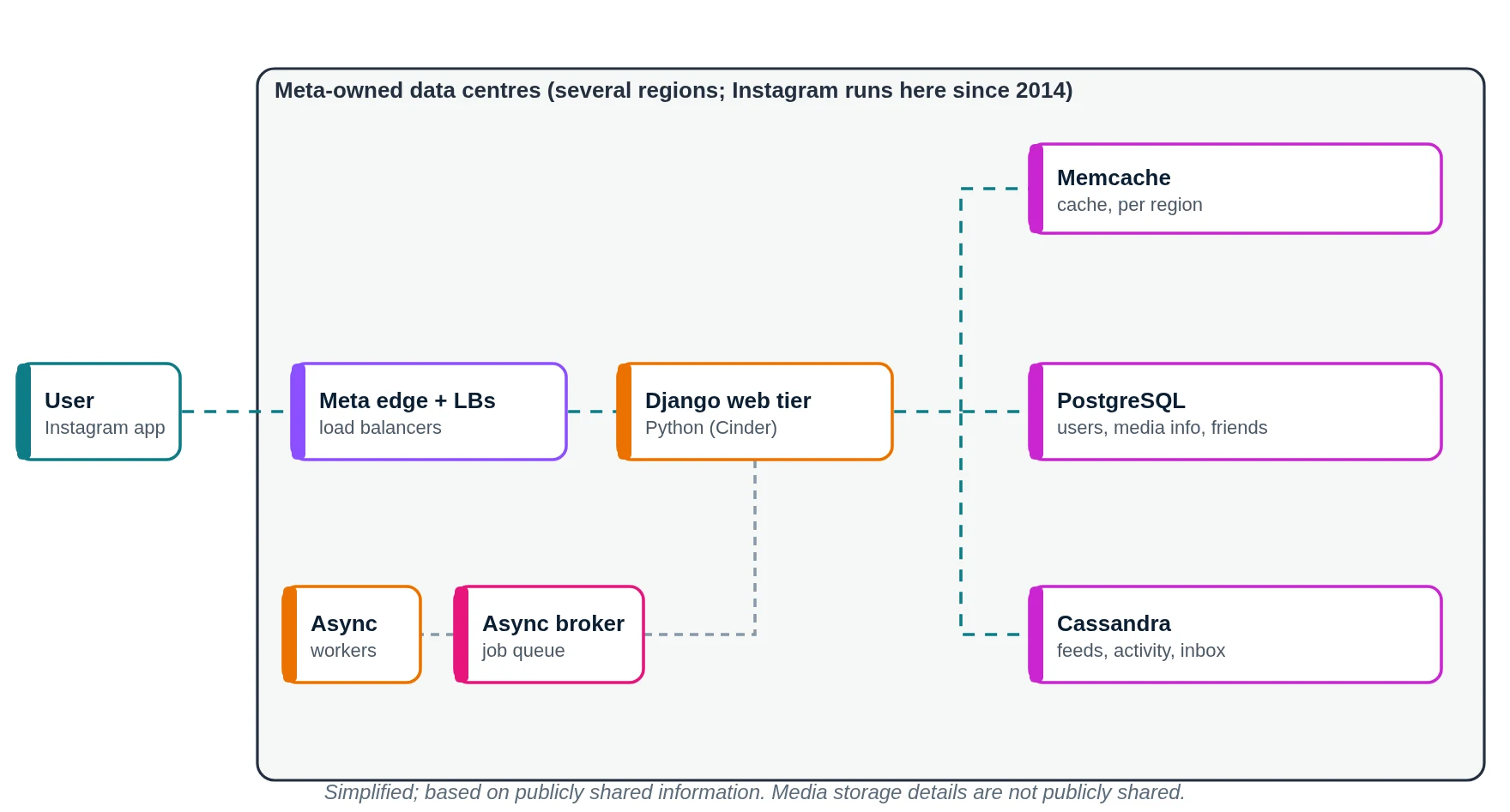
- You tap a reel. The app sends a request to Meta's edge network.
- Load balancers pick a healthy Django web server in a nearby data centre.
- The Django (Python) web server builds the response.
- It reads hot data from Memcache first, because cache is fastest.
- On a cache miss it reads PostgreSQL (users, media info, friendships).
- Feed and activity data comes from Cassandra.
- Slow work (notifications, fan-out) is put on the async queue for workers.
- The answer goes back to your phone and the reel starts playing.
What does Instagram use? Main technologies
| Layer | What Instagram uses (public) | What it does in simple words |
|---|---|---|
| Language and framework | Python, Django (Cinder runtime) | Writes the main app logic |
| Main relational database | PostgreSQL | Users, media information, friendships |
| NoSQL database | Apache Cassandra | Feeds, activity, inbox-style data |
| Cache | Memcache | Keeps hot data in memory |
| Background jobs | Async message broker + workers | Notifications, fan-out, slow tasks |
| Search | Meta's Unicorn (since 2015) | Finds users, hashtags, places |
| Hosting | Meta-owned data centres | Servers, network and storage |
About Cassandra: Instagram started using Cassandra in 2012, replacing Redis, for fraud detection, Feed and the Direct inbox. Later Instagram built Rocksandra, which uses RocksDB as Cassandra's storage engine, and open-sourced it in 2018. It gave a big drop in tail latency (slowest responses).
Which cloud provider does Instagram use?
Today Instagram does not use a public cloud like AWS, Google Cloud or Azure for its main app. It runs on Meta's own data centres, using Meta's internal tools for deployment, networking and storage. That is the honest answer.
- 2010–2013: AWS (EC2, ELB, S3, CloudFront, EBS).
- 2013–2014: moved to an AWS VPC, then to Facebook data centres via Direct Connect.
- 2015 onwards: spread across several Meta data centres in different regions.
How does Instagram store photos and videos?
In 2011, photos went straight to Amazon S3 and were served through CloudFront. Today the media lives in Meta's storage systems and is delivered through Meta's own edge network. Instagram has not publicly shared a detailed design of its current media storage, so we will not guess.
What is known about the 2015 multi data centre setup:
- PostgreSQL and Cassandra data is global: it is copied (replicated) to every data centre.
- Each region has read replicas, so reads stay local and fast.
- Writes to PostgreSQL still go to the primary database, even if it is in another region.
- Memcache is local to each region. To stop old data being shown, a database change triggers a cache invalidation message in other regions.
How does Instagram monitor its systems?
In the AWS days the team used Munin, Pingdom, PagerDuty and Sentry, as listed above. Today Instagram uses Meta's internal monitoring and alerting tools. The details of the current internal setup are not publicly shared, so this article does not name them.
If we built an app like Instagram on AWS (illustrative)
Please read this first
This section is a learning design by Ravindra Bagale. It is not Instagram's real setup. Instagram runs in Meta's own data centres. We use AWS here because it is what you learn in the AWS course.
Suppose you want to build "PuneGram", a small Instagram-like app for your college. Here is how you could lay it out on AWS.
1. Network: VPC, subnets, route tables, gateways
- Create one VPC with CIDR
10.0.0.0/16in the Mumbai region. - Use two Availability Zones (A and B), so one AZ failing does not stop the app.
- In each AZ make three subnets: public (load balancer, NAT), private app (your code), private data (databases, cache).
- Attach one internet gateway (IGW) to the VPC.
- Public route table:
0.0.0.0/0 → IGW. This is what makes a subnet public. - Private app route table:
0.0.0.0/0 → NAT gateway, so servers can download updates but nobody can connect in. - Private data route table: only the local VPC route. Databases never talk to the internet.
2. Compute: where the code runs
- Put an Application Load Balancer (ALB) in both public subnets.
- Run the API (Django like Instagram, or any language) on Amazon EKS or on EC2 with an Auto Scaling group in the private app subnets.
- Scale out when CPU or request count goes up, scale in at night.
- Run background workers (resize images, send notifications) as a separate deployment that reads from SQS.
3. Storage and databases
- S3 stores the original photos and reels. Users upload directly using pre-signed URLs.
- CloudFront caches photos and videos at edge locations close to users.
- Aurora PostgreSQL stores users, posts and follows (writer in AZ A, reader in AZ B).
- DynamoDB stores very high-traffic data like like-counts and activity items.
- ElastiCache (Redis) keeps feeds and sessions in memory.
4. Monitoring
- CloudWatch metrics and alarms: ALB 5xx errors, latency, CPU, database connections.
- CloudWatch Logs for app logs; X-Ray traces to see which step is slow.
- An alarm on the SQS queue age, so you know when workers fall behind.
Request flow diagram
Press Play. The numbered list below the diagram lights up with each step.
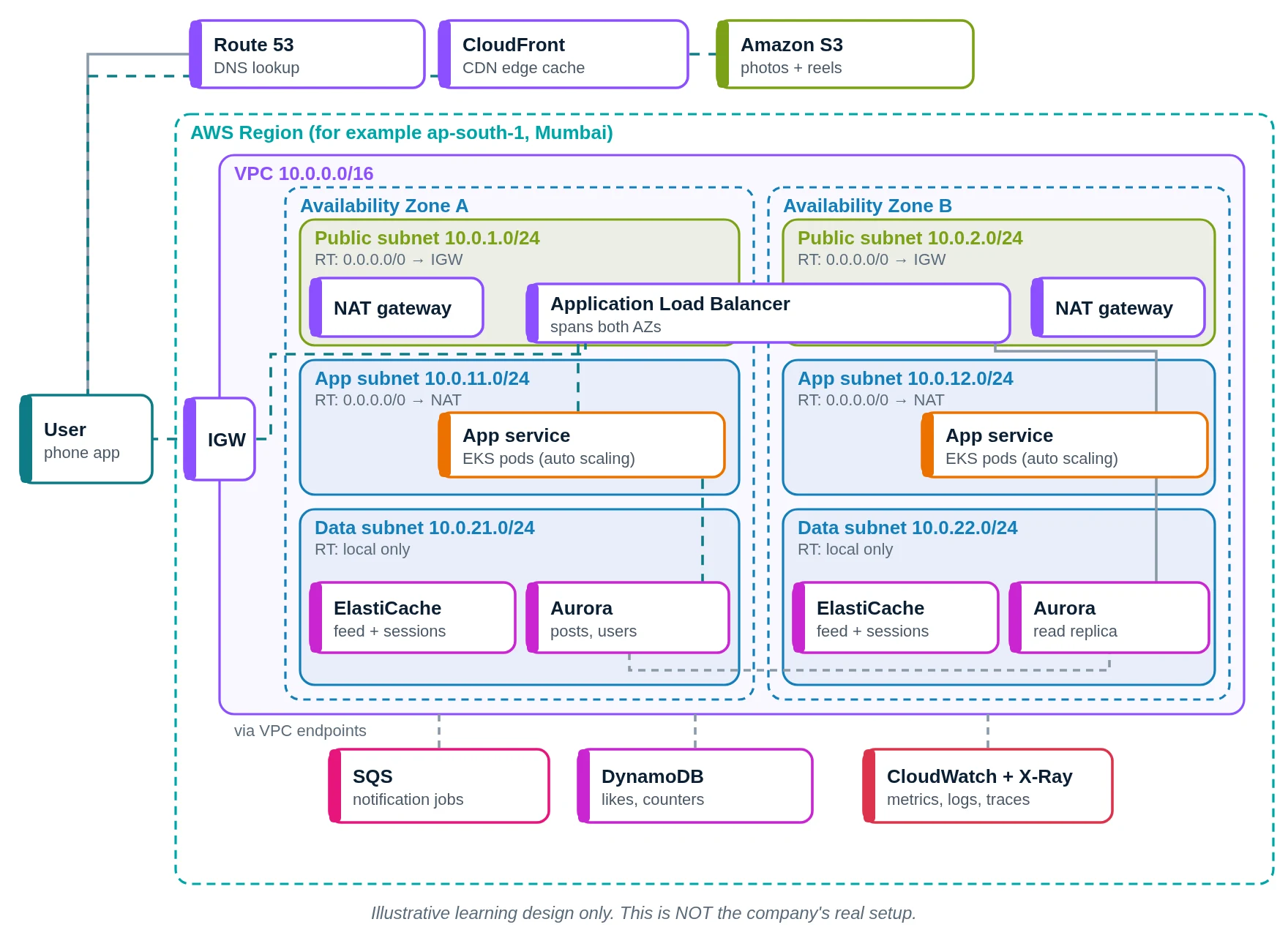
- You open the app. Route 53 turns the app's domain name into an address.
- Photos and reels load from CloudFront, the CDN edge nearest to you (for example Mumbai).
- If CloudFront does not have the file yet, it fetches it once from S3 and keeps a copy.
- API calls (feed, likes, comments) enter the VPC through the internet gateway.
- The Application Load Balancer in the public subnets sends the call to a healthy app pod.
- The app service on EKS runs in a private subnet. Nobody on the internet can reach it directly.
- It checks ElastiCache (Redis) first for your feed and session.
- On a miss it reads Aurora (posts, users). Likes and counters go to DynamoDB.
- Slow work like "send a notification to 500 followers" goes to SQS for background workers.
- Every step sends metrics, logs and traces to CloudWatch and X-Ray.
- The response travels back through the ALB and internet gateway to your phone.
Instagram then, now, and our AWS design
| Part | Instagram 2011 (AWS) | Instagram today | Our AWS design |
|---|---|---|---|
| Hosting | EC2 | Meta data centres | EKS or EC2 Auto Scaling |
| Load balancing | ELB + Nginx | Meta edge + load balancers | ALB |
| Main database | PostgreSQL on EC2 | PostgreSQL | Aurora PostgreSQL |
| Feeds | Redis (Cassandra from 2012) | Cassandra | DynamoDB + ElastiCache |
| Cache | Memcached | Memcache | ElastiCache |
| Media | S3 + CloudFront | Meta storage (not publicly detailed) | S3 + CloudFront |
| Background jobs | Gearman | Async broker + workers | SQS + workers |
| Monitoring | Munin, Pingdom, Sentry | Meta internal (not publicly detailed) | CloudWatch + X-Ray |
Quick quiz: check what you learned
Where does Instagram run its main app today?
- Meta-owned data centres
- Google Cloud regions only
- Microsoft Azure regions
- Small rented office servers
Show answer
A. Instagram moved from AWS to Facebook (Meta) data centres in 2013–2014.
Which framework is at the centre of Instagram?
- Ruby on Rails framework
- Spring Boot in Java
- Python Django framework
- Laravel in PHP code
Show answer
C. Instagram runs one of the largest Django deployments.
Why did Instagram first move into an Amazon VPC?
- To get cheaper S3 storage
- To avoid an IP address clash
- To use a new database
- To speed up the app UI
Show answer
B. Facebook's private IP space clashed with EC2, so a VPC came first.
In our AWS design, what makes a subnet public?
- A security group with port 22
- An EC2 instance with a key
- A NAT gateway in the subnet
- A route 0.0.0.0/0 to the IGW
Show answer
D. Only the route to the internet gateway makes a subnet public.
Learn it properly
Build the AWS parts yourself with these free guides and lessons:
- How to create a custom VPC with subnets, internet gateway and route tables
- Public vs private subnet in AWS · 3-tier architecture project on AWS
- How to launch an EC2 instance · Install the CloudWatch agent on EC2
- AWS course: What is a VPC? Default VPC vs custom VPC
- Related architectures: Netflix Architecture Explained: AWS, Microservices, Open Connect · Amazon.com Architecture Explained: Services, DynamoDB and AWS · Prime Video Architecture Explained: AWS Elemental, ECS and Live Sport · Airbnb Architecture Explained: AWS, Rails to Services, Kubernetes
- All famous app architectures explained