Chapter 93: AWS Lambda and Serverless for DevOps
93.15 Interview questions, revision and chapter quiz
Why
Explain a safe complete flow, not just a service name.
What
These standalone cards recap the terms and trade-offs.
How
- Read the question aloud.
- Give a short answer and an example.
- Open the quiz answers only after you try.
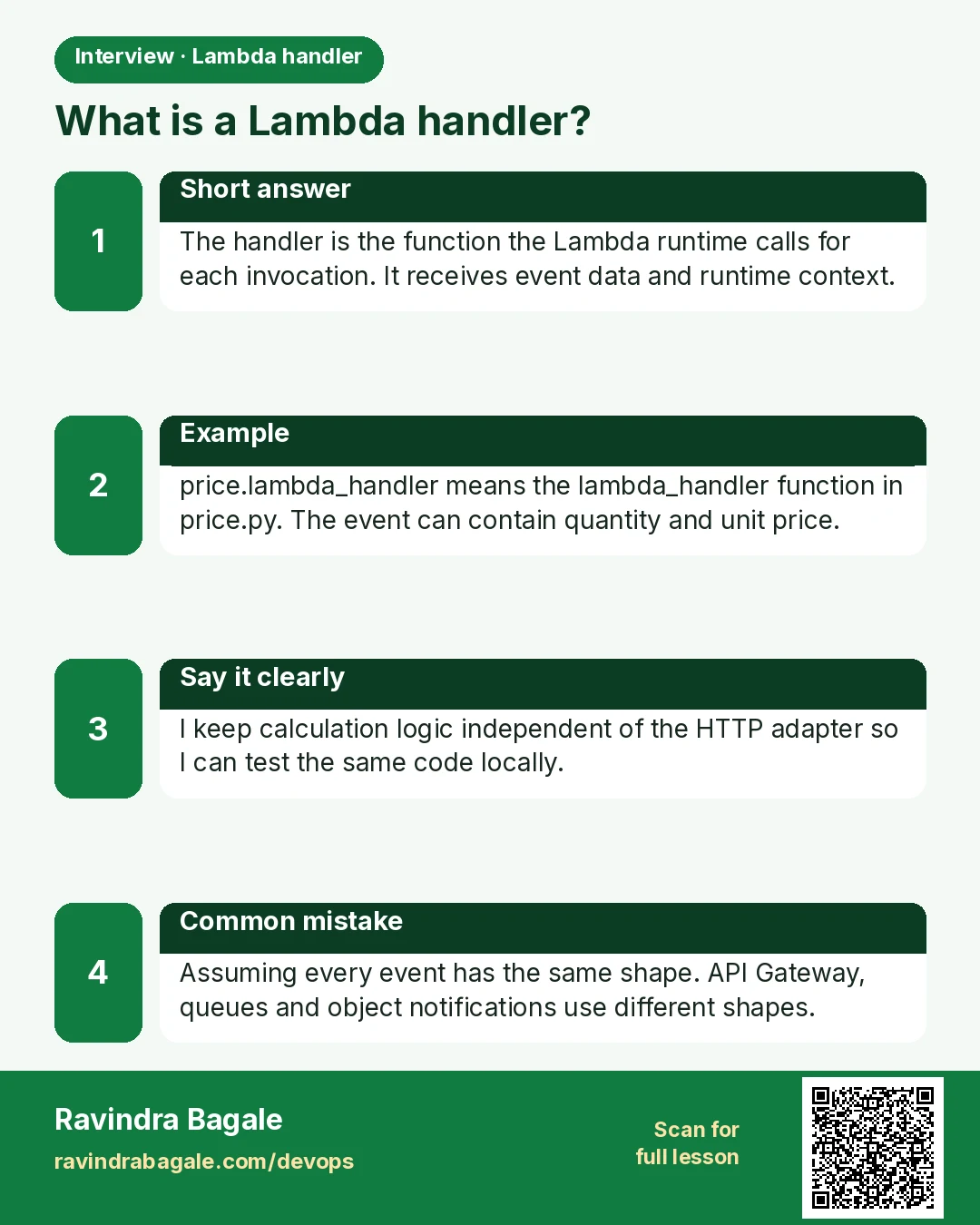
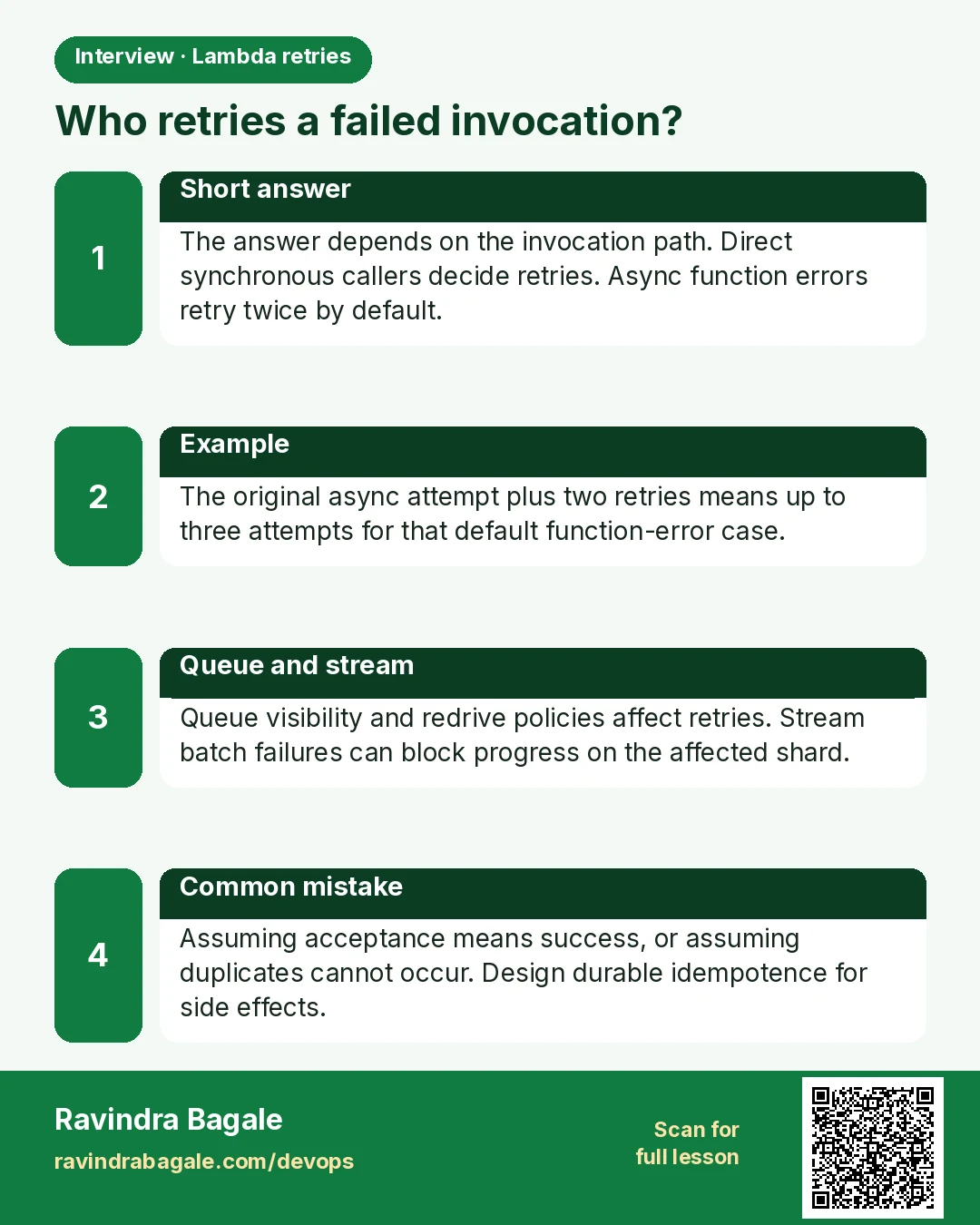
Revision checklist
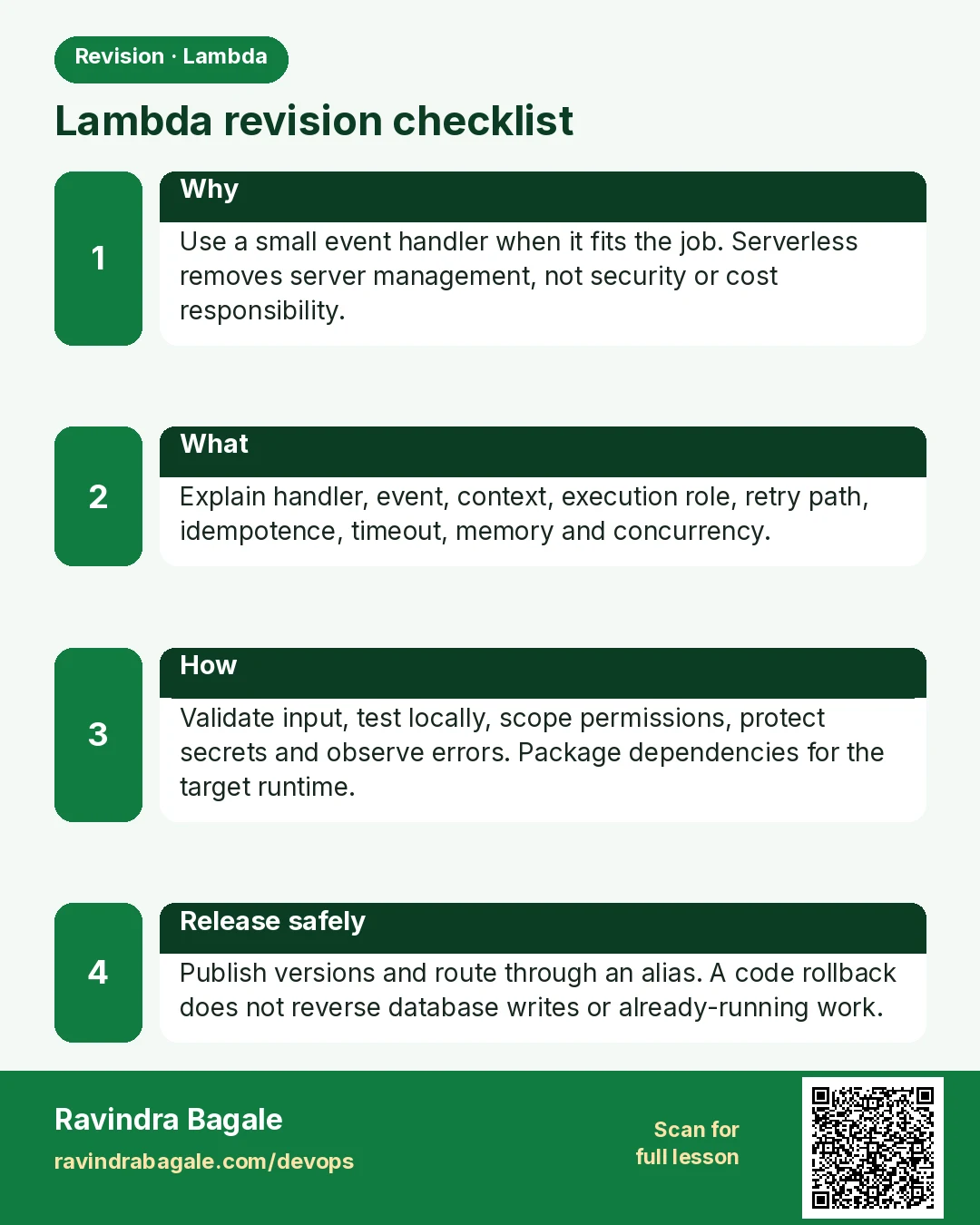
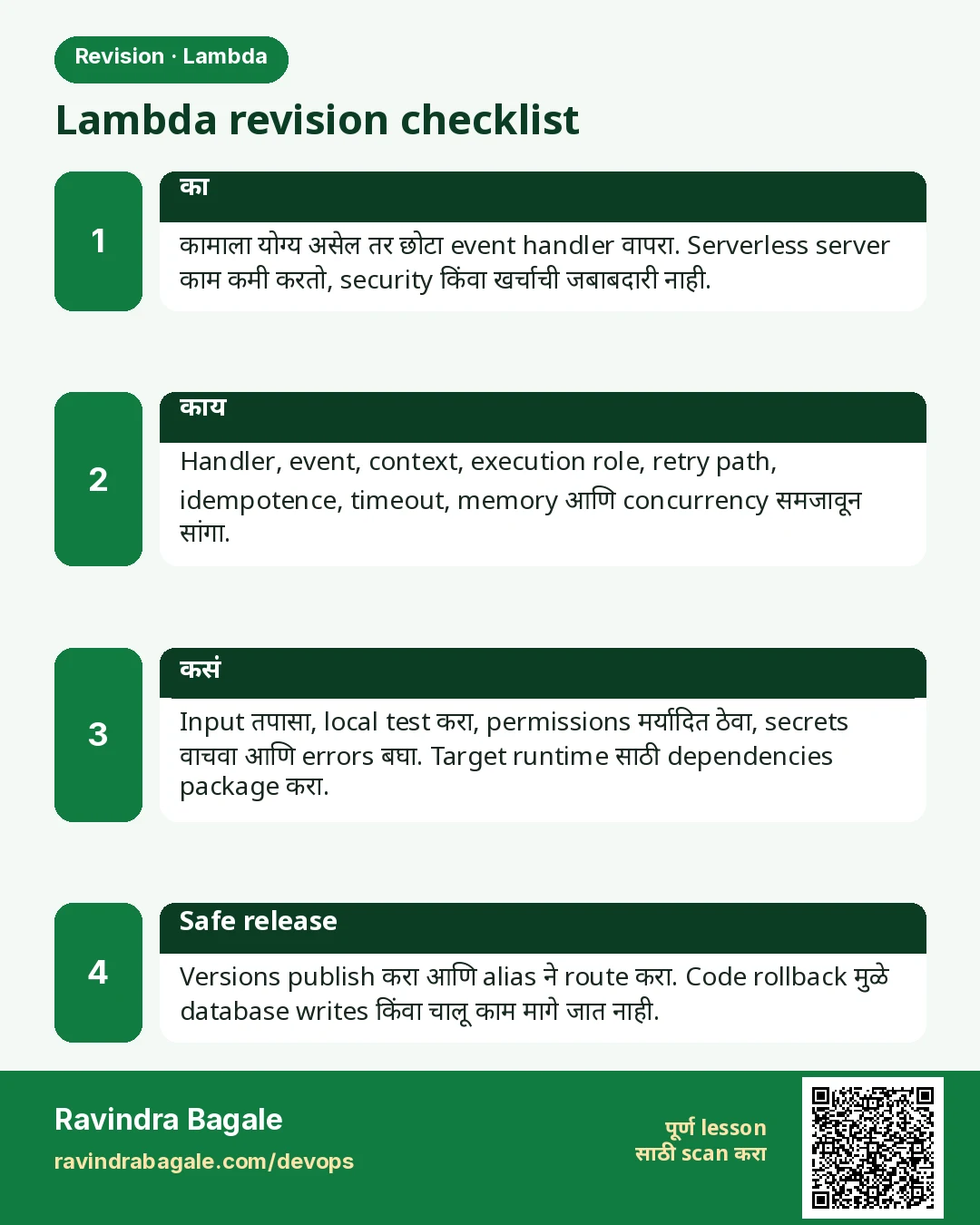
- I can identify the event, handler and context.
- I can explain role permissions and separate invocation permission.
- I know retry behaviour depends on the invocation path.
- I can distinguish a pure repeatable result from durable idempotency.
- I can explain timeout, memory and both concurrency settings.
- I never put secrets in code, events or logs.
- I can separate an adapter from core logic.
- I can describe versions, alias routing and rollback limits.
- I can compare Lambda, ECS and EC2 honestly.
- I can run the local tests without AWS.
Ravindra Bagale's Tip
Explain the retry path before claiming a function is safe.
Function safe आहे म्हणण्याआधी retry path समजावून सांगा.
Function safe कहने से पहले retry path समझाओ.
Did you understand? Let us try it once more.
Quick quiz
Q1. What does serverless remove?
Managing the underlying servers; not code, security, data or cost responsibility.
Q2. What does price.lambda_handler name?
The function lambda_handler inside the file price.py.
Q3. Does a direct synchronous function error automatically retry twice?
No. The caller decides retries; the async function-error default is two retries.
Q4. Is a Python set enough for production duplicate protection?
No. It is local to an environment and not durable or shared. Use a properly designed atomic durable claim and recovery.
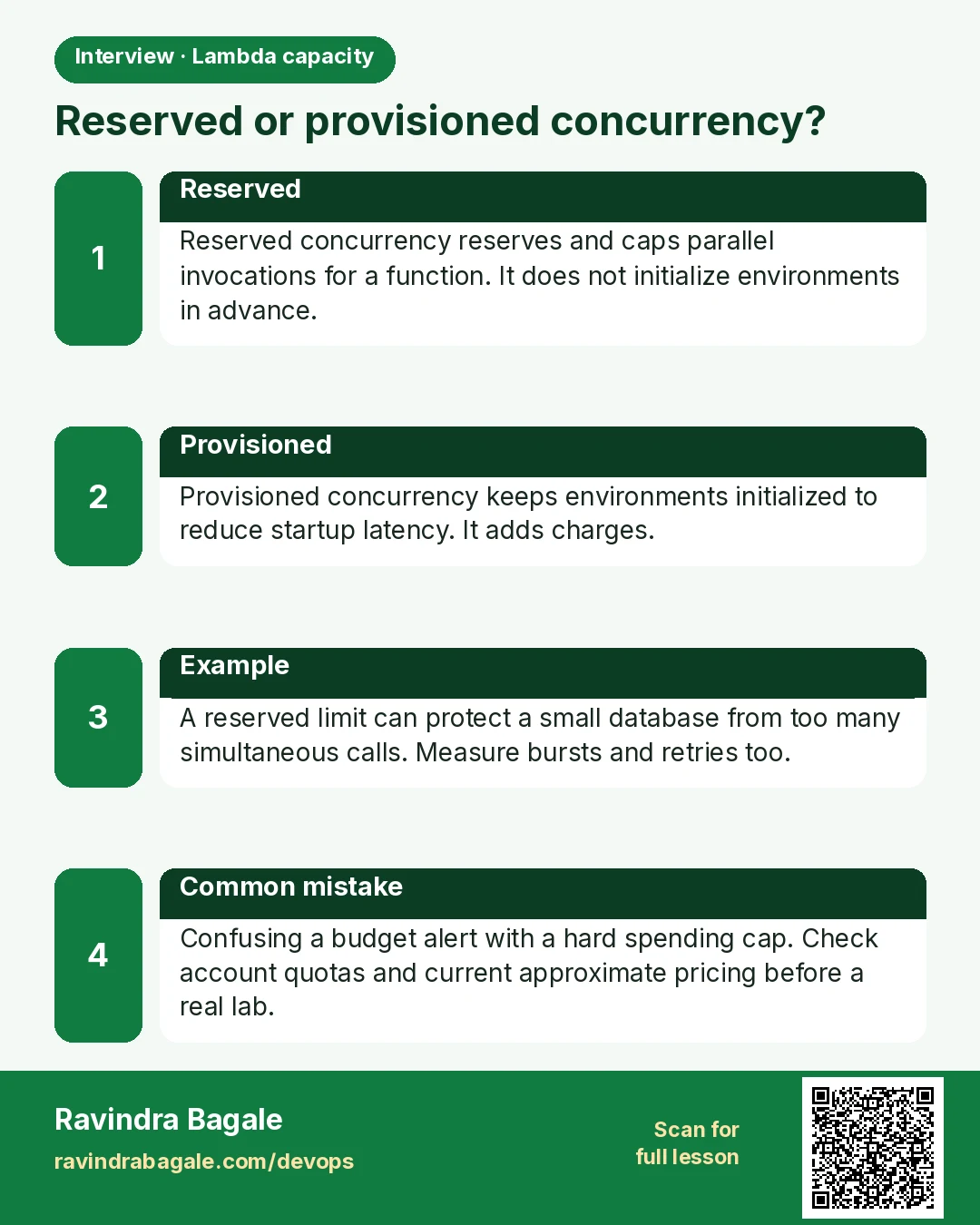
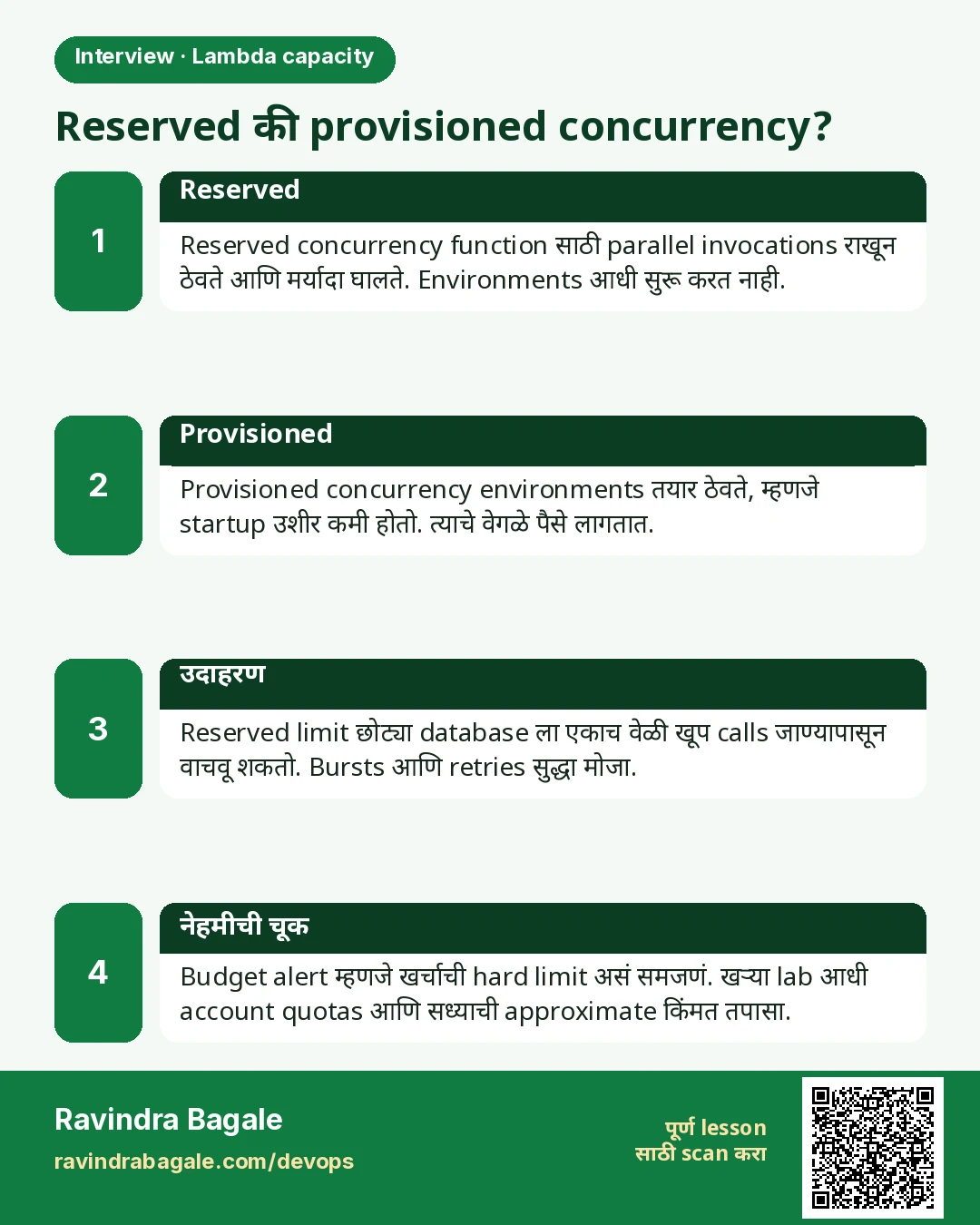
Q5. What does reserved concurrency do?
It reserves and caps concurrency for a function; it does not pre-initialize environments.
Q6. What is provisioned concurrency for?
Keeping environments initialized to reduce startup latency, with additional charges.
Q7. Should a function contain long-lived AWS keys?
No. Use a least-privilege execution role for AWS access.
Q8. Does an S3 notification contain the complete object body?
No. It describes the object event; authorized code retrieves the object if needed.
Q9. Does an alias rollback undo database writes?
No. It redirects later alias-routed invocations; data recovery is separate.
Q10. What do the eight local tests prove?
The tested Python behaviours, not real AWS integration, limits, billing or runtime execution.
Did you understand? Let us try it once more.
In short
- A small event starts a handler in a managed runtime.
- Use scoped identity, retry-aware logic and safe limits.
- Package and observe deliberately; release immutable versions through aliases.
- Test locally first; validate cloud wiring only in a separately approved funded environment.
Official references opened for this draft
These references were read on 6 November 2026. This chapter's numeric limits apply to ordinary Lambda event functions; the official pages also describe other modes with different limits.