Ravi Sir's Cyber Security Cards › Revision Cards
Symmetric Encryption
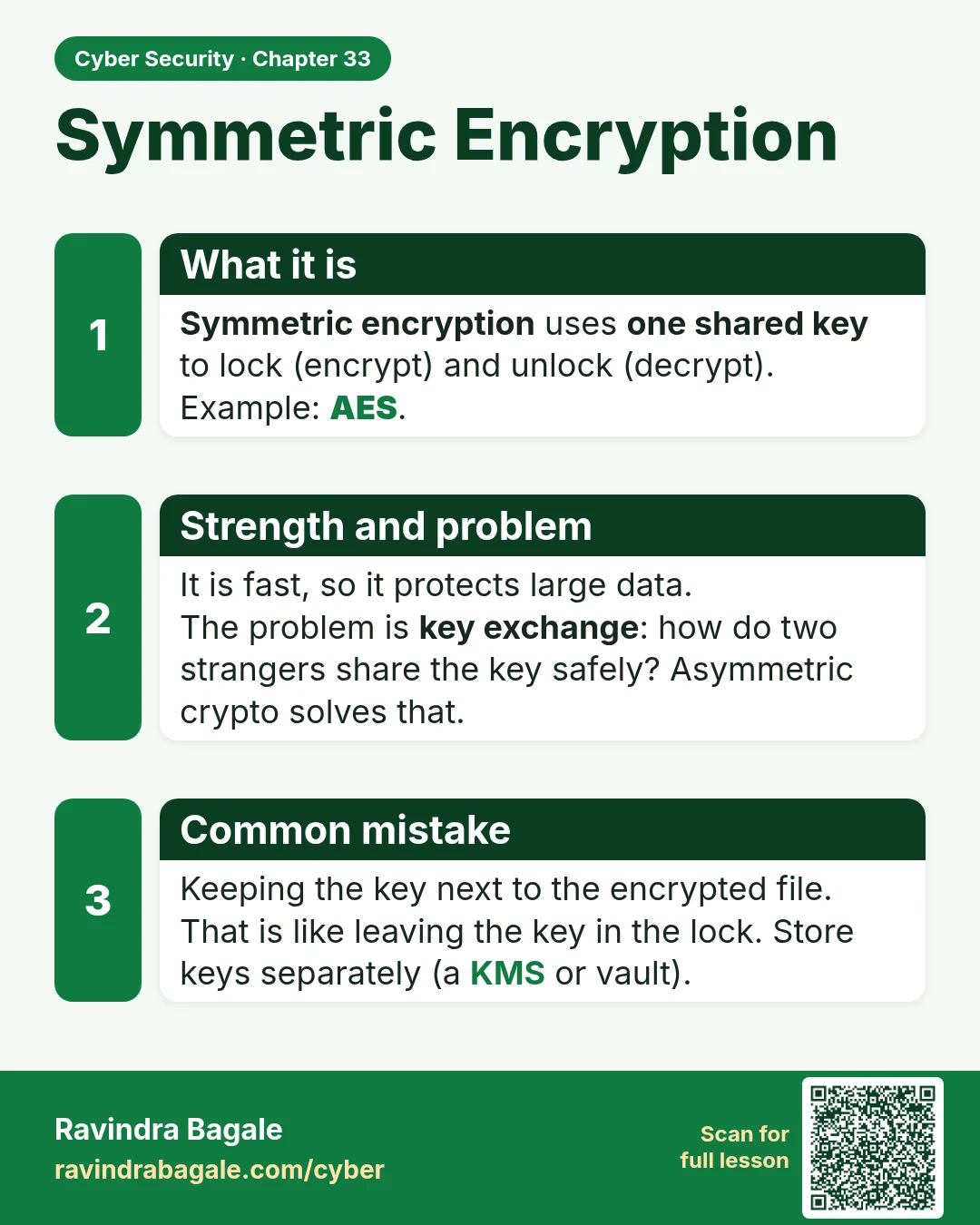
Symmetric Encryption Symmetric encryption uses one shared key to lock (encrypt) and unlock (decrypt). Example: AES . It is fast, so it protects large data. The problem is key exchange : how do two strangers share the key safely? Asymmetric crypto solves that. Keeping the key next to the encrypted fi
Read card text
What this card says
What it is
Symmetric encryption uses one shared key to lock (encrypt) and unlock (decrypt).
Example: AES.
Strength and problem
It is fast, so it protects large data.
The problem is key exchange: how do two strangers share the key safely? Asymmetric crypto solves that.
Common mistake
Keeping the key next to the encrypted file. That is like leaving the key in the lock. Store keys separately (a KMS or vault).
Learn more in the lesson: 33.3 Symmetric Encryption