Ravi Sir's Cyber Security Cards › Revision Cards
IPv4 Structure: Bits, Octets and the Subnet Mask
IPv4 Structure: Bits, Octets and the Subnet Mask An IPv4 address has 32 bits , written as 4 numbers called octets . Each octet is 8 bits, from 0 to 255 . Example: 192.168.1.10. 32 bits give about 4.3 billion addresses. That is too few today. This is why we use NAT, private IPs and IPv6. A subnet mas
Read card text
What this card says
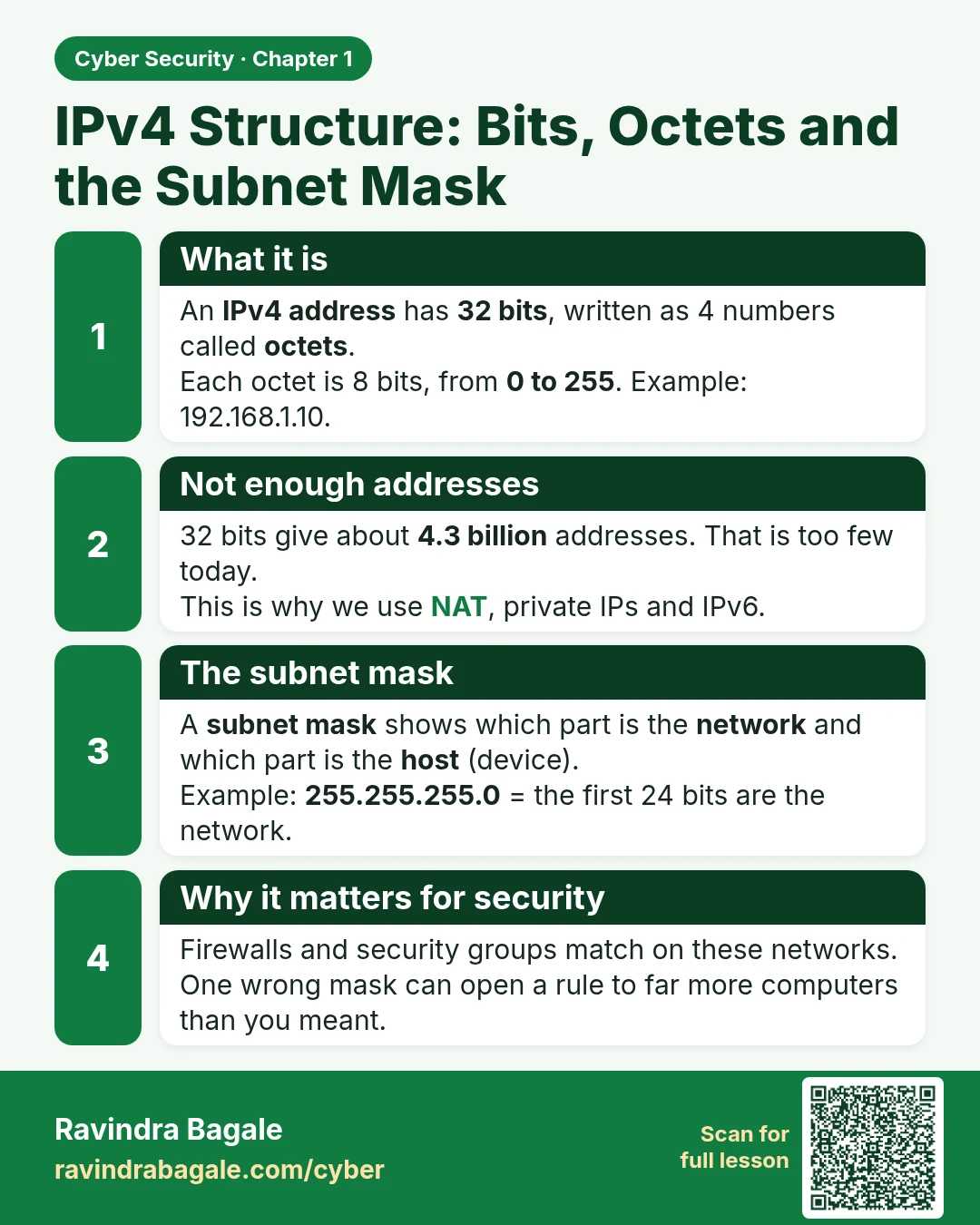
What it is
An IPv4 address has 32 bits, written as 4 numbers called octets.
Each octet is 8 bits, from 0 to 255. Example: 192.168.1.10.
Not enough addresses
32 bits give about 4.3 billion addresses. That is too few today.
This is why we use NAT, private IPs and IPv6.
The subnet mask
A subnet mask shows which part is the network and which part is the host (device).
Example: 255.255.255.0 = the first 24 bits are the network.
Why it matters for security
Firewalls and security groups match on these networks.
One wrong mask can open a rule to far more computers than you meant.
Learn more in the lesson: 1.2 IPv4 Structure: Bits, Octets and the Subnet Mask