Ravi Sir's Cyber Security Cards › Revision Cards
HTTPS and TLS Basics – Port 443
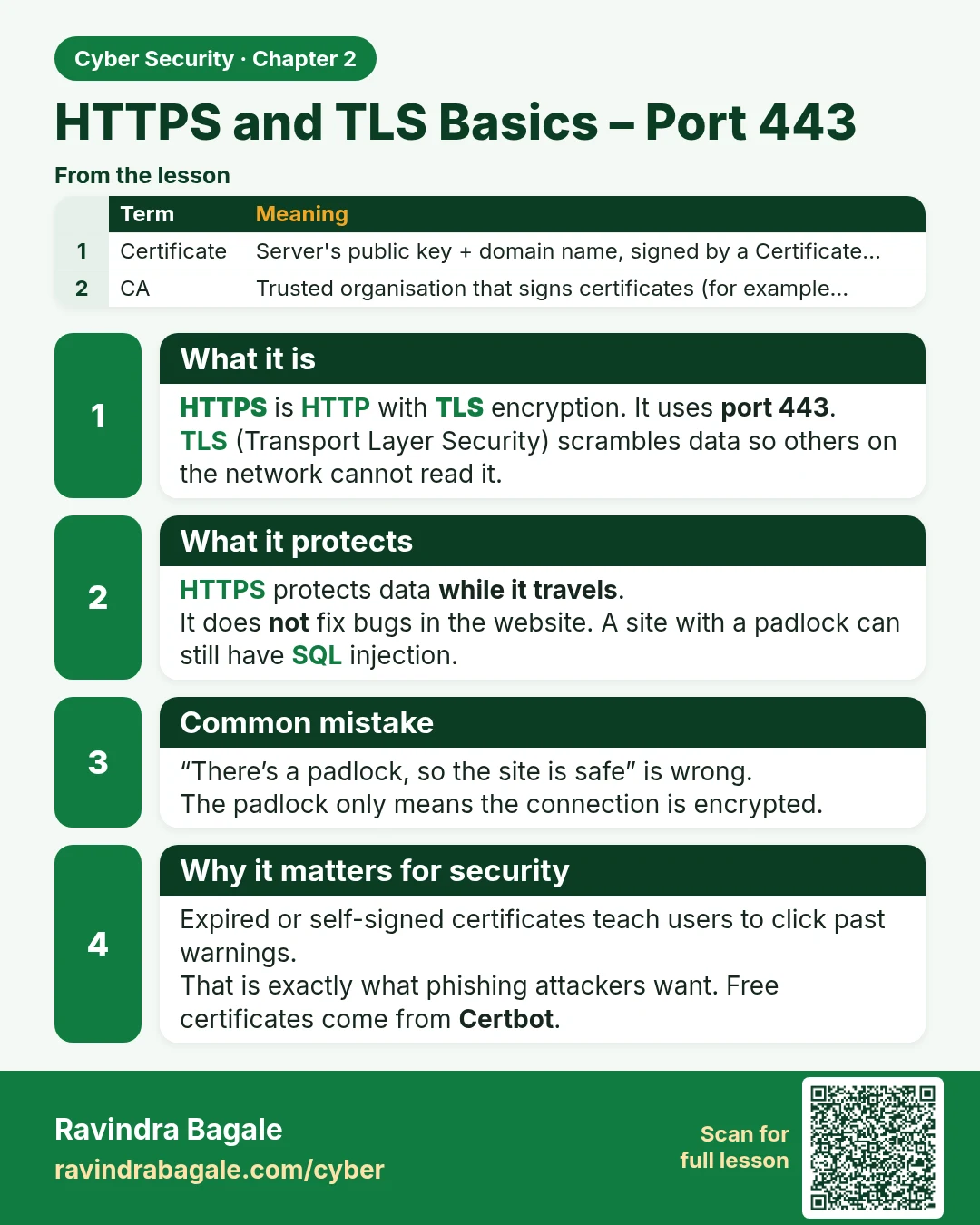
HTTPS and TLS Basics – Port 443 HTTPS is HTTP with TLS encryption. It uses port 443 . TLS (Transport Layer Security) scrambles data so others on the network cannot read it. HTTPS protects data while it travels . It does not fix bugs in the website. A site with a padlock can still have SQL injection.
Read card text
What this card says
What it is
HTTPS is HTTP with TLS encryption. It uses port 443.
TLS (Transport Layer Security) scrambles data so others on the network cannot read it.
What it protects
HTTPS protects data while it travels.
It does not fix bugs in the website. A site with a padlock can still have SQL injection.
Common mistake
“There’s a padlock, so the site is safe” is wrong.
The padlock only means the connection is encrypted.
Why it matters for security
Expired or self-signed certificates teach users to click past warnings.
That is exactly what phishing attackers want. Free certificates come from Certbot.
| Term | Meaning |
|---|---|
| Certificate | Server's public key + domain name, signed by a Certificate… |
| CA | Trusted organisation that signs certificates (for example… |
| Symmetric encryption | Same key encrypts and decrypts – fast, used for the actual… |
| Asymmetric encryption | Public/private key pair – used for identity and key exchange |
| TLS 1.2 / 1.3 | Current secure versions; SSL 2/3 and TLS 1.0/1.1 are… |
Learn more in the lesson: 2.4 HTTPS and TLS Basics – Port 443