Ravi Sir's Cyber Security Cards › Revision Cards
How Passwords Are Stored
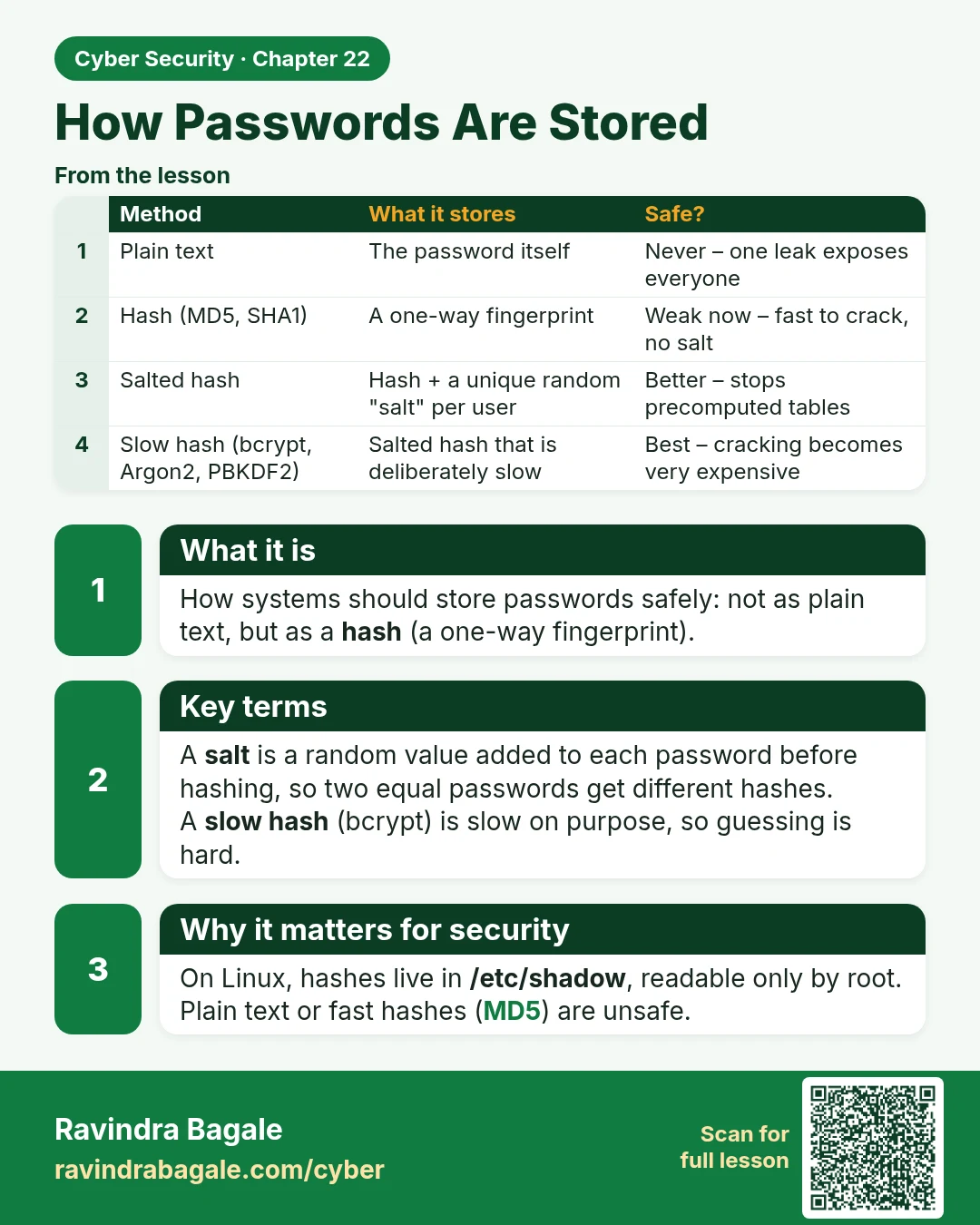
How Passwords Are Stored How systems should store passwords safely: not as plain text, but as a hash (a one-way fingerprint). A salt is a random value added to each password before hashing, so two equal passwords get different hashes. A slow hash (bcrypt) is slow on purpose, so guessing is hard. On
Read card text
What this card says
What it is
How systems should store passwords safely: not as plain text, but as a hash (a one-way fingerprint).
Key terms
A salt is a random value added to each password before hashing, so two equal passwords get different hashes.
A slow hash (bcrypt) is slow on purpose, so guessing is hard.
Why it matters for security
On Linux, hashes live in /etc/shadow, readable only by root.
Plain text or fast hashes (MD5) are unsafe.
| Method | What it stores | Safe? |
|---|---|---|
| Plain text | The password itself | Never – one leak exposes everyone |
| Hash (MD5, SHA1) | A one-way fingerprint | Weak now – fast to crack, no salt |
| Salted hash | Hash + a unique random "salt" per user | Better – stops precomputed tables |
| Slow hash (bcrypt, Argon2, PBKDF2) | Salted hash that is deliberately slow | Best – cracking becomes very expensive |
Learn more in the lesson: 22.1 How Passwords Are Stored