Ravi Sir's Cyber Security Cards › Revision Cards
Asymmetric Encryption
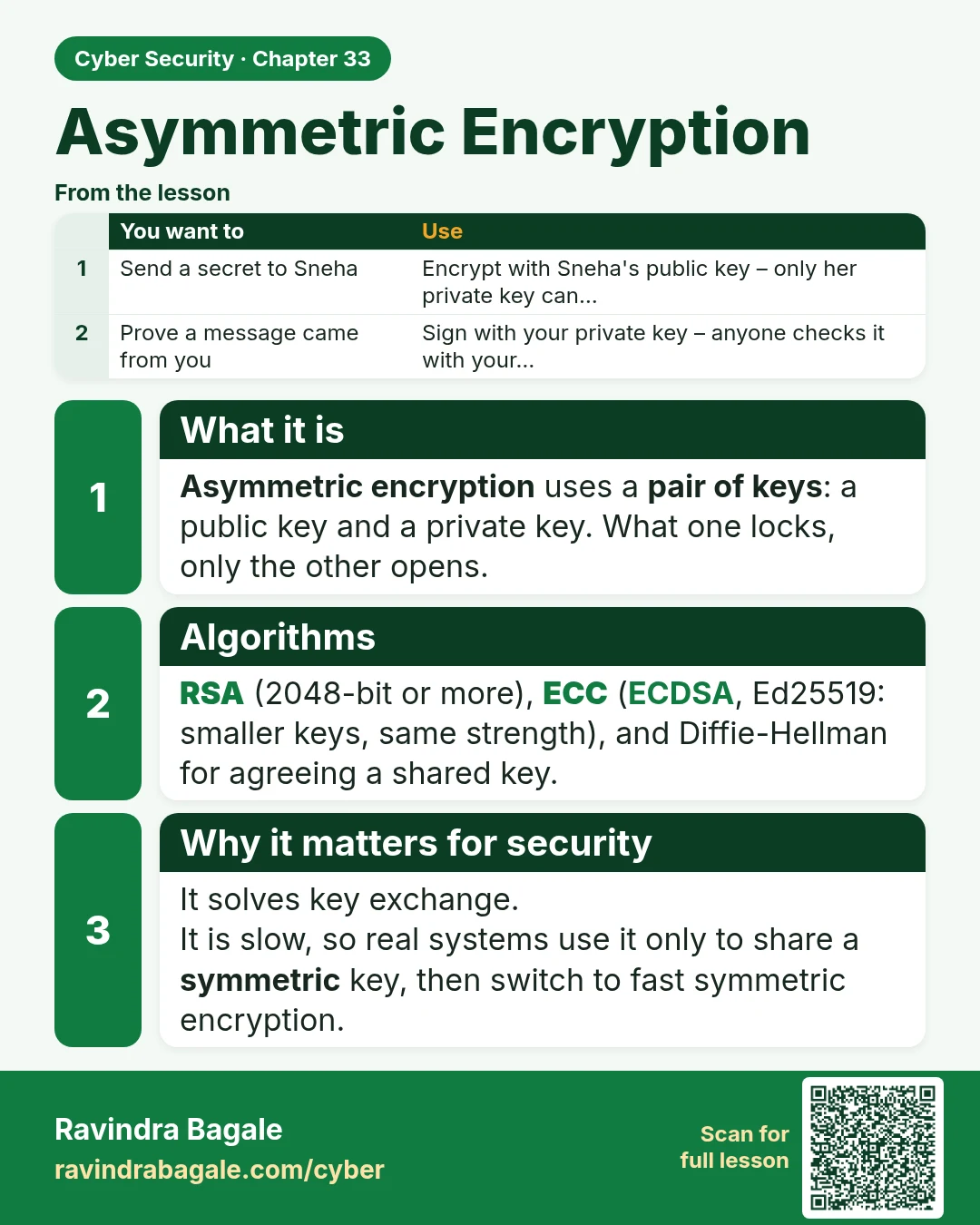
Asymmetric Encryption Asymmetric encryption uses a pair of keys : a public key and a private key. What one locks, only the other opens. RSA (2048-bit or more), ECC (ECDSA, Ed25519: smaller keys, same strength), and Diffie-Hellman for agreeing a shared key. It solves key exchange. It is slow, so real
Read card text
What this card says
What it is
Asymmetric encryption uses a pair of keys: a public key and a private key. What one locks, only the other opens.
Algorithms
RSA (2048-bit or more), ECC (ECDSA, Ed25519: smaller keys, same strength), and Diffie-Hellman for agreeing a shared key.
Why it matters for security
It solves key exchange.
It is slow, so real systems use it only to share a symmetric key, then switch to fast symmetric encryption.
| You want to | Use |
|---|---|
| Send a secret to Sneha | Encrypt with Sneha's public key – only her private key can… |
| Prove a message came from you | Sign with your private key – anyone checks it with your… |
Learn more in the lesson: 33.4 Asymmetric Encryption